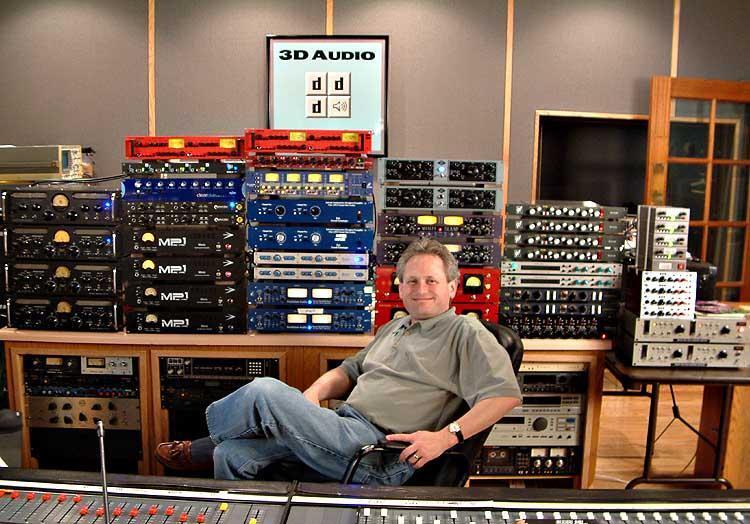
Over the past decade, I’ve recorded dozens of shootouts here at Sweetwater, comparing gear for musicians, artists, and engineers. Here’s why we go to all the trouble to do these shootouts.
Empowerment Through Listening: Instead of just reading opinions, you can listen or download audio files (often 24-bit/96kHz) and listen on your own speakers to decide for yourself.
Unbiased Comparison: By carefully controlling variables like mic placement, room acoustics, and signal levels, we create a level playing field for dozens of different products.
Discover Surprises: Shootouts frequently reveal that inexpensive mics can sound fantastic alongside premium gear, and that gear described as “bright” or “warm” might surprise listeners.
Find “Character”: Beyond technical specs, the goal is to demonstrate the unique “character” or emotional context a microphone brings to a performance, ultimately helping musicians find inspiration.
Comprehensive Auditioning: By testing a vast array of gear, from vocal mics to kick drum mics to guitar cabinet mics, we can save you the time spent acquiring these items and help you find what you like
Click on the topics below, and you’ll find revealing sound samples, fascinating photos, and helpful info in these shootout articles.
- For Engineers
- For Guitar Players
- For Singers and Podcasters
- For Keyboardists
- For Drummers
- For Bass Players
- For Live Sound
Why Do We Compare Gear?
Anyone who strives to make things better or easier is always comparing one tool to another, whether it be a woodworker, a chef, a photographer, or a musician. Why are we always searching for something better? For me, it all comes back to one main reason: curiosity — and the desire to make things better and acquire the tools to achieve great results in the easiest possible way. That’s what drives me. I have an inquisitive mind, and I’m always wondering, “What if I changed this one thing? Or tried a different method? Or used a different tool?” I like to explore using different mics and preamps and guitars and processors to see what I can come up with. I think all musicians, maybe all creatives, do that.
I’m not alone in my pursuit for new sounds using new tools and exploring options. Have you ever been in a room with several guitar players and started a discussion about . . . well, anything related to guitars? If not, then you should try it. Start by asking about pickups. Or strings. Or amps. Or wood. Or pedals. Or bridge pins. Even cables. You’re going to hear some interesting and emphatic opinions any time a group of passionate musicians gets together and talks about gear. That’s a reflection of who we are. These are our tools. They are extensions of ourselves. They allow us to create better sounds and, hopefully, to make the process of creation easier.
Any instrumentalist who has played different instruments or any engineer who has tried out different microphones knows how great it is when you find the “right one.” But, with all the great studio gear that is offered these days (mics, compressors, equalizers, preamps, direct boxes), how can you possibly decide which one you like the best? Sure, you can try one and then try another and then another. That can take weeks or months (or years). For me, trying out one new tool at a time is fun, but it takes a long time if your ultimate goal is to find the best tool by auditioning several (or maybe dozens of) alternatives. What are your options?
What Are Your Options?
Here are some options for narrowing down your gear choices.
- Check out online forums or magazine reviews to see what people are saying.
- Talk to friends who have the gear you’re considering.
- Rent the gear to try it out on your own.
Regarding #1, unless you know the person who’s making the comment about mic X online, either personally or by reputation, you can’t be sure he’s not a dog — or maybe someone with limited experience. I read one mic review online that talked about how superb the mic was, and, at the end of the article, the author revealed that his other mic was an SM57. Really? Yep.
Even if the writer/commenter is a professional, their tastes may be drastically different than yours. What they consider “present” might be your “strident”; their “warm” may be your “muddy.” Can you trust their written interpretation?
For #2, unless you have friends who are into recording/playing, you may not be able to find anyone who owns the gear you’re curious about. I have people reach out to me all the time because I’ve tried out lots of gear in my 40+ years in the studio, but you may not have a friend like that.
The best idea is #3 if you can find someone who owns and will rent you the gear — and if you have the time and money to go that route — but the cost of the rental plus shipping for more than a few items will eat into your equipment budget.
So, how else can you decide if you like the sound of one piece of gear over another?
What if…?
Wouldn’t it be great to have someone you trust who has access to lots of great gear who could bring it all into the studio and set it up so you could audition it side by side? Imagine if you could “sit in” on the session and hear for yourself the differences between vocal mic A, B, C, and D. Or equalizer A, B, C. Or digital piano A, B, C, D, etc.
Or, alternatively, if you couldn’t be there, you could have someone record all the samples and send you the files. Can you imagine how much work it takes to get all the gear; book a studio; book the talent; get it all unboxed, set up, and calibrated; and then record identical takes. It can take days depending on how much gear you’re reviewing and how ambitious the project is. Who in the world is going to do all that? It would have to be someone that’s as passionate about the gear as you are.
“Who would go to that much trouble?”
Well, the Answer Is… We Do!
We do. At Sweetwater, we take the time to do shootouts because we know you are as passionate as we are. We know you want to find the gear, whether it’s a guitar or a keyboard or an amp or a mic, that will help you sound your best. We know that you’re willing to spend as much as it takes to get the right tool but don’t want to spend more than you need to. Know what? We’re the same way. Why spend $3,000 on a mic if you can’t tell it apart from a $200 mic? Why spend $4,000 on an equalizer if it sounds the same to you as a $59 plug-in?
We understand that, sometimes, you listen to a piece of gear and hear that magic sound that you’ve been trying to achieve for years. You finally recognize that this one piece of gear is the key to a sound that’s been eluding you. You plug it in, and there’s that “Aha!” moment of “So that’s how they got that sound!”
When you hear it, you know it’s time to pull the trigger and spend the money on a tool that will elevate the sound of everything you do from this day forward. I know that feeling: hearing a piece of gear that is so superior to everything I’d heard before that it made me want to go back and start my career over again — but with this tool in the signal path this time. That’s the gear we search for and why, as musicians and engineers, we’re on a lifelong quest to find tools that will let us create better sounds than we even thought possible. So, that’s why we do shootouts — to help you find those tools and fulfill those dreams.
Pick the category that fits your interest and explore these shootouts we’ve done.
For Engineers
For Guitar Players
For Singers and Podcasters
For Keyboardists
For Drummers
For Bass Players
For Live Sound
What’s Next?
Let us know. If you have questions or suggestions about other shootouts you’d like to see us do, then give your Sweetwater Sales Engineer a call, and they’ll pass that info along. And order your newly discovered favorite kick-drum mic or new favorite guitar strings while you’re at it. (800) 222-4700.
Lynn’s Epilogue
If you read this far, I’ll make a confession. I’ve been doing shootouts for over 40 years now — long before I got to Sweetwater. The first gear shootout I did was when I was working at a jingle company in Nashville. In that pre-Internet age, we submitted all our ideas/music to agencies on cassettes that were overnighted via FedEx. I had noticed that some cassette tapes sounded better than others, and I was determined to figure out why. That’s because, in the competitive world of jingles with six-figure accounts on the line, I needed every advantage I could muster.
I noticed that some cassette decks made cassettes that sounded great when played back on the same deck, while others made cassettes that sounded great when played back on any deck. How in the world did I figure that out?
Well, here’s the confession. I actually got six cassette decks, dubbed a series of music snippets onto each one using the same brand of tape (Maxell XLII), and then played back each cassette (from machines A through F) on each machine (A through F) and listened and compared them. Did that take a while? You bet it did. But, when I was finished, I knew which machine made the best-sounding cassette copies that would translate best on most of the decks they were played on. I was sure that the cassettes we were sending out were the absolute best they could be.
It may sound a bit crazy or obsessive (no doubt), but the results justified the time and energy it took. And cassette decks were just the beginning . . .