“Used to improve the quality of program material previously recorded on equipment of inferior quality or differing characteristics.”
— from the Pultec EQP-1A manual, ca. 1951
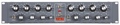
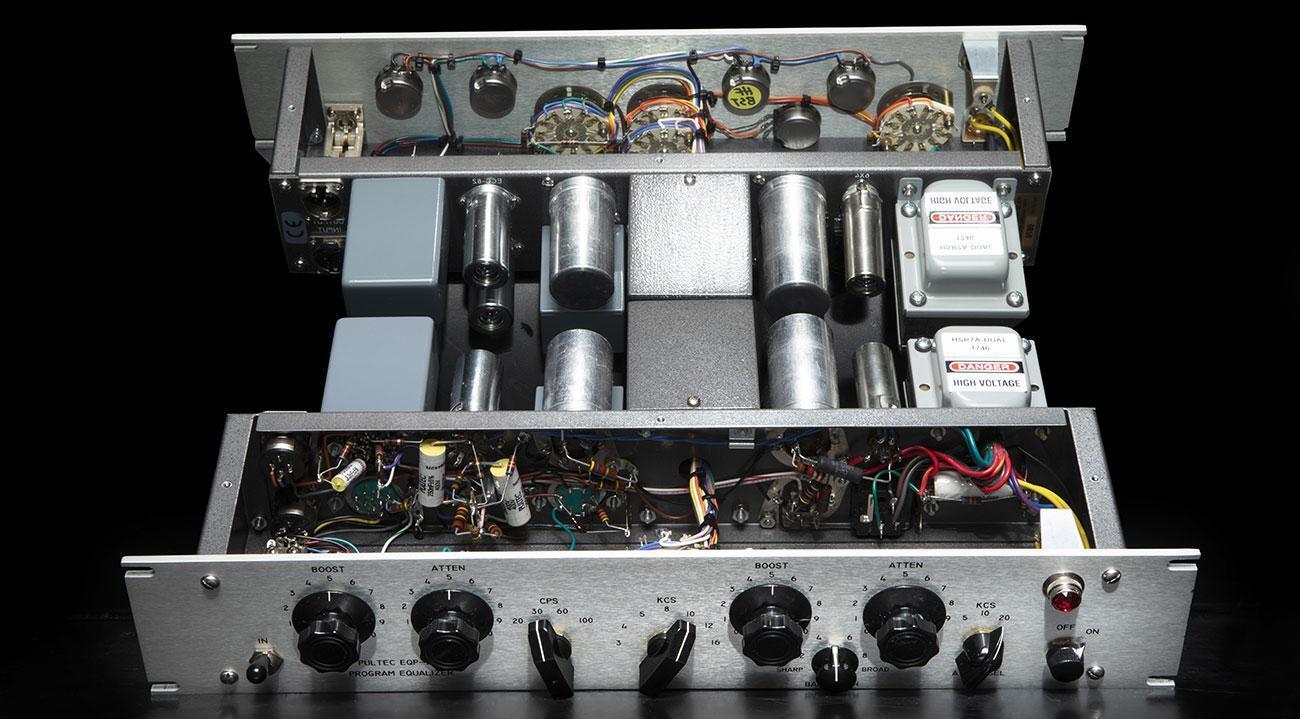
Back in the 1950s, when electrical engineers Eugene (Gene) Shenk and Oliver (Ollie) Summerlin started a company called Pulse Techniques (Pultec), they designed and created what has become one of the most unique and desirable equalizers of all time — the Pultec EQP-1A. This passive EQ design utilized transformers and tubes (common at the time) with a unique tube makeup gain circuit (uncommon at the time) to compensate for insertion loss, meaning that a Pultec could be inserted at unity gain. Their combination of the highest-quality transformers and incredibly broad (low-Q) frequency bands translated into what is still one of the sweetest-sounding EQs ever made. Even though the company went out of business in the 1980s, demand for these amazing equalizers never decreased and prices for vintage versions continued to climb. That’s why today there are numerous companies making Pultec clones. The current owner of the Pulse Techniques brand, Steve Jackson, bought the name Pulse Techniques and is manufacturing “true to the original” reproductions. His reproductions are so accurate that the differences between his new units and the vintage originals is that his new ones have 1) detachable IEC power cords and 2) XLR in and out connectors instead of terminal strips. Other manufacturers also make Pultec-style tube EQs trying to mimic that legendary sound. And there are software designers that have modeled and interpreted the Pultec sound into plug-ins.
The Pultec Sound
The sweetest thing about a Pultec is how you can alter the frequency spectrum in such a drastic and desirable way. I remember the first time I used one (on a Russ Taff record in the 1980s). I was floored by how I could add all the presence and brilliance I wanted without any sibilance or harshness. How was that possible? And I could grab as much warmth and fullness as I desired without the bottom end getting muddy or thick. Again, how does it do that? I fell in love with the Pultec sound — at a time when vintage units were hard to find and even harder to afford. It took me six years to find the pair that I eventually bought. Thankfully, these days getting that Pultec sound is far easier and more affordable.
What I love about using a Pultec is that the more I boost the EQ the more it makes me smile.
That Pultec Magic
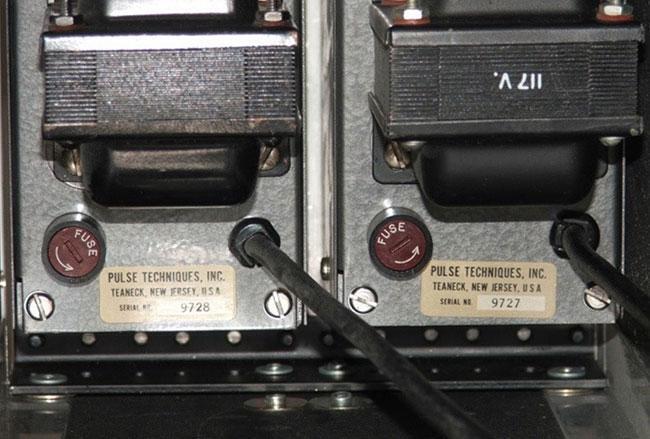
In my opinion, the real magic of the Pultec sound is in (a) the transformers, (b) the tubes, and (c) the incredibly wide bandwidth of the filters. When I would use my pair of vintage Pultec EQP-1A3s (serial #s 9727 and 9728) when mastering, sometimes I didn’t even switch in the EQ, but just ran the signal through the transformers and tubes for the wonderful sonic glue it imparted. (Even better than tape — heresy, I know!)
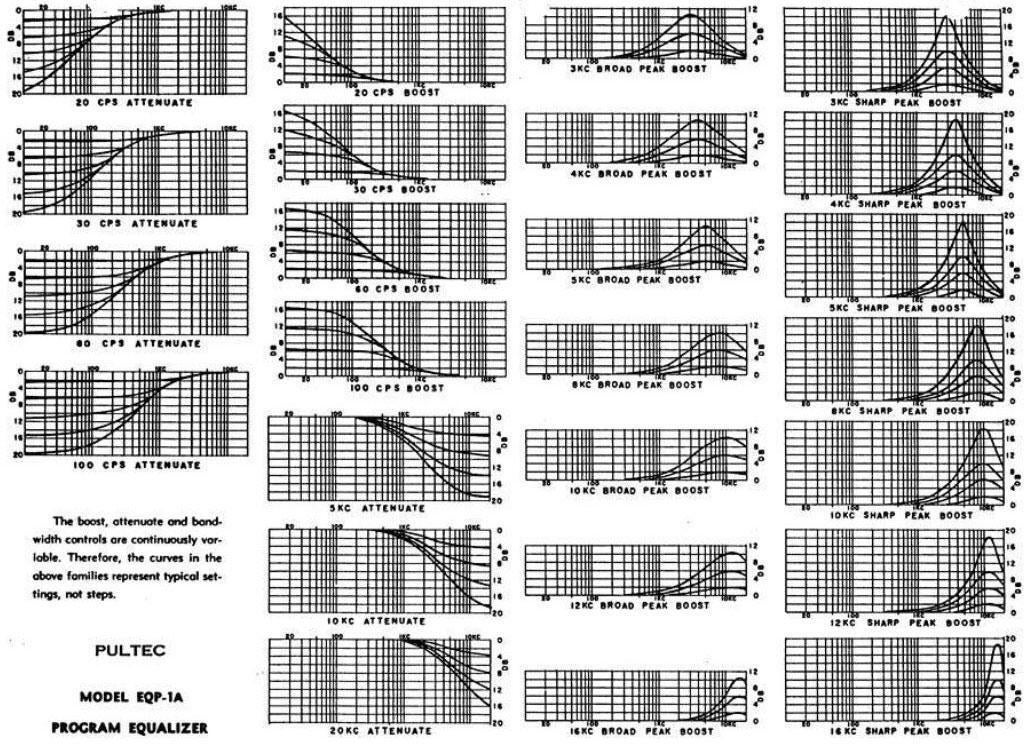
Many people have never seen the Pultec frequency response charts (the charts from the original manual are included below) and don’t realize that boosting at 30CPS (cycles per second, or Hertz) on a Pultec affects frequencies all the way up to 1000Hz, five octaves higher. Similarly, with the HF boost set to the highest audible octave — 10KCS (kHz) Broad — its bandwidth reaches down to 200Hz, over five octaves lower. That’s wide!
The Goal
With nearly a dozen Pultec imitations currently being made, we wondered about how these units compare to each other sonically. Do they capture the Pultec magic? Can they produce the massive low end of an original? Or the brilliance and sweetness on the top end? We decided to find out.
We gathered together eight hardware units that aspire to the Pultec sound and chose to include seven Pultec-style plug-ins. I decided not to include an original vintage Pultec, because even the youngest original Pultec is nearly 40 years old. Though the design and components of the originals are very stable (according to Steve Jackson of Pulse Techniques, who has measured dozens of originals with an Audio Precision test rig), it seemed unfair to put these new units up against a vintage unit, especially when choosing one particular vintage Pultec to compare them to. Also, software models are true to the one specific unit that was modeled, which may not sound the same as another unit. So I decided right up front that we would only compare contemporary units. With that decision out of the way, we proceeded to gather the contestants and design a listening test.
Control Layout
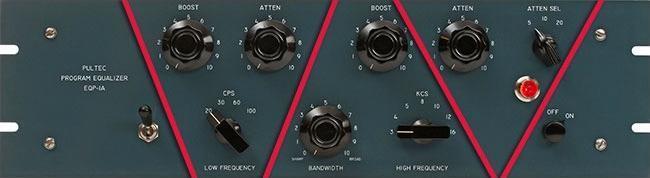
The knob layout on a Pultec is very nonintuitive and still confuses users to this day, so I will walk you through the controls. It’s not so much the function of the knobs as the layout that confuses people. The function of each knob is clearly delineated. BOOST and ATTEN do just what they say — boost and attenuate. Broad and Sharp refer to the bandwidth of only the High Frequency Boost knob, with broad affecting the widest frequency range. See the image below to understand the knob groupings. From the left, BOOST and ATTEN both are controlled by the Low Frequency select knob, with the same turnover frequency for each, which is a bit counterintuitive, since most EQs offer a single knob that will either boost or cut. The High Frequency controls are grouped in the middle: Boost only, Bandwidth, and High Frequency select, which goes all the way down to 1kHz in the midrange. Finally, the two rightmost controls are ATTEN and ATTEN SEL for attenuating high frequencies above the selected frequency: 5kHz, 10kHz, or 20kHz.
How Can “Bypass” Sound Better?
One unique thing about Pultecs is that the Bypass on the front panel is not a “hard-wire bypass,” and when the EQ is switched out, the signal still passes through the transformers and the makeup gain circuit, thus imparting a sound. Many engineers have discovered that some of the Pultec magic can be accomplished just by patching the unit (transformers and tube “push-pull amplifier”) into the signal path, even without switching the EQ in. Not only is there a change in the “sound,” but there’s also a modification of the frequency response, with a slight boost in the mids. As part of our testing, we discovered that some of the software plug-ins model this change as well, modifying the level and sound when in Bypass. Vintage units (and many contemporary units) exhibit a gain change when they are patched into the circuit. The two columns in the chart below show the gain change when (a) the unit is inserted with the EQ switched out and (b) with the EQ switched in. Some plug-ins even mimic this gain change. Note that only two plug-ins (Avid and iZotope Ozone) are actually unity gain when inserted (0 in/0 out).
| HARDWARE | dB Change with EQ Out |
dB Change with EQ In – No Boost or Cut |
| Pulse Techniques EQP-1A3 | 0.6 | 0.6 |
| Pulse Techniques EQP-1A3-SS | 2.0 | 2.0 |
| Tube-Tech PE 1C | 0.3 | -0.5 |
| Manley Enhanced Pultec EQ | 0.0 | 0.0 |
| Retro Instruments 2A3 | -0.1 | -0.1 |
| WesAudio LC-EQP | 0.0 | -0.2 |
| Warm Audio EQP-WA | 3.9 | 2.5 |
| Klark Teknik EQP-KT | 2.3 | 0.9 |
| SOFTWARE | ||
| Apogee FX Rack | 0.9 | 0.9 |
| Avid Pultec Bundle | 0.0 | 0.0 |
| IK Multimedia T-RackS | 0.0 | 0.2 |
| iZotope Ozone 8 Vintage EQ | 0.0 | 0.0 |
| Softube Tube-Tech | 0.0 | -0.4 |
| Universal Audio UAD-2 Pultec EQP-1A | 1.3 | 1.1 |
| Waves PuigTec | 1.2 | 1.2 |
How to Compare Equalizers
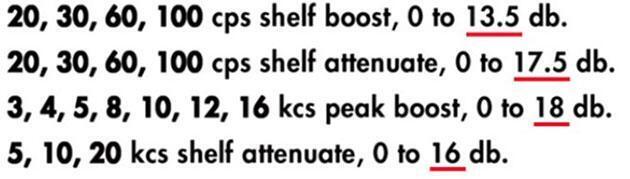
Comparing EQs is easy, right? “Just pick the same frequency on all the units and turn the boost knobs up to 5 and see how they sound.” Ha! Not so fast. First off, although the numerical values for boost and cut on a vintage Pultec are from 0 to 10, those values are not in dB. Low-frequency Boost adds up to 13.5dB, while low-frequency Attenuate cuts 17.5dB at the max setting (10). In Sharp, the midrange will boost up to 18dB. While comparing settings on the units, we noticed that identical knob settings yielded very different Boost/Cut amounts. Could we devise a way to compare just the sound of the units with identical boost settings? Otherwise we would only be comparing the variation in the different knob settings.
To make sure we were adding the same amount of boost on each unit, we chose to use a sine wave at a chosen frequency, say 30Hz for the low band, and then boosted a specified amount and calibrated them to within 0.1dB. We did the same on the Broad setting for the HF boost, calibrating to within 0.1dB (if knob detents allowed).
Just so you can see how wide the variations are, here are the knob settings (below) that result in identical boosts at 30Hz and 12kHz Broad. We calibrated all the hardware and software this same way.
| HARDWARE | Knob Setting for Boost at 30Hz |
Knob Setting for Boost at 12kHz |
| Pulse Techniques EQP-1A3 | 5.8 | 3.9 |
| Pulse Techniques EQP-1A3-SS | 3.5 | 3.3 |
| Tube-Tech PE 1C | 5.3 | 3.7 |
| Manley Enhanced Pultec EQ | 6.1 | 4.4 |
| Retro Instruments 2A3 | 4.3 | 3.9 |
| WesAudio LC-EQP | 5.0 | 4.3 |
| Warm Audio EQP-WA | 5.0 | 2.4 |
| Klark Teknik EQP-KT | 6.0 | 2.7 |
| SOFTWARE | ||
| Apogee FX Rack | 4.0 | 3.6 |
| Avid Pultec Bundle | 5.4 | 2.6 |
| IK Multimedia T-RackS | 5.7 | 3.0 |
| iZotope Ozone 8 Vintage EQ | 4.1 | 3.2 |
| Softube Tube-Tech | 5.8 | 4.8 |
| Universal Audio UAD-2 Pultec EQP-1A | 5.1 | 4.9 |
| Waves PuigTec | 5.5 | 4.5 |
The Contestants
We selected eight hardware boxes to audition, listed here from highest to lowest price. We also chose to listen to seven plug-ins, listed in alphabetical order.
The Hardware
Pulse Techniques EQP-1A3
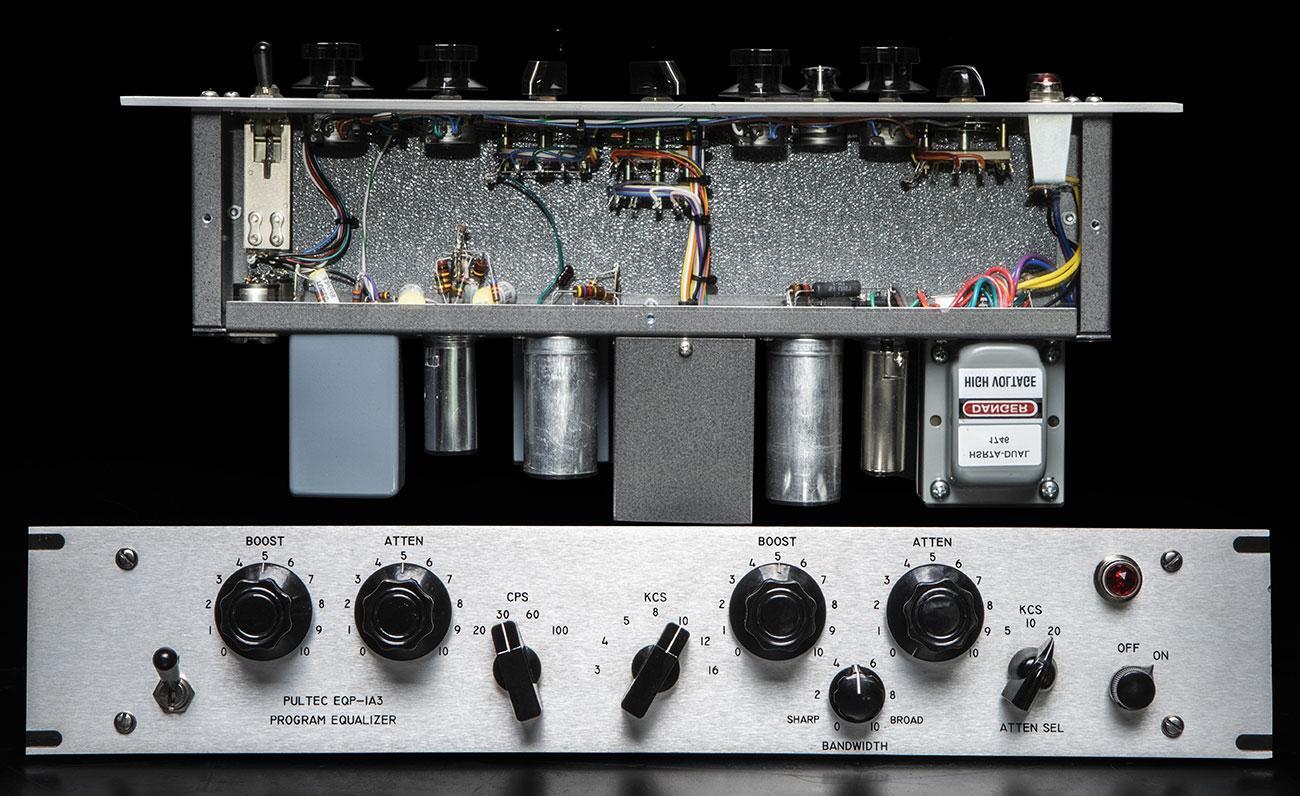
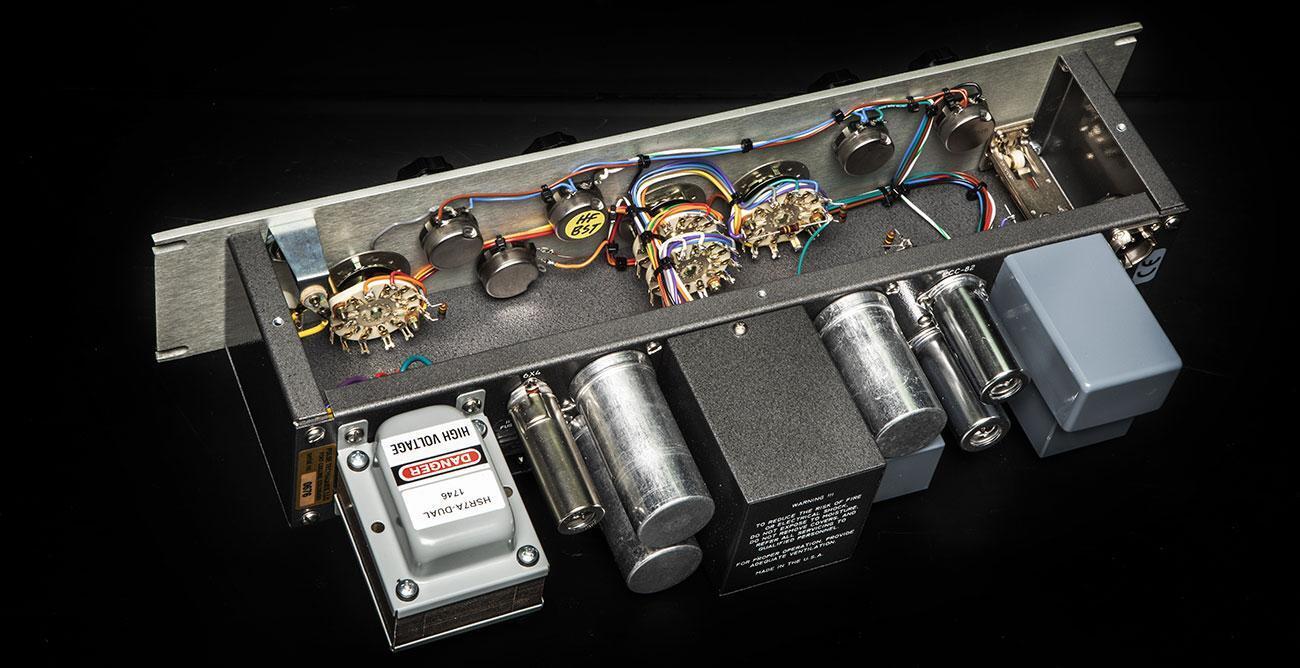
The Pulse Techniques EQP-1A3 is a re-creation of the original hand-wired, point-to-point Pultec design, differing by having an IEC connector instead of a fixed power cable and XLR in and out instead of a terminal strip for I/O like the vintage units.
Pulse Techniques EQP-1A3-SS
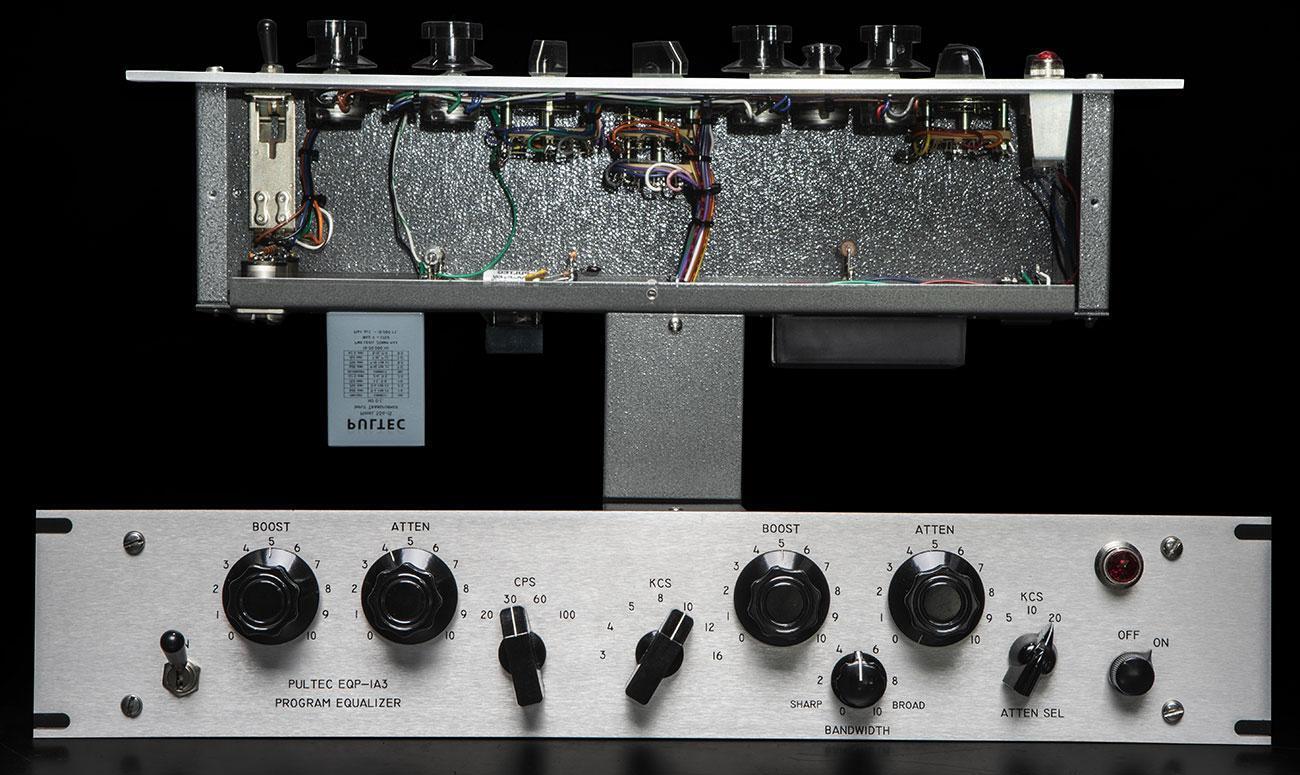
The Pulse Techniques EQP-1A3-SS is the same chassis and circuitry as the tube Pultec above, except it uses a solid-state amplifier section instead of tubes. It is fascinating to hear how big a difference that makes in the sound.
Tube-Tech PE 1C
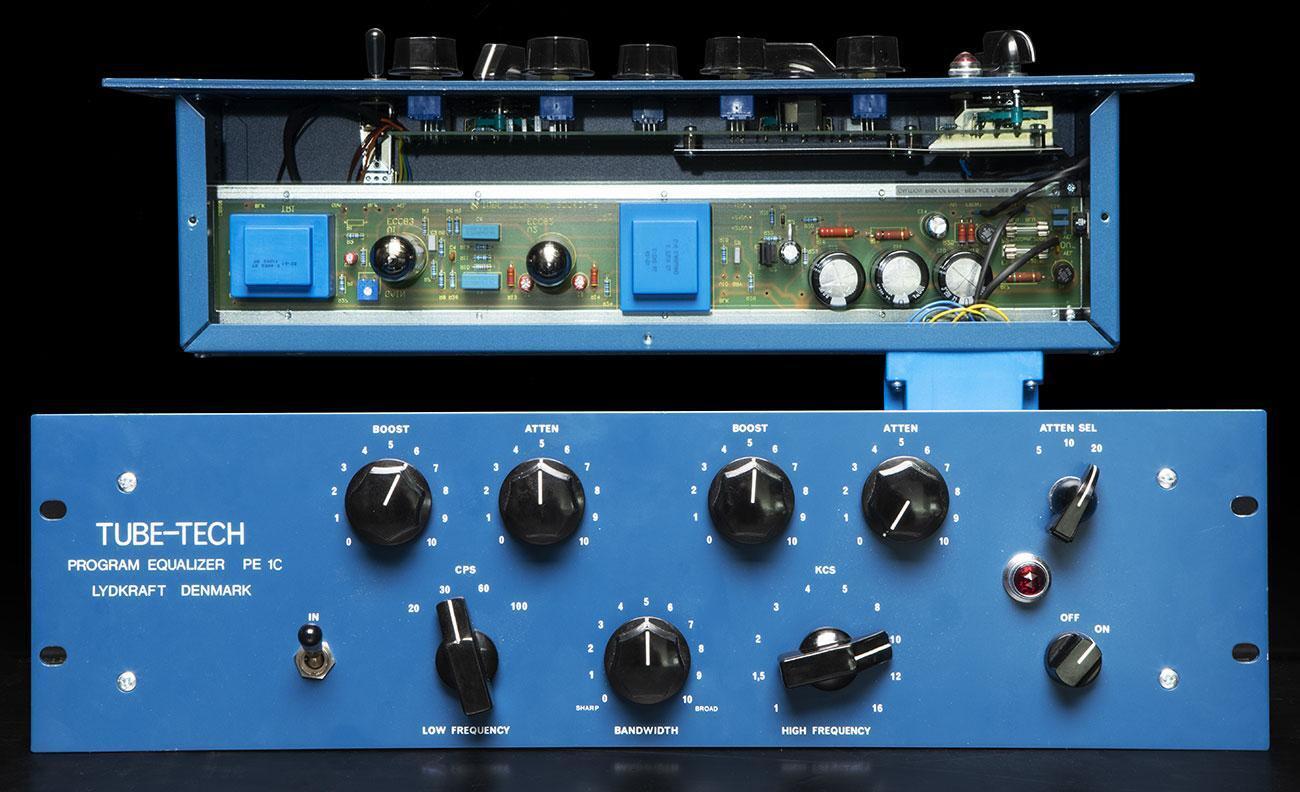
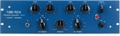
The Tube-Tech PE 1C was the earliest Pultec clone I ever encountered and has been in production since 1985. Its 3RU form factor, just like the EQP-1A, belies the clean, high-tech interior design.
Manley Enhanced Pultec EQ
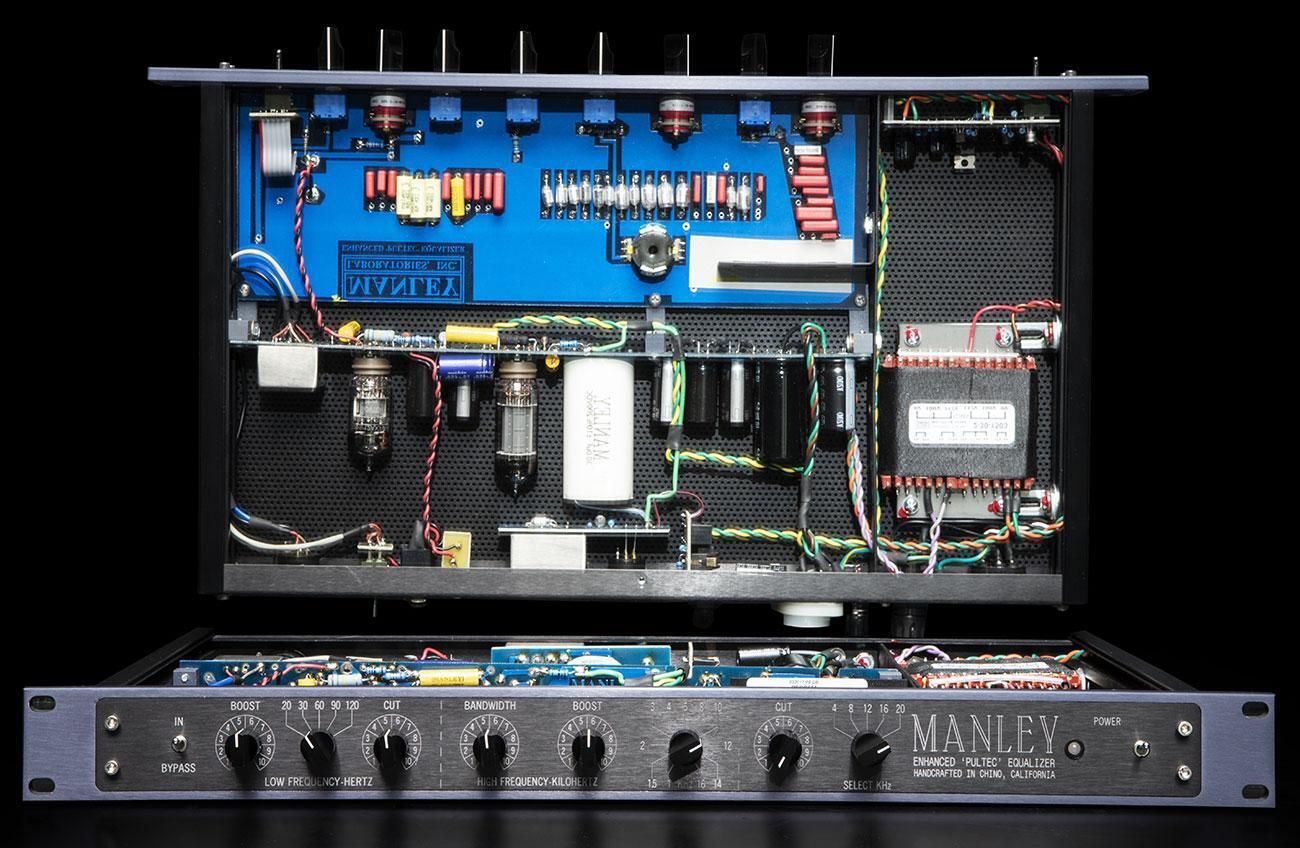
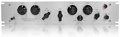
As the oldest Manley unit that has been continuously in production, the Manley Enhanced Pultec is unique as the only single-rack-space unit in this lineup. It features custom Manley-designed transformers.
Retro Instruments 2A3
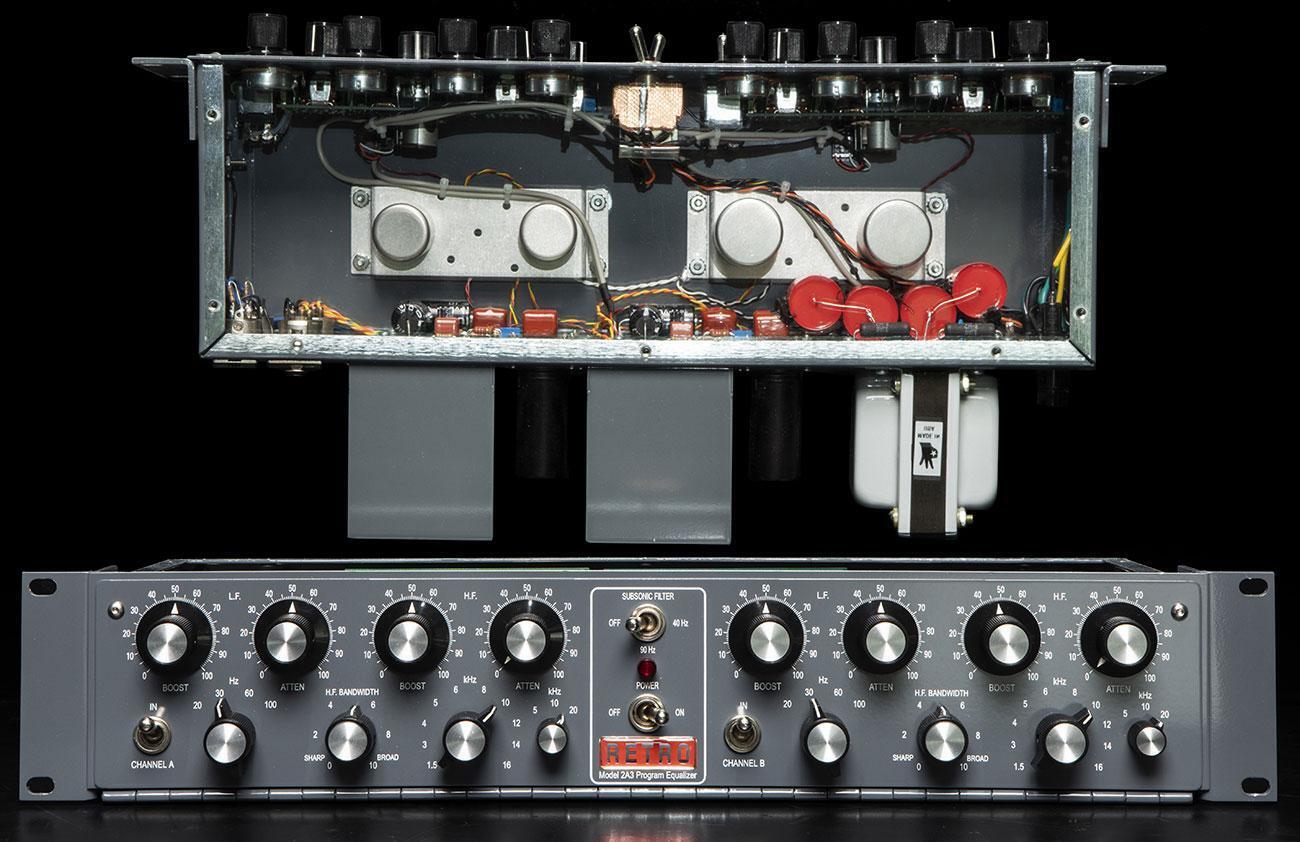
The Retro Instruments 2A3 distinguishes itself by offering two channels in one unit and also adds a switchable subsonic filter (40Hz or 90Hz).
WesAudio LC-EQP
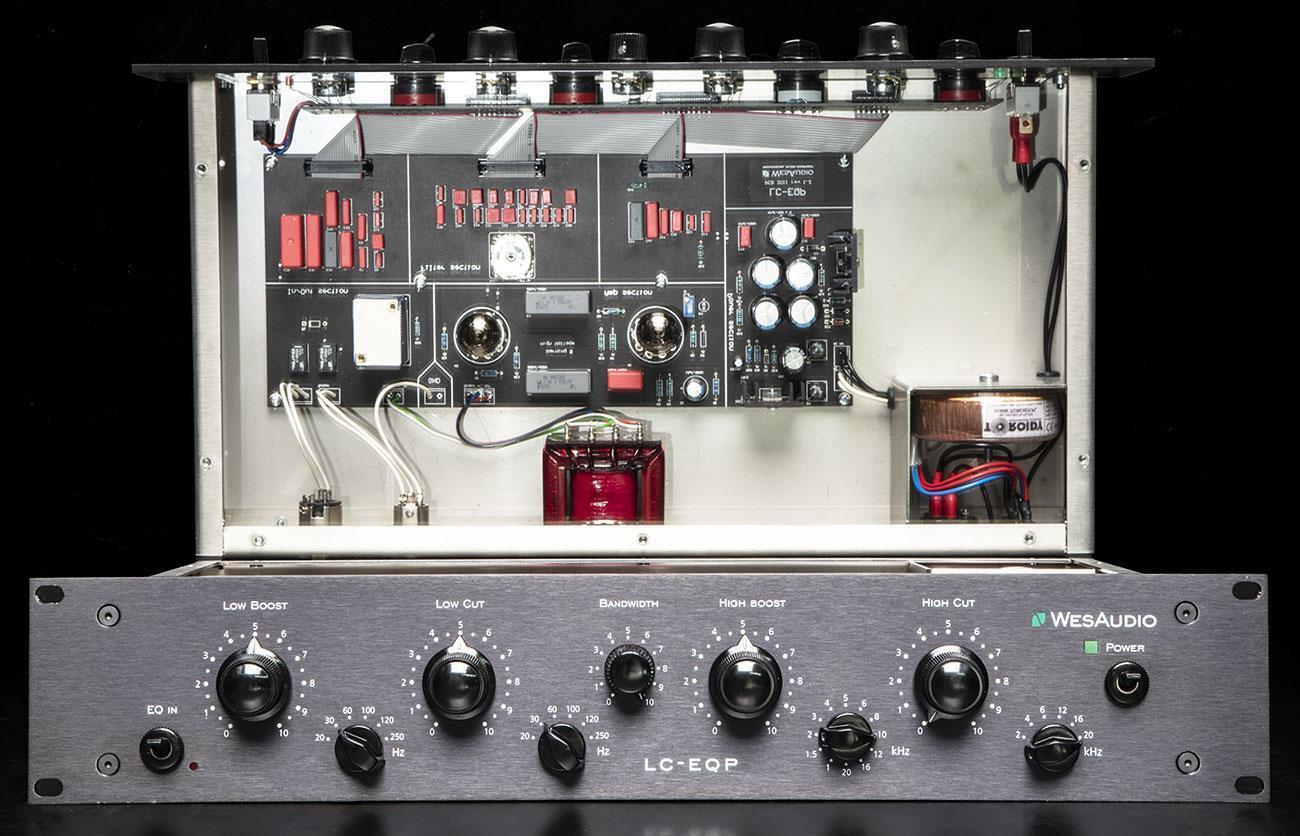
The WesAudio LC-EQP is made in Poland, features a striking internal layout, and is the only unit that offers low boost and low cut with independent frequency selects for each filter, similar to the Lang EQ.
Warm Audio EQP-WA
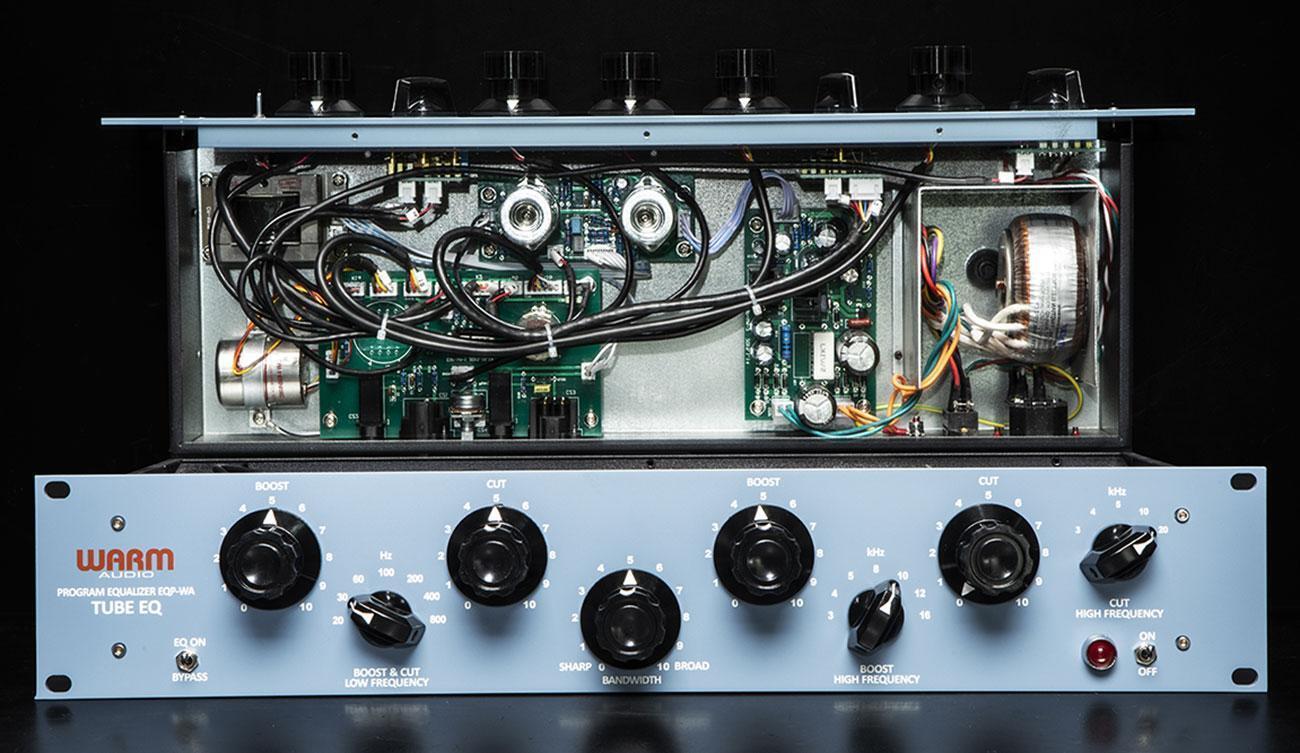
The Warm Audio EQP-WA includes CineMag input and output transformers.
Klark Teknik EQP-KT
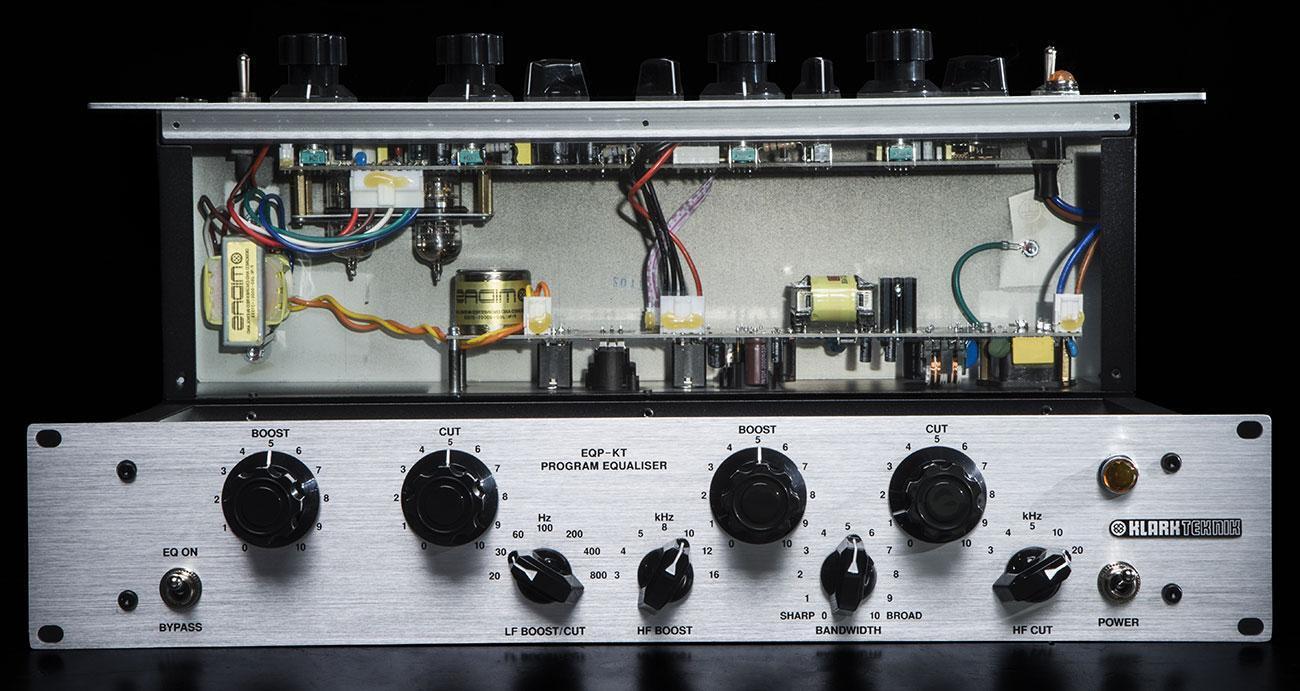
The surprisingly affordable Klark Teknik EQP-KT features Midas-designed transformers.
The Software
Apogee FX Rack Pultec EQP-1A Program EQ
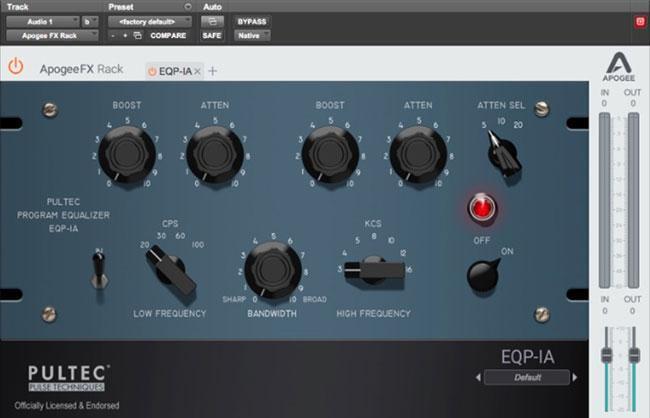
The Apogee FX Rack Pultec EQP-1A Program EQ was developed in conjunction with Steve Jackson’s Pulse Techniques and has his blessing. Listen carefully to see how close Apogee came to duplicating the sound of the current Pultec tube unit.
Avid Pultec Bundle
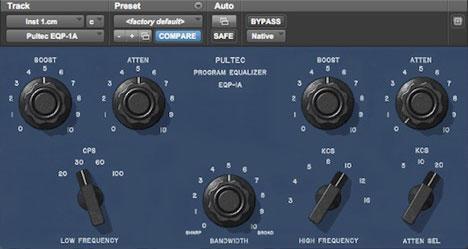
The Avid Pultec Bundle offers the classic EQP-1A, EQH-2, and MEQ-5 equalizers all in one bundle.
IK Multimedia T-RackS
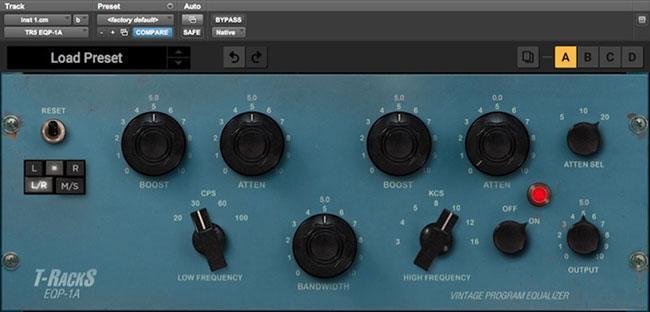
The IK Multimedia T-RackS offers a resizable plug-in window and recallable presets along with M/S processing.
iZotope Ozone 8 Vintage EQ
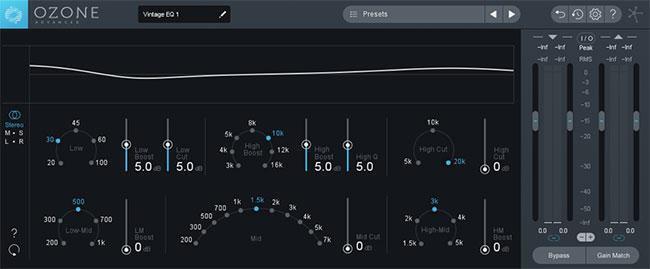
The iZotope Ozone 8 Vintage EQ could easily be overlooked as a Pultec-inspired EQ because of its very distinctive non-vintage look and control configuration.
Softube Tube-Tech PE 1C
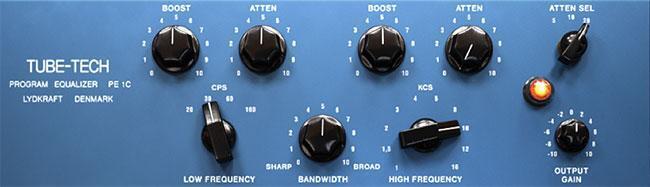
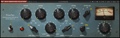
This Softube Tube-Tech models the hardware PE 1C original. You can listen to both of them side by side.
Universal Audio UAD-2 Pultec EQP-1A
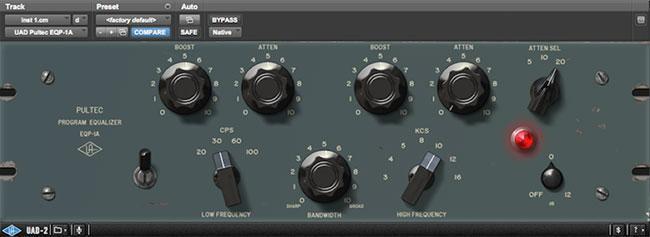
The Universal Audio UAD-2 Pultec EQP-1A is designed to work with UAD hardware and offers zero-latency monitoring.
Waves PuigTec
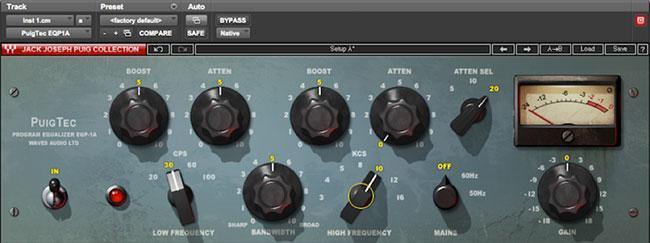
The Waves PuigTec is a replication of the original Pultec owned by renowned producer/mix engineer Jack Joseph Puig.
Frequency Curves
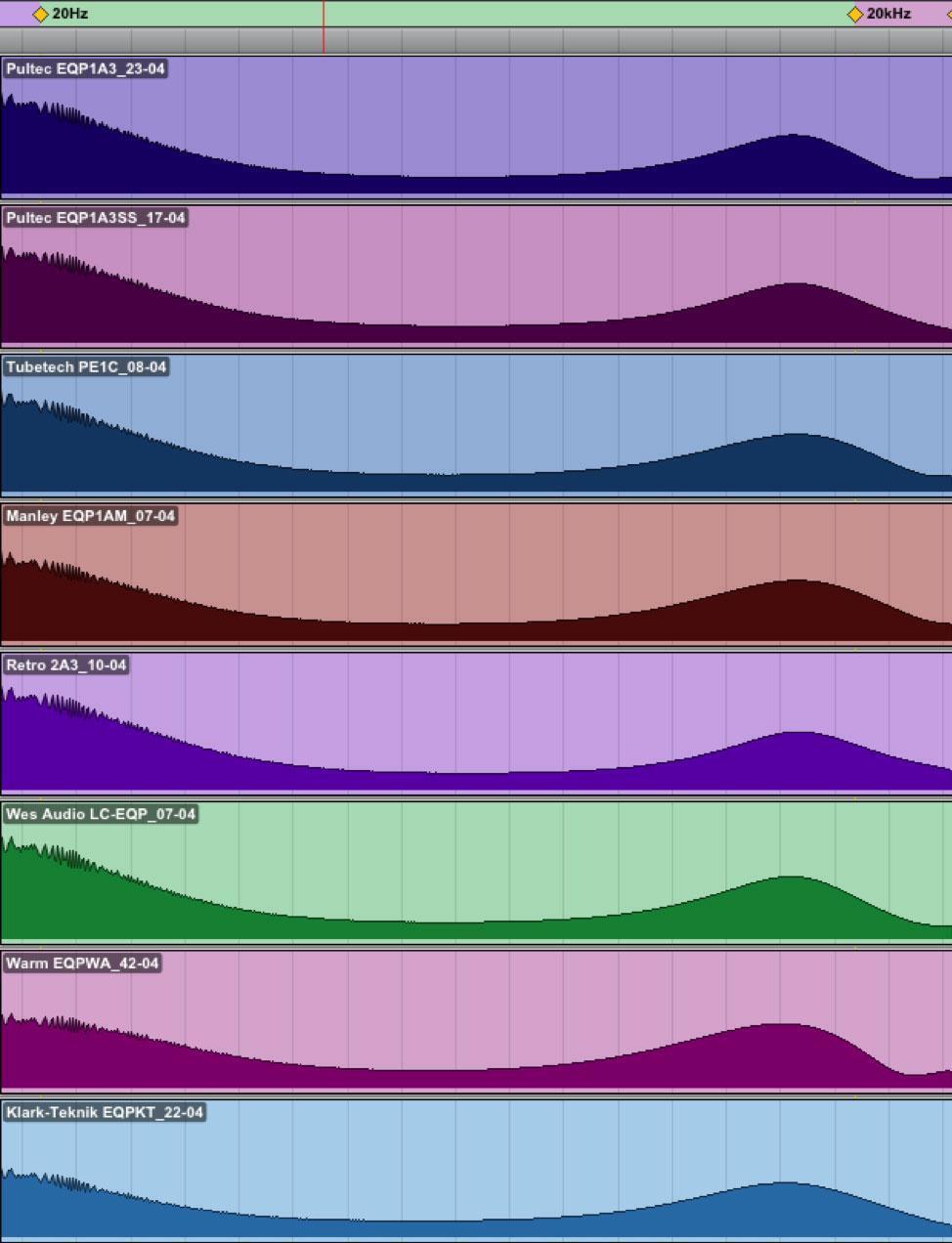
Here are the curves from the hardware units we tested. The source is a 20Hz to 48kHz sine wave sweep. In this first image, the boost is set to 10 at 30Hz and 12kHz Broad. You can see the differences in the resulting boost and bandwidth among the units.
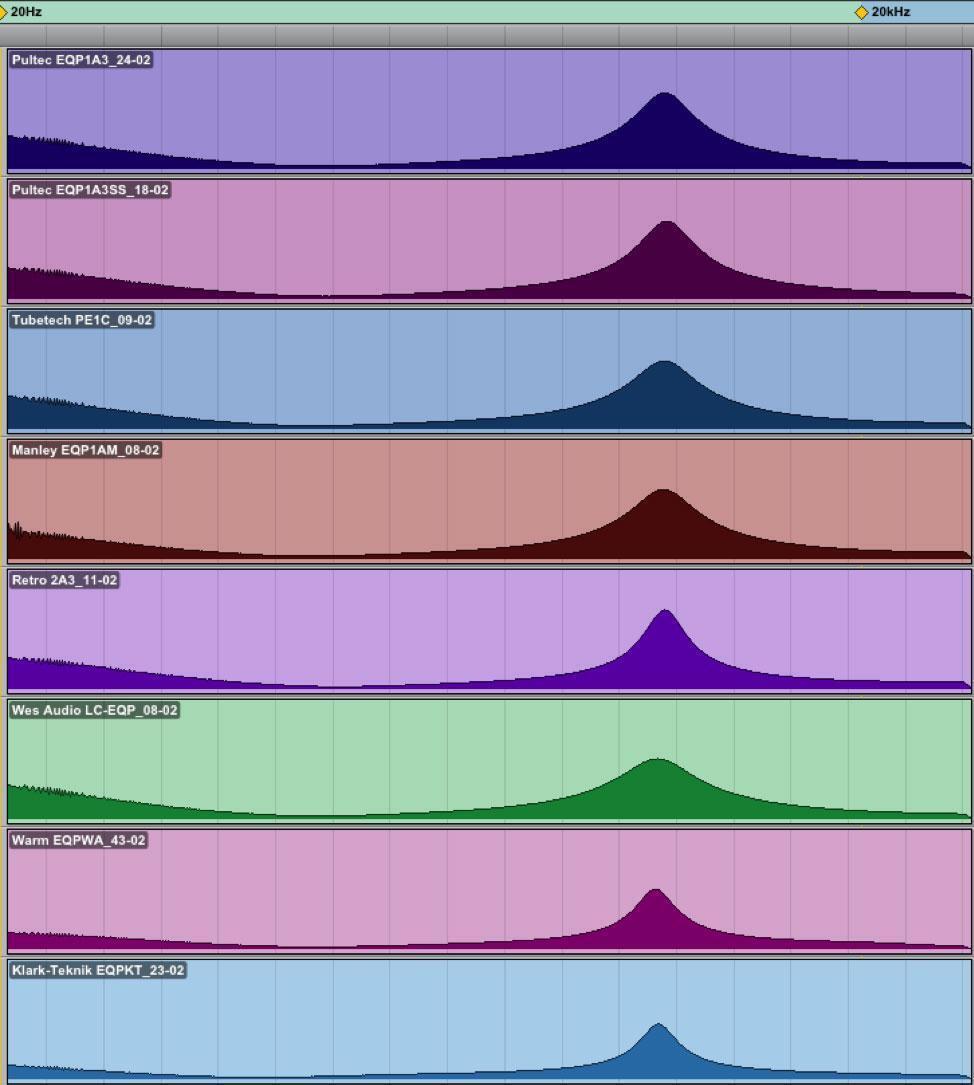
Next we turned both the LF Boost and LF cut to 10 and changed the high frequency to 4kHz and Sharp and boosted it to 10. The source was the same 20Hz to 48kHz sine wave sweep. Again the differences and similarities among the units are clearly visible.
Testing Method
For the hardware units, we took a single calibrated analog output from the Avid MTRX and went into each unit and then back into a calibrated input on the MTRX and recorded the resulting audio. Every unit was tested using the same exact output/input and same exact cabling. All units were powered up for 12 hours before we began recording. For the plug-ins, we took the flat (non-EQd) audio track and inserted the plug-in on that track and recorded the processed audio. Here are the audio sources you will hear. You are strongly encouraged to use the highest quality listening system to audition these files so you can fully appreciate the differences.
The playable files below are presented as 320K MP3s, but I strongly encourage you to download and listen to the 24-bit, 96kHz original sound clips. For Pro Tools users, you can download the Pultec Shootout session by clicking here. Non Pro Tools users can download the Pultec Shootout folder full of audio files by clicking here.
Let’s Listen
We chose four audio clips to demonstrate the sound of the Pultecs.
- Drum Mix
- Rock Vocal Mix
- Female Vocal Mix
- Drum Mix with the LF and HF boost gradually increased from 0 to 10
Drum Mix
This drum track was recorded at Sweetwater Studios. We boosted the low frequencies (LF) at 30Hz and boosted the high frequencies (HF) at 12kHz, set to Broad bandwidth. The first unit (the tube Pultec EQP-1A3) was dialed in by ear and then we matched all subsequent units to the same measured values of boost. Here are the knob settings (below) for identical boosts on each unit. As you can see, the knob settings vary widely to accomplish identical boosts.
| HARDWARE | Knob Setting for Boost at 30Hz |
Knob Setting for Boost at 12kHz |
| Pulse Techniques EQP-1A3 | 5.8 | 3.9 |
| Pulse Techniques EQP-1A3-SS | 3.5 | 3.3 |
| Tube-Tech PE 1C | 5.3 | 3.7 |
| Manley Enhanced Pultec EQ | 6.1 | 4.4 |
| Retro Instruments 2A3 | 4.3 | 3.9 |
| WesAudio LC-EQP | 5.0 | 4.3 |
| Warm Audio EQP-WA | 5.0 | 2.4 |
| Klark Teknik EQP-KT | 6.0 | 2.7 |
| SOFTWARE | ||
| Apogee FX Rack | 4.0 | 3.6 |
| Avid Pultec Bundle | 5.4 | 2.6 |
| IK Multimedia T-RackS | 5.7 | 3.0 |
| iZotope Ozone 8 Vintage EQ | 4.1 | 3.2 |
| Softube Tube-Tech | 5.8 | 4.8 |
| Universal Audio UAD-2 Pultec EQP-1A | 5.1 | 4.9 |
| Waves PuigTec | 5.5 | 4.5 |
Flat_Drum Mix
Pultec Tube_Drum Mix
Pultec SS_Drum Mix
Tubetech_Drum Mix
Manley_Drum Mix
Retro_Drum Mix
WesAudio_Drum Mix
Warmaudio_Drum Mix
Klark Teknik_Drum Mix
Apogee_Drum Mix
Avid_Drum Mix
IKM T-RackS_Drum Mix
Ozone8_Drum Mix
Softube_Drum Mix
Universal_Drum Mix
Waves_Drum Mix
Rock Vocal Mix
This is an excerpt of Russ Taff’s “There’s a Hallelujah in It All” from his new album Believe (2018), produced here at Sweetwater Studios by Phil Naish and Mark Hornsby. For this track, we boosted at 20Hz and 16kHz.
Flat_Rock Vocal Mix
Pultec Tube_Rock Vocal Mix
Pultec SS_Rock Vocal Mix
Tubetech_Rock Vocal Mix
Manley_Rock Vocal Mix
Retro_Rock Vocal Mix
WesAudio_Rock Vocal Mix
Warmaudio_Rock Vocal Mix
Klark Teknik_Rock Vocal Mix
Apogee_Rock Vocal Mix
Avid_Rock Vocal Mix
IkM T-RackS_Rock Vocal Mix
Ozone8_Rock Vocal Mix
Softube_Rock Vocal Mix
Universal_Rock Vocal Mix
Waves_Rock Vocal Mix
Female Vocal Mix
This is the intro of “You Don’t Let Me Down” from Jordan West’s new self-titled EP (2019), produced here at Sweetwater Studios by Mark Hornsby and Nick D’Virgilio. On this song, we only added at 16kHz, with no LF boost or cut.
Flat_Female Vocal Mix
Pultec Tube_Female Vocal Mix
Pultec SS_Female Vocal Mix
Tubetech_Female Vocal Mix
Manley_Female Vocal Mix
Retro_Female Vocal Mix
WesAudio_Female Vocal Mix
Warmaudio_Female Vocal Mix
Klark Teknik_Female Vocal Mix
Apogee_Female Vocal Mix
Avid_Female Vocal Mix
IkM T-RackS_Female Vocal Mix
Ozone8_Female Vocal Mix
Softube_Female Vocal Mix
Universal_Female Vocal Mix
Waves Female Vocal Mix
Drum Mix — Gradual Boost
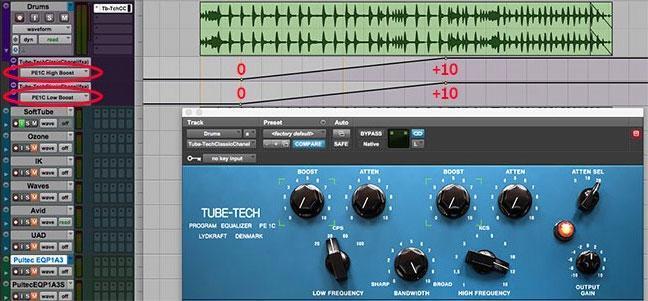
One of the great things about Pultecs is how audio just blossoms as you turn the knob farther and farther. In order to give you an idea of how each of these sounds as you gradually increase the boost, we decided to gradually “wind up” the gain as the audio clip progressed. In these clips you will hear the drums starting flat and then the boost knobs are gradually increased until they are at full value for the last 8 seconds of the clip. The sonic differences are most evident when the knobs are wide open.
0:00 No Boost
0:02 Boost begins
0:07 Boost knob is at 5
0:12 Boost knob is at 10
Flat_Drum Mix – No Boost
Pultec Tube_Drum Mix – Gradual Boost
Pultec SS_Drum Mix – Gradual Boost
Tubetech_Drum Mix – Gradual Boost
Manley_Drum Mix – Gradual Boost
Retro_Drum Mix – Gradual Boost
WesAudio_Drum Mix – Gradual Boost
Warmaudio_Drum Mix – Gradual Boost
Klark Teknik_Drum Mix – Gradual Boost
Apogee_Drum Mix – Gradual Boost
Avid_Drum Mix – Gradual Boost
IkM T-RackS_Drum Mix – Gradual Boost
Ozone8_Drum Mix – Gradual Boost
Softube_Drum Mix – Gradual Boost
Universal_Drum Mix – Gradual Boost
Waves_Drum Mix – Gradual Boost
Conclusion
Hopefully you found this listening experiment as enlightening as we did. Several of the people who listened as we were recording had never heard a hardware Pultec before — most had only heard the software plug-in versions. My findings were exactly as I anticipated. I was reminded how much I love the Pultec sound, just as much as I did when I discovered it 25 years ago. Everyone who listened came away with a new understanding and appreciation for the magic of the Pultec EQ.
Credits
Many thanks to Sweetwater staff engineers Bobby Dellarocco and Krystal Davis for their help in accurately capturing these samples. When trying to get lots of details absolutely right, it helps to have three sets of eyes and ears. Thanks also to Steve Jackson of Pulse Techniques, Phil Moore of Retro Instruments, EveAnna Manley of Manley Labs, Brad Lunde and David Seal of TransAudio Group, Dan Anckney, and Roger Robindore of Apogee for all their help in accomplishing this ambitious project.