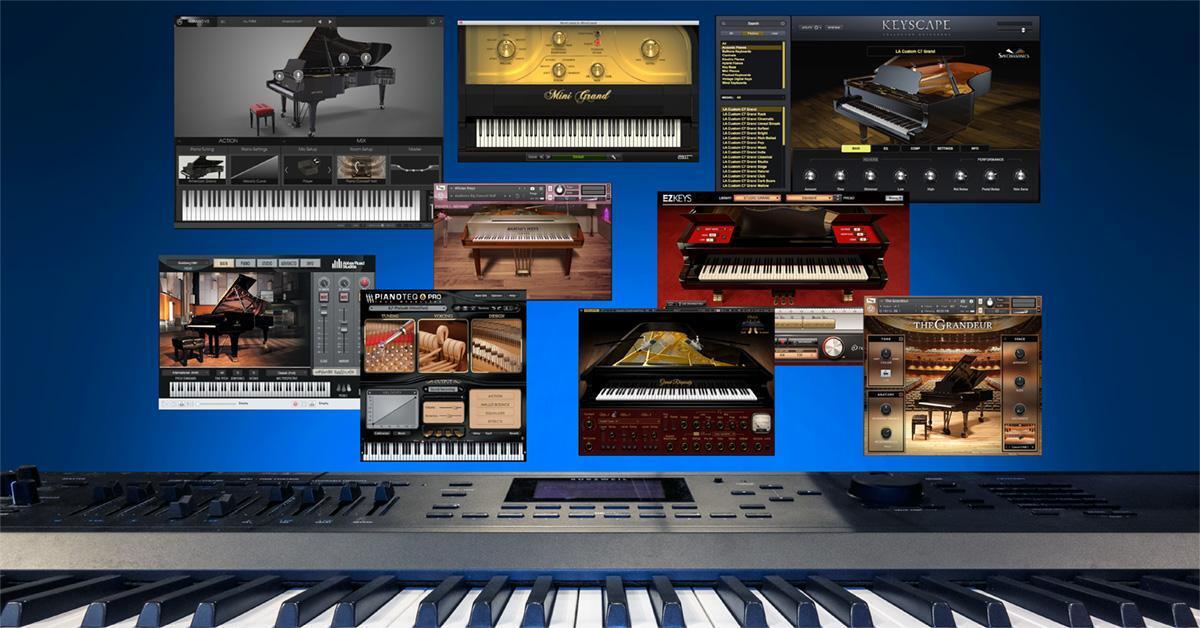
When we recorded the Digital Piano Shootout, several people asked, “What about virtual pianos?” That was a great idea so we decided to audition a group of VIs (Virtual Instruments). Virtual pianos and sample libraries have improved drastically in the past few decades. But how many people have taken the time to compare them side by side? Not many, so we decided we should do it. We installed a big collection of virtual piano programs and listened to them all. It was a fascinating exercise and a real revelation in terms of the sound of the different pianos. So we’re delighted to present our Virtual Piano Shootout.
The Goal
With so many virtual pianos on the market, how can you know how the different pianos sound? Well you can try hopping from website to website auditioning the sounds or listening to YouTube videos uploaded by different users. The problem with that approach is that there is no uniformity to the presentation. Levels, reverb, performances — the variables are all over the map. To help simplify the auditioning process for you, we chose several leading brands of virtual pianos and performed the same composition on each to give you a simple comparison between instruments, where you listen to them all in one sitting.
The Process
Jacob Dupre, Sweetwater’s Keyboard Artist, composed and recorded three solo piano performances in different styles and then played the same MIDI performance through a host of virtual pianos. Here’s Jacob to fill in the rest of the details.

I created three original pieces titled “Em Jam,” “Jazz Ballad,” and “Sonata Dupre” that I composed just for this comparison. The names reflect their musical styles. They were performed on a Korg Kronos, and the MIDI data was captured live. Then I took that uniform MIDI data and performed the piece on each instrument with no adjustments. The velocity of the notes in the performances ranges from as low as 24 to as high as 127. Since reverb volumes vary widely on the instruments, I tried to make the reverb level uniform between instruments. Because the options for mics and mic placement are so numerous in several programs, I didn’t change any of those from their stock presets. I also didn’t change settings for pedal noise, tuning, dynamic range, voicing, or any other parameters.
The tracks were recorded as 24-bit/96kHz WAV files and are presented here as 328k MP3s. If you want to hear them at their full resolution (highly recommended), you can download the high-resolution WAV files, either in a Pro Tools session or as a folder of audio files, and listen to them in your own studio. I also included the MIDI files with the downloads in case you want to use them to audition other virtual pianos that I didn’t include.
The Virtual Pianos
(listed in alphabetical order)
Arturia Piano V2
– American Grand

Manufactured by the French company Arturia, the Piano V2 comes with 12 piano models. I used their American Grand Piano. More info here.
Avid Mini Grand by AIR
– Mini Grand

AIR Music Technology created Mini Grand, which Avid uses as the standard virtual piano included with Pro Tools. More info here.
Best Service Galaxy II Pianos
– 1929 German Baby Grand
– Galaxy Steinway
– Vienna Grand

Galaxy has a Vienna, Steinway, and 1929 German Baby Grand. All of these instruments are featured here.
Garritan Abbey Road CFX Concert Grand
– CFX Concert Grand

MakeMusic, known for Garritan software instruments and the popular music notation software Finale, created their VP by recording a Yamaha CFX Concert Grand inside Abbey Road Studio One. More info here.
Modartt Pianoteq 6 Pro Edition
– K2 Prelude
– Steinway D Prelude

I featured the Steinway D Prelude and K2 Prelude from this French company’s newest version of Pianoteq. More info here.
Native Instruments Komplete 11 Ultimate
– Alicia’s Keys
– The Grandeur
– The Maverick

Native Instruments is known for having a wide variety of virtual instruments. One of those is Alicia’s Keys, which was sampled from Alicia’s own playing on her own piano in her home studio. How cool is that? More info here.
Spectrasonics Keyscape Collector Keyboards
– LA Custom C7

This California-based company features the largest selection of collector keyboards in the world, so I picked one of their grand pianos: LA Custom C7. More info here.
Synthogy Ivory II
– American Concert D
– Bosendorfer 290 Grand
– German Concert D Grand
– Studio C7 Grand 16

Ivory II, created by Synthogy, has a variety of pianos in their collection, including Steinways, Bosendorfers, and an Italian made 10 Foot Concert Grand. I featured the Bosendorfer 290 Grand, German Concert D Grand, and Studio C7 Grand 16. These three pianos come in the Grand Piano bundle. I also featured the American Concert D (Steinway).
Toontrack EZkeys Studio Grand Songwriting Software and Virtual Grand Piano
– Grand Piano

From the company that also makes the popular Superior Drummer line, the Toontrack EZkeys interface includes songwriting tools in addition to a virtual piano. More info here.
Waves Grand Rhapsody Piano
– Grand Rhapsody Piano

Waves is a well-known name in the world of plug-ins and virtual instruments. I used Grand Rhapsody, their premier virtual piano. More info here.
What to Listen For
Above all else, listen for the basic character of each piano. You’ll notice right away that many of them have major differences. Some are punchy, gentle, bright like a brand-new piano, or vintage like an old grand.
Here are other things you should note while you listen:
- Fullness of sound — especially listen to long, sustained chords. Are they warm and deep? Bright and airy?
- Attack of each note — is it harsh or soft?
- Decay or ring — pay special attention to the sound after a short note or chord is played. For instance, when a note in the lower register is hit hard and short, can you hear the buzz of the string as the note decays? When a single key or short chord is hit and allowed to ring in open space, what is the quality of the sound?
- Sustain pedal — how realistic do sustained chords sound? Can you hear greater resonance and a difference in tone when the pedal is engaged? I would encourage you to download the MIDI files in a DAW, so you can see exactly where I was using the pedal.
- Sounds that add realism and detail to the instrument — can you hear hammer noise or the sustain pedal being pressed down and released?
- Dynamic range of the performance — how much musical expression is achieved by the piano? Remember that the MIDI tracks have a velocity range of 24–127.
- Definition between notes in the low, mid, and high ranges — to what degree does the upper register cut through over the low and midranges? What do you notice about the balance in volume, tone, and intonation between each range of the instrument?
Lynn Fuston discusses Volume Matching
We worked hard to match up the levels on all these piano samples, but the frequency balance (high to mid to low notes) and dynamics of the different samples made it impossible to match them exactly. When the levels were matched in the softer beginning, sometimes the loud parts became mismatched. But if we matched the loud parts (which we did with weighted average SPL metering), then the quieter intros were often mismatched. Since each keyboard received exactly the same MIDI input, it’s enlightening to realize that the differences you hear reflect variations from one virtual piano to another. Ultimately Jacob and I sat and listened through to all of them to make sure we were pleased that the volume levels were matched fairly from one piano to the next.
Let’s Listen
Here are the all the virtual piano audio clips presented as 320K MP3 audio clips with no processing (no EQ, compression, or additional reverb added). Although the differences are audible in these MP3 clips, I strongly encourage you to click on one of the links below and download the high-resolution (24-bit/96kHz) audio clips, and open them in your DAW to listen at maximum fidelity.
Download the 24/96 sound files in a Pro Tools session
Download the 24/96 sound files for users without Pro Tools

Em Jam
Arturia Piano V2
Avid Mini Grand
Best Service Galaxy II — 1929 Baby Grand
Best Service Galaxy II — Steinway
Best Service Galaxy II — Vienna
Garritan Abbey Road CFX Concert Grand
Modartt Pianoteq 6 Pro Edition — K2 Prelude
Modartt Pianoteq 6 Pro Edition — Steinway D Prelude
Native Instruments Komplete 11 Ultimate — Alicia’s Keys
Native Instruments Komplete 11 Ultimate — The Grandeur
Native Instruments Komplete 11 Ultimate — The Maverick
Spectrasonics Keyscape Collector Keyboards — LA Custom C7 Studio
Synthogy Ivory — American Concert D
Synthogy Ivory — Bosendorfer 290 Grand
Synthogy Ivory — German Concert D Grand
Synthogy Ivory — Studio C7 Grand 16
Toon EZKeys Studio Grand Songwriting Software and Virtual Grand Piano
Waves Grand Rhapsody Piano
Jazz Ballad
Arturia Piano V2
Avid Mini Grand
Best Service Galaxy II — 1929 Baby Grand
Best Service Galaxy II — Steinway
Best Service Galaxy II — Vienna
Garritan Abbey Road CFX Concert Grand
Modartt Pianoteq 6 Pro Edition — K2 Prelude
Modartt Pianoteq 6 Pro Edition — Steinway D Prelude
Native Instruments Komplete 11 Ultimate — Alicia’s Keys
Native Instruments Komplete 11 Ultimate — The Grandeur
Native Instruments Komplete 11 Ultimate — The Maverick
Spectrasonics Keyscape Collector Keyboards — LA Custom C7 Softest
Synthogy Ivory — American Concert D
Synthogy Ivory — Bosendorfer 290 Grand
Synthogy Ivory — German Concert D Grand
Synthogy Ivory — Studio C7 Grand 16
Toon EZKeys Studio Grand Songwriting Software and Virtual Grand Piano
Waves Grand Rhapsody Piano
Sonata Dupre
Arturia Piano V2
Avid Mini Grand
Best Service Galaxy II — 1929 Baby Grand
Best Service Galaxy II — Steinway
Best Service Galaxy II — Vienna
Garritan Abbey Road CFX Concert Grand
Modartt Pianoteq 6 Pro Edition — K2 Prelude
Modartt Pianoteq 6 Pro Edition — Steinway D Prelude
Native Instruments Komplete 11 Ultimate — Alicia’s Keys
Native Instruments Komplete 11 Ultimate — The Grandeur
Native Instruments Komplete 11 Ultimate — The Maverick
Spectrasonics Keyscape Collector Keyboards — LA Custom C7 Classical
Synthogy Ivory — American Concert D
Synthogy Ivory — Bosendorfer 290 Grand
Synthogy Ivory — German Concert D Grand
Synthogy Ivory — Studio C7 Grand 16
Toon EZKeys Studio Grand Songwriting Software and Virtual Grand Piano
Waves Grand Rhapsody Piano
What We Learned

All these pianos have great qualities about them, and each represents hundreds of hours of work to achieve a high level of acoustic realism. While you’ll likely have a favorite, I don’t think there is one that towers high over the rest. Just sitting in my office playing through each piano over the past few weeks, I would play one piano and think, “Wow! This one is sweet. It’s clearly my absolute favorite!” Then I’d go to another one, and I’d love that one too and play it for another hour, and the next one, and the next, and on and on. My conclusion is that each piano serves a different purpose and works better for certain styles or contexts. As piano players know, some pianos work better for classical, jazz, or pop. Some are better for being bright and brutal, others soft and mellow, and some are well-rounded, appropriate for many styles of playing. I can say that I certainly learned a lot during this project and greatly enjoyed the process. — Jacob
The thing that amazed me the most is the realism of these pianos. Close your eyes and listen and several of them sound convincingly like you are sitting on the piano bench with your hands on the keys. The varieties of sound surprised me as well. I’ve recorded Baldwins, Yamahas, Steinways, Bosendorfers, and they are all very different. I honestly didn’t expect the differences between these sample libraries to be so great. While listening to them all it was not hard to imagine perfect applications for any number of them. One for film scores, one for classical, one for vocal accompaniment, one for a busy rock track. Just like with microphones or guitars, you can never have too many options. — Lynn
Conclusion
Hopefully this sonic exploration has helped you in your own journey to choosing the right virtual piano for you. But the journey doesn’t stop here! If you really like one of these pianos and are ready to add it to your arsenal, or if you have any other questions about virtual pianos, please call your Sweetwater Sales Engineer at (800) 222-4700.