Sweetwater Welcomes Turtle AV

Dynamic Microphones

Get More at Sweetwater

Refine Your Search

Availability

Brand

Price Range

Financing

Type of Deal

Sale

Series

Polar Pattern

Connector

Max SPL

Application

Related Searches

You can only compare four products at a time.
If you want to compare another product, please remove one of your earlier choices.
Please select more items to compare.

Dynamic Microphones: Timeless Tools for Every Engineer


Sweetwater Studios’ world-class mic lockers are stocked with some of the finest vintage and modern microphones money can buy — many of them quite exotic. And yet, when it comes to capturing a roaring guitar amp, an explosive snare drum, or a brassy belter, our engineers time and again reach for the humble dynamic mic.


Why? Because when you need an affordable workhorse that's virtually indestructible and able to handle extremely high sound pressure levels, a trusted dynamic mic is the way to go. Indispensable in the studio and on location, a good selection of dynamic mics is the cornerstone of every engineer's tool kit.


Sweetwater Has Dynamic Mics for Every Taste


As the largest online musical instrument and pro audio retailer in the country, Sweetwater is your number-one resource for dynamic microphones of every vintage. We’re proud to partner with long-standing mic leaders Shure, Sennheiser, Electro-Voice, AKG, and Telefunken and relative newcomers to the space Blue Microphones, Audix, RODE, and Audio-Technica to furnish all your dynamic mic needs.


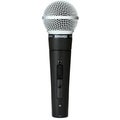
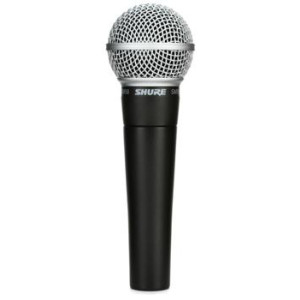
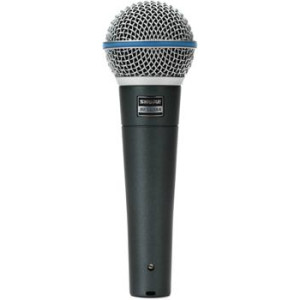
Are you torn between the proven performance of a Shure SM58 and the contoured punch of an Audix D6? Sweetwater’s Sales Engineers have the knowledge and experience to steer you in the right direction. We use dynamic microphones in our home and commercial studios daily, so we’re uniquely qualified to help recommend the right gear for your setup.


Best-Selling Dynamic Microphones You Can't Miss


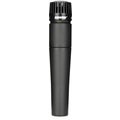
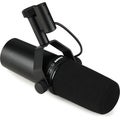
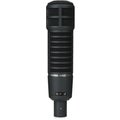
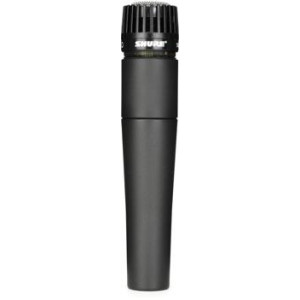
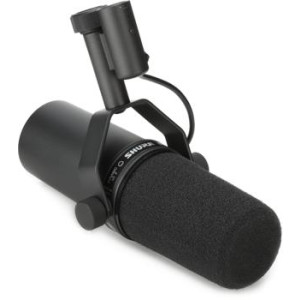
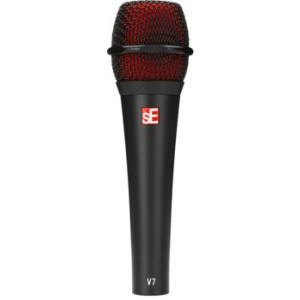
Band session booked? You can't go wrong with a Sennheiser MD 421 for toms and an AKG D112 for kick and bass amps, along with an armload of Shure SM57s for snare and guitar amps. Live vocals? The focused clarity of a supercardioid sE V7 or hypercardioid Audix OM5 will keep lead performers front and center. High-profile interview? The RODE PodMic and Electro-Voice RE20 deliver big vocal presence for podcasts and online content. You can experiment later if time permits, but these industry standards will always serve as excellent starting points.


Dynamic Microphone Polar Patterns Explained


Most popular dynamic mics utilize a cardioid polar pattern, meaning they capture sound primarily from the front and reject off-axis sound from the sides and back. This suits them well for most stage and studio applications. Less common, supercardioid mics are more directional than a cardioid; hypercardioid mics even more so. Unlike cardioid, these highly directional polar patterns exhibit tight front-facing sound pickup with sensitive rear lobes to reduce bleed coming in from the sides. Quite rare, dynamic mics with omnidirectional and figure-8 polar patterns tend to be employed for more specialized tasks. Hear these polar patterns and more in action in our “Microphone Polar Patterns Demonstrated” shootout.


Dynamic Microphone FAQs


What is a dynamic microphone?


Dynamic microphones operate under the electrodynamic principle of induction. They are often passive circuits (though not always) that utilize a moving copper coil suspended in a magnetic field to induce current as external sound waves vibrate an internal diaphragm. As sound enters the capsule of a dynamic microphone, it’s converted (or transduced) into electrical energy, which audio engineers know as signal. Note that this transduction of sound to signal happens mechanically, without needing an external power supply.


In short, a dynamic vocal microphone works like a tiny speaker wired in reverse. The pressure waves of your voice move a thin diaphragm attached to a moving coil, creating an electric signal. No added power required!


What's the difference between a dynamic mic and a condenser mic?


Dynamic and condenser mics may share space in many of our mic lockers, but their designs are quite unique.


As explained above, a dynamic mic creates signal (electricity) as sound waves move a coil in a magnetic field. The push-pull motion of the coil creates positive and negative voltages proportional to the polarity and intensity of the signal.


Condenser microphones don’t rely on magnetic induction. Instead, they create signal electrostatically through the principle of changing capacitance. Inside each condenser mic are two conductive parallel surfaces — a moving diaphragm (often gold-plated Mylar) and a fixed backplate — separated by a dielectric (nonconductive) gap. When a constant charge is applied to both surfaces via an internal battery or external power supply, a capacitor is created. As sound pressure waves push and pull on the thin diaphragm, changes in the distance between the two surfaces generate voltage, which forms the signal.


As you can see, there are many differences between these two microphone types. To learn more, see SweetCare's “What Is the Difference Between Dynamic and Condenser Microphones?”, or read on for applications where dynamic microphones have the edge.


What are the advantages of a dynamic microphone?


Due to their elegance and simplicity, dynamic mics have some key advantages over other common microphone types, both for studio applications and live sound:


  • Cost — Dynamic mics are among the most affordable microphones in pro audio, making it possible to stock a venue or studio without going over budget.
  • Serviceability— Simpler circuitry makes dynamic microphones easier to repair and modify.
  • Durability — Certain dynamic stage mics have literally been used to hammer nails. Try doing that with your prized studio ribbon!
  • SPL handling — Few mics can stand in the blast radius of a TAMA Terminator brass snare or non-master-volume Plexi without overloading as dynamics can.
  • Response — HVAC noise, barking dogs, clinking glasses — not everything in your performance space deserves the spotlight. Dynamic mic sensitivity drops off rapidly as distance from the capsule increases. This often makes them the best option for minimizing room interference and live stage bleed.
  • Passive design — Unless you’re using an inline mic booster or a mic with an internal preamp circuit, no power supply is needed to operate a dynamic — just plug in, crank up, and create.
  • Coloration — Dynamic microphones are sponges for preamp character, which makes them valuable tools for adding textures to a mix.


Shopping for Your Next Dynamic Microphone? Find It at Sweetwater


Whether you're recording a country rock band in the studio or mixing live sound for a jazz fusion quartet, the Sweetwater team has the mics (and the knowledge) to help you succeed. Need your next mic in a hurry? Our fast, free shipping means you'll be making beautiful music with your new mic in no time. And, thanks to Sweetwater's extended 2-year warranty on nearly every microphone we carry, you can invest in quality gear without fear.

Why shop Dynamic Microphones at Sweetwater.com?


With a massive selection of Dynamic Microphones, free shipping, a free 2-year warranty, 24/7 access to award-winning support - and more - Sweetwater gives you more than any other retailer! If you have any questions about Dynamic Microphones, make sure to give your personal Sales Engineer a call at (800) 222-4700.