
Pro Tools Quickstart Guide
In this guide, we will show you how to get started with the Pro Tools DAW software. That means we’ll show you how to create a session, set up audio and MIDI devices, and then record with them. Follow the sections below to get started.
- Launch and scanning plug-ins
- Create a new Pro Tools session
- Audio: Setup and record
- MIDI: Setup and record
Launch and scanning plug-ins
Once you’ve gotten Pro Tools both activated and installed, the next thing to do is launch the DAW software. The first time you use Pro Tools, it will scan your system for plug-ins and devices but, once done, will prompt you to either open or create a new session.
If Pro Tools can’t detect its license, you’ll be prompted to either connect an iLok USB dongle or start an iLok Cloud Session. Check our iLok Licenses and Activation Codes guide for more information. Once you can create a session and navigate the windows continue to record audio.
Scanning plug-ins
When you launch Pro Tools, it first does scan for plug-ins (instruments and effects). That just means it’s adding all the AAX plug-ins installed on your computer into the DAW. If your plug-in is not available as AAX, it will not be loaded into the Pro Tools, and you’ll need to either find an updated AAX version or use a different plug-in. Learn more about Pro Tools plug-in compatibility.
- If a plug-in can’t detect its license, you’ll be prompted to either resolve the issue or move the plug-in to an Unused folder.
- To view plug-ins by both category and manufacturer, select the Pro Tools menu and choose Preferences… In the Display tab, for the first drop-down menu, select Category and Manufacturer and click OK.
Rescan missing plug-ins
If your AAX compatible plug-ins aren’t showing up, they might need to be rescanned or reinstalled. Try each of the solutions below to get your plug-ins back.
- Restart your computer and restart Pro Tools
- Trash your Pro Tools preferences
- Download and reinstall the plug-in
Launching Pro Tools and scanning in plug-ins.
Create a new Pro Tools session
Pro Tools works in sessions. That means when you’re recording a song or working on a project, you’ll open its .ptx Pro Tools session file. When creating a new session, you’ll need to consider a few settings (e.g., sample rate, bit depth, file type). 44.1kHz, 24bit, and .WAV will work for many purposes and are commonly used. Learn more about how to create your first Pro Tools session.
- File Type (.WAV or .AIFF): Select the default audio file format for recorded tracks. Pro Tools can use both simultaneously, so don’t worry about starting in one format and then importing from the other. Learn more about .WAV and .AIFF.
- Bit Depth (16-bit, 24-bit, or 32-bit float): This is the dynamic resolution of recorded audio. We recommend 24-bit for most music production users. While all three will sound great, just remember that the larger the bit depths will always produce a larger file size. Learn more about bit depth.
- Sample Rate (44.1 – 192 kHz): The amount of times per second audio is digitally sampled/recorded. We recommend 44.1 kHz (for CD) or 44.8 kHz (for DVD) to most new music production users. Learn more about sample rates.
- I/O Settings (Last Used or Presets): These are the settings Pro Tools uses for labeling and routing signal in and out of your audio interface.
Pro Tools Tech Tips — Playback Engine
Navigate Edit and Mix windows
When you use Pro Tools, you’ll mainly work in the Edit and Mix windows. The Edit window is where you edit audio, create fades, and draw parameter automation. MIDI is similar, but in its own MIDI Editor window instead. The Mix window is where you control each track’s level, inserts, and sends. In other words, that’s where you create the mix by adjusting volume and inserting plug-ins. View the Window menu for more options and configuration settings.
Useful commands
The hotkeys below are some useful shortcuts we found useful for navigating and editing in Pro Tools. Learn more about useful Pro Tools shortcuts.
| Action | Mac | PC |
|---|---|---|
| Horizontal Zoom | Command + [ or ] | Ctrl + [ or ] |
| Amplitude Zoom | Command + Option + [ or ] | Ctrl + Option + [ or ] |
| Separate region | Command + E | Ctrl + E |
| Heal separation | Command + H | Ctrl + H |
| Create Fade | Command + F | Ctrl + F |
| Save Session | Command + S | Ctrl + S |
Pro Tools Tech Tips — Keyboard Shortcuts
Pro Tools Tech Tips — Track I/O Keyboard Shortcuts
Audio: Setup and record
One of the first things to do once you create a new session is to start recording audio. To do that, you will first need to configure the audio settings. That means you will need to select your audio hardware, configure the DAW input and output settings, and then create and record some audio tracks.
Select audio hardware
Pro Tools, like most DAW’s, has its own audio settings. That means you’ll need to select your audio device inside the Playback Engine settings. If this is the first time connecting your audio interface, you’ll want first to install its driver software. Once done, the interface can be connected directly to the computer and then selected as the Playback Engine.
You’ll also need to select the H/W Buffer Size, which determines the amount of time your computer has to process audio before outputting to the speakers. When recording and input monitoring, you’ll use a lower value for less latency (less processing time). For mixing and producing or when you’re not recording, select a higher value for more buffer processing time (more latency, but more time for signal processing).
- Go to the Setup menu and select Playback Engine.
- Select your audio interface from the Playback Engine drop-down menu.
- Select the H/W Buffer Size:
- Lower for input monitoring while recording (less latency and processing)
- Higher for mixing and producing (more latency and processing)
Other settings
- Ignore Errors During Playback/Record: OFF
- Dynamic Plug-in Processing: ON
- Video Engine: OFF
Audio interface not showing up?
If your audio device does not show up, follow our troubleshooting guides for PC (Windows) or Mac (macOS).
Configure DAW I/O settings
Once the audio interface is selected as the Playback Engine, its connections need to be configured within the Pro Tools Input and Output (I/O) Settings. That just means you’ll tell Pro Tools what to title each of your interface’s input and output channels. These settings don’t require customization but should be set to default when getting started for the first time. Within the I/O Settings are multiple routing tabs, but you only need to configure the Input, Output, and Bus tabs.
Default I/O settings
Click the Setup menu and select I/O…. For each of the Input, Output, and Bus tabs:
- Select all the paths and click Delete Path.
- Click Default.
- Rename or reroute any paths.
- Click Export Settings… and save the settings (e.g., Apollo Twin Input, AVB Outputs, or Mastering).
Saving I/O settings
If your system doesn’t involve much (just stereo out and virtual Pro Tools busses) then I/O settings aren’t a big deal. Systems with more channel counts or outboard gear have a lot more inputs and outputs, which means recreating the I/O settings for large setups can take a while. Since I/O settings are unique to the system, we recommend saving them to not only the default folder, but the session folder, too. If the I/O settings need reset; save your settings, save the session, and then default the I/O to the current Playback Engine.
- Inputs are the same inputs of your interface (e.g., mic preamps, line, ADAT or S/PDIF inputs) and are what you select on Pro Tools tracks to determine what audio gets recorded to them.
- Outputs just send signal to the speakers or outboard gear (e.g., monitor, ADAT or S/PDIF outputs). Most tracks will have their output assigned to the main speakers, but all other outputs can be customized to your liking.
- The Bus tab represents the internal mono or stereo busses (paths) that Pro Tools uses for sending audio to other tracks. You’ll also see that some of the busses also have selections in the Mapping to Outputs column. This is so you can send audio directly to one of your Playback Engine’s outputs. (e.g., to outboard gear or a headphone distribution system).
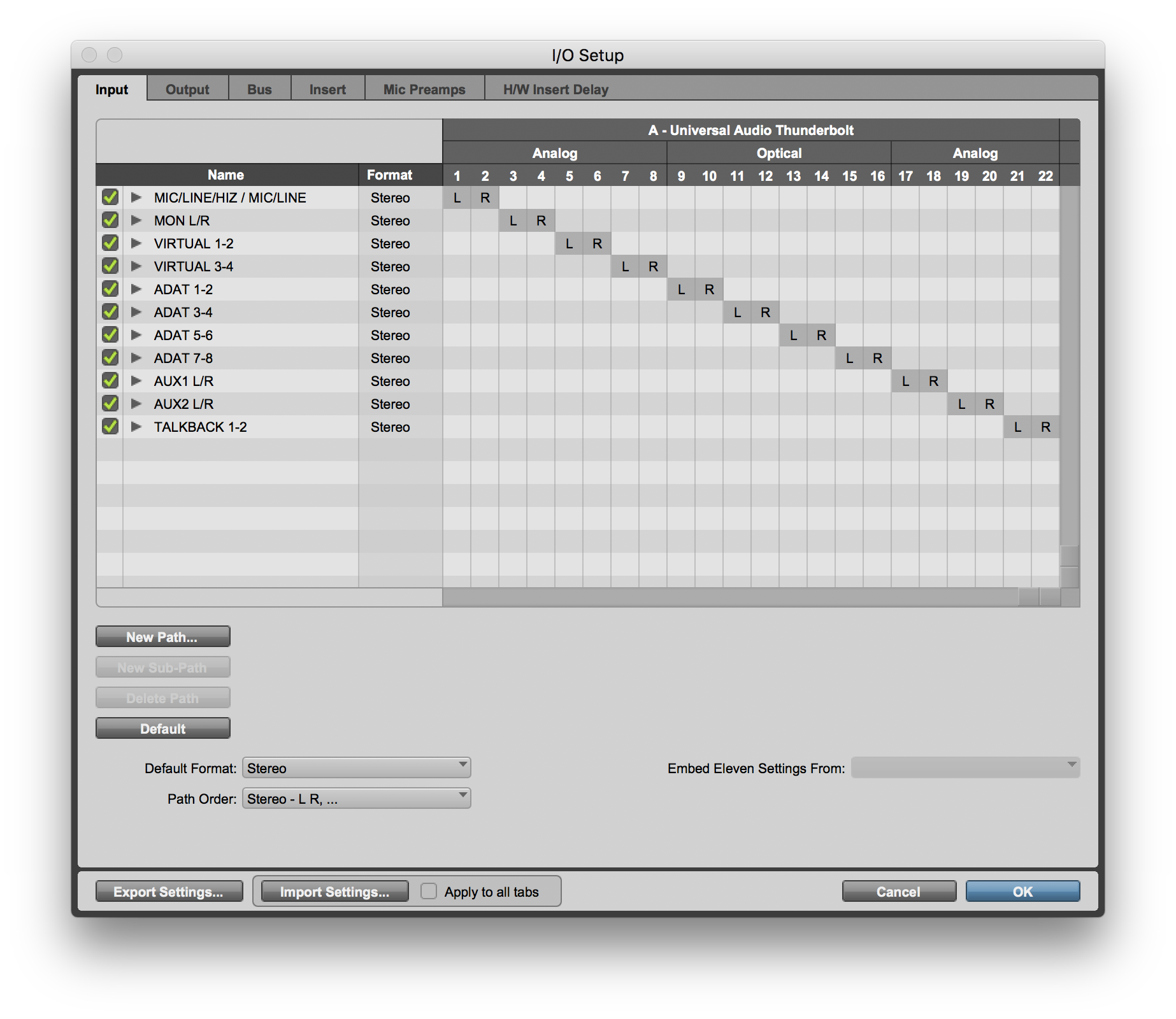
Input tab
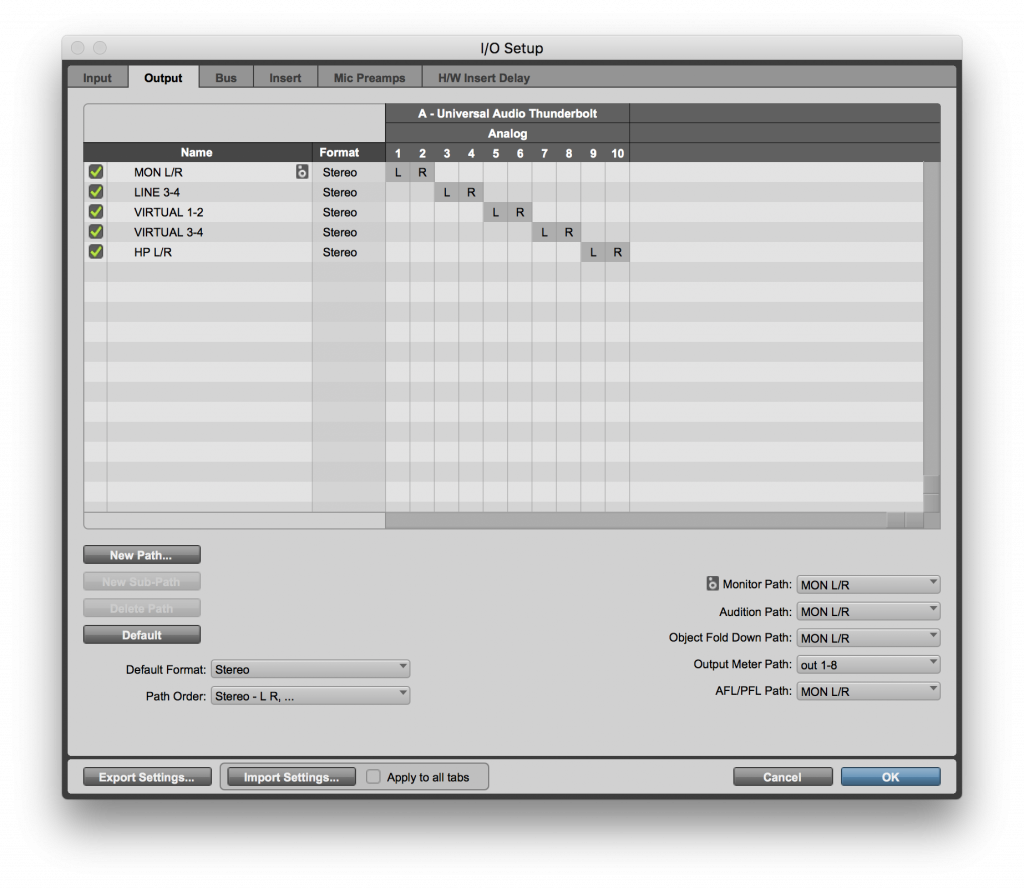
Output tab
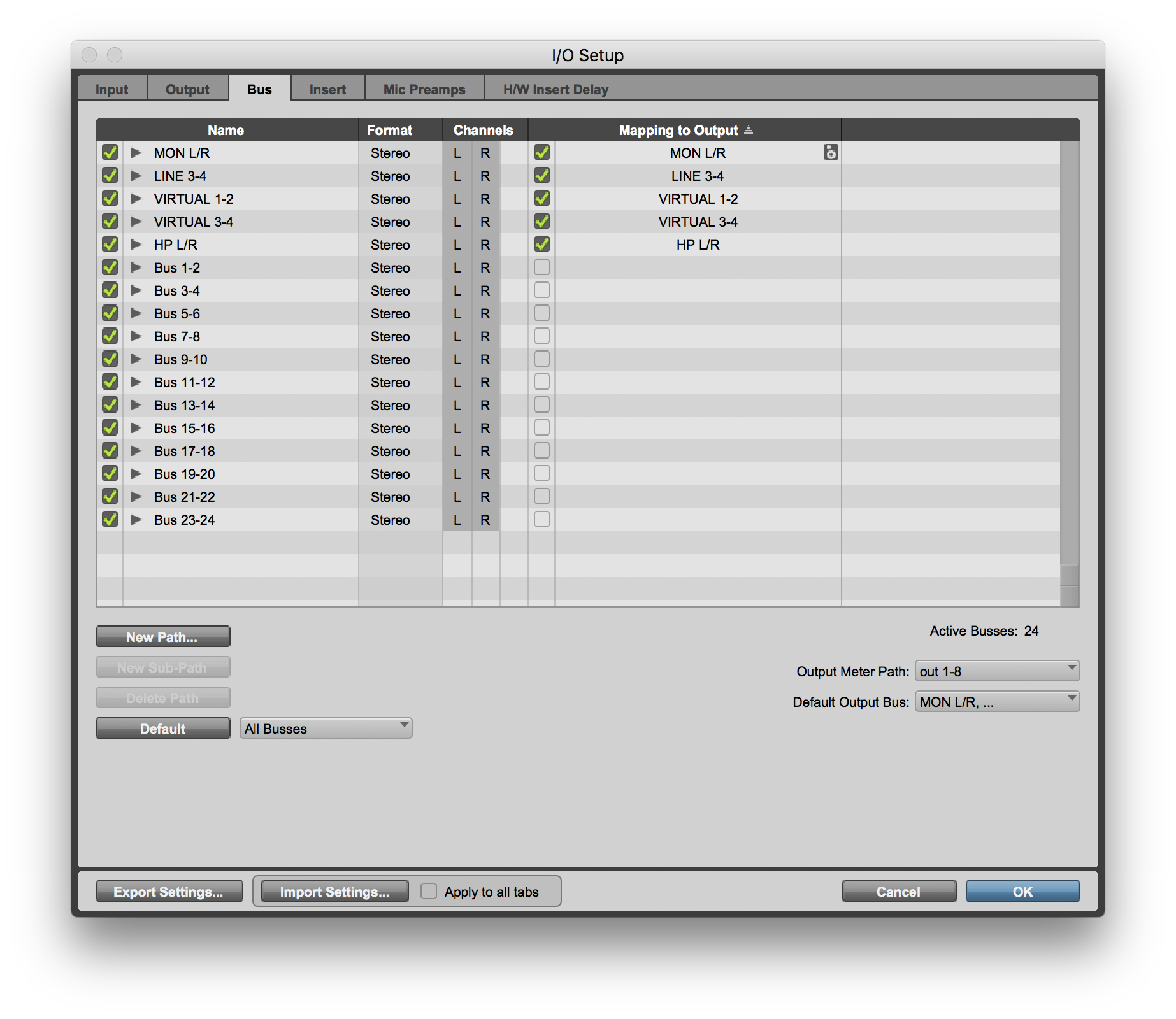
Bus tab
Create and record audio tracks
Recording audio is a breeze once the audio settings are configured. All you have to do is create a mono or stereo track, select the input, and then start recording. Each time you create a new track, consider renaming it and changing the track color. To do so, just double-click its name or channel tab. Keeping organized with good track titles and clear colors will add a lot to your Pro Tools workflow.
Once audio is recorded, it will be saved in your session folder’s Audio Files folder. Make sure when copying or moving a Pro Tools session folder that the .ptx file and Audio Files folder are always kept together. This will ensure that you’ll always be able to restore your session.
- Open the Track menu and choose New….
- Select a Mono (1 channel) or Stereo (2 channels) Audio Track and click Create.
- Select the track’s Input and Output paths. You can also double-click the track’s name to rename it.
- Click the track’s Record Enable button and set the preamp gain level on your recording device.
- Select where you want to record, click the Transport’s Record Enable button, and then click Play. Clicking either Play or Stop will end recording and playback.
Inserting plug-in effects
To use plug-ins and effects in Pro Tools, they must be selected as inserts. Channel inserts are the essentially effects inserted to a channel. You can also select hardware inserts for outboard gear, but that requires additional I/O configuration. The signal flows from top to bottom, so the order you choose will have a direct impact on the processed signal.
Pro Tools Tech Tips — Activate Sends and Inserts
Pro Tools Tech Tips — Bypassing Inserts
MIDI: Setup and record
To play virtual instruments, you’ll need to send them MIDI data. You can write MIDI in Pro Tools, but you’ll likely prefer using a keyboard or drum controller. Many MIDI controllers are bus-powered, meaning they’re powered from a USB connection and do not require a power supply adapter. If your MIDI controller includes driver software, make sure to install it before connecting your device.
Connect MIDI controller

MIDI controllers will connect to your computer either via USB or MIDI. While most will work just fine over MIDI, some controllers require (or only have) USB connections to access all their features. Once connected, check that your MIDI controller is detected in Pro Tools.
Connect via USB
USB is a common connection nowadays, and often used because it also provides power to the controller. That means the device is both connected and powered from the same USB port. Many MIDI devices have an additional power jack for connecting an external power supply, which is useful when using a MIDI connection instead of USB. A USB hub can help connect multiple devices to your computer, but we only recommend powered hubs with a dedicated power supply adapter.
- USB-A to USB-B cable
- Requires available USB port
- Bus powered from USB connection
- MIDI in and out (if supported)
- Supports optional software features
Connect via MIDI
Another option is to connect via MIDI to a MIDI or audio interface’s MIDI input jack. This way, the MIDI controller will appear as the interface’s MIDI port instead of its USB device title. Keep in mind that since MIDI does not provide bus power, you will need either USB power or a wall wart power adapter to turn on the device.
- 5-pin MIDI cable
- Requires available MIDI port
- USB connection to computer not required
- Requires additional power supply adapter
- Separate cables required for MIDI In/Out
Enable MIDI device
When you launch Pro Tools, it will scan for your connected MIDI devices. All you have to do is make sure the devices are enabled (checked) in the MIDI Input Devices menu. For MIDI controllers with more than just keys or pads, you’ll also need to configure them within the Peripherals menu. This will enable the encoder knobs, faders, and transport features on most controllers. While similar, not all MIDI controllers are alike, so visit the device’s user manual for specific installation and configuration instructions.
- Click the Setup menu, go to MIDI, and select MIDI Input Devices.
- Select each MIDI device port you wish to enable. Unchecked ports will be disabled in Pro Tools.
- Click the Setup menu and choose Peripherals…
- Select the MIDI Controllers tab and configure your device(s):
- Type: HUI, M-Audio Keyboard
- Receive/Send: input and output ports
- #Ch’s: bank of MIDI channels
Pro Tools Tech Tips — Virtual MIDI Keyboard
Create and record MIDI tracks
To “play” virtual instrument plug-ins, you need MIDI data. MIDI data can be drawn in with your mouse (in the MIDI Editor window) but also recorded by playing your device. There are two methods for recording MIDI and playing virtual instruments. The first option is quick and straightforward, but the second is more useful when sending multiple MIDI tracks to the same virtual instrument. Keep in mind that MIDI data plays the instrument, and the MIDI data alone is not audio. You’ll need to record it to an audio track if you want an actual audio file.
Option 1 – Record to an instrument track
Instrument Track – a combination of MIDI and Aux Input tracks. Records MIDI only, holds virtual instrument plug-in and outputs audio for monitoring. Audio can be sent to an audio track (via a bus send) for recording.
- Select the Track menu and click New.
- Select Stereo from the first drop-down menu, Instrument from the second drop-down menu, and then click Create.
- Go to the Mix window, click on the insert selector at the top of the instrument track and select the instrument plug-in you’d like to use
- Record enable the instrument track and play your MIDI controller.
Pro Tools Tech Tips — Instrument Folder Presets
Option 2 – Record to a MIDI track
MIDI track: records MIDI data (not audio). Assign one or more MIDI tracks’ output(s) to a virtual instruments MIDI input(s).
Aux Input track: holds the virtual instrument plug-in and outputs audio. Can be sent to an audio track (via a bus send) for recording.
- Select the Track menu and click New.
- Create both a MIDI track and Stereo Aux Input track.
- Go to the Mix window and insert a virtual instrument plug-in on the Aux Input track.
- Select the MIDI track’s output and choose the inserted virtual instrument.
- Record enable the MIDI track and play your MIDI controller.
Pro Tools Tech Tips — Retrospective MIDI Record
More MIDI tips
There is a lot you can do with MIDI in Pro Tools. In particular, you might want to know the additional recording modes, or how to record virtual instruments to audio tracks.
Additional MIDI recording modes
Pro Tools has a few other ways for helping your record MIDI performances. Consider the following:
- Loop Record: This will let you record a section over and over.
- Destructive: Similar to loop mode, it will let you track over and over, but it will erase your previous take.
- Punch In/Out: This will allow you to add punch-in and punch-out points where it will only record during that specific section.
- Quantize: By quantizing, you can change the position of MIDI data to the nearest selected grid position in the measure.
Record virtual instrument to an audio track
- Select the Track menu and click New.
- Create a Stereo Audio track.
- Select a Stereo Bus (e.g., Bus 1-2) for the audio track’s input.
- Assign the same Stereo Bus to the virtual instrument track’s Sends or Output.
- (optional) When using a bus send, you also need to turn up the send level. Consider enabling the PRE fader button to bypass the track’s level (level fader and mute).
- Record enable both the audio track and transport then press Play.
Pro Tools Tech Tips — Get Started Playlist
Pro Tools Tech Tips — Dig Deeper
When you need help, Sweetwater has the answers!
Our knowledge base contains over 28,000 expertly written tech articles that will give you answers and help you get the most out of your gear. Our pro musicians and gear experts update content daily to keep you informed and on your way. Best of all, it’s totally FREE, and it’s just another reason that you get more at Sweetwater.com.