
Fender Studio Pro Quickstart Guide
IMPORTANT! This article applies to the new Fender Studio Pro software. If you are looking for PreSonus Studio One content, please visit our “Studio One Quickstart Guide”.
In this guide, we’ll show you how to get up and running with Fender Studio Pro. You’ll learn the fundamentals, such as how to create a session, set up audio and MIDI devices, and then record with them for the first time! Follow the sections below to get started.
- Select Your Audio Interface in Fender Studio Pro
- How to Create a Song in Fender Studio Pro
- Create and Record Audio Tracks
- Enable MIDI devices
- Create and Record MIDI tracks
- How to Load Effects Plug-ins and Virtual Instruments in Fender Studio Pro
Select Your Audio Interface in Fender Studio Pro
Fender Studio Pro has its own audio settings like other DAWs, which means you must choose your audio device within Fender Studio Pro’s Audio Setup page. If this is your first time setting up your interface, you first must download its driver beforehand (if applicable). Once the driver is installed, you can then connect it to your computer and set it as the primary audio device.
- On the Fender Studio Pro Start page, click the box underneath the audio interface icon to open the Audio Setup menu.
- Alternatively, click Configure Audio Device, then click the Audio Setup tab.
- In the Audio Setup window, choose the interface you’re using from the drop-down menu.
- If you need to update the interface buffer size, click Control Panel to open the interface’s driver software options.
Is your audio interface not showing up?
If your audio interface isn’t showing up in the Audio Setup window of Fender Studio Pro, be sure that you’ve installed the latest drivers for your interface. Also, be sure to check out our guides for resolving audio interface issues on PC and Mac.
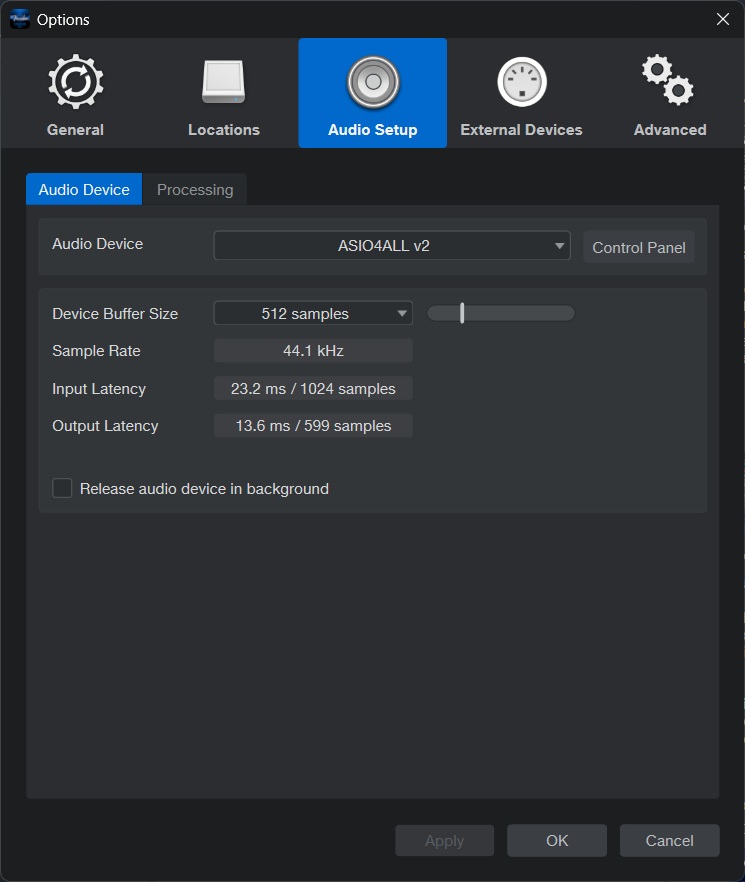
Fender Studio Pro Audio Setup menu
How to Create a Song in Fender Studio Pro
Not only will you configure your audio interface from the Studio Pro Start Page, but this is also where you’ll create and load songs. You can create a song from scratch, but Fender has also included project templates that include audio tracks, buses, effects, and more to help you get up and running.
If you own a Fender Studio or PreSonus audio interface or digital mixer, you can create a project that automatically routes all channels. If you’ve created a template, you can also load it from here.
- Click + New…, then choose the factory preset or user template.
- The factory templates have a short description, making it easy for you to choose what fits your needs the most.
- Update the Song Title, File Location, and Audio Settings.
- Click the > icon next to Settings to display additional project settings.
- Once the Song settings are set, click OK.
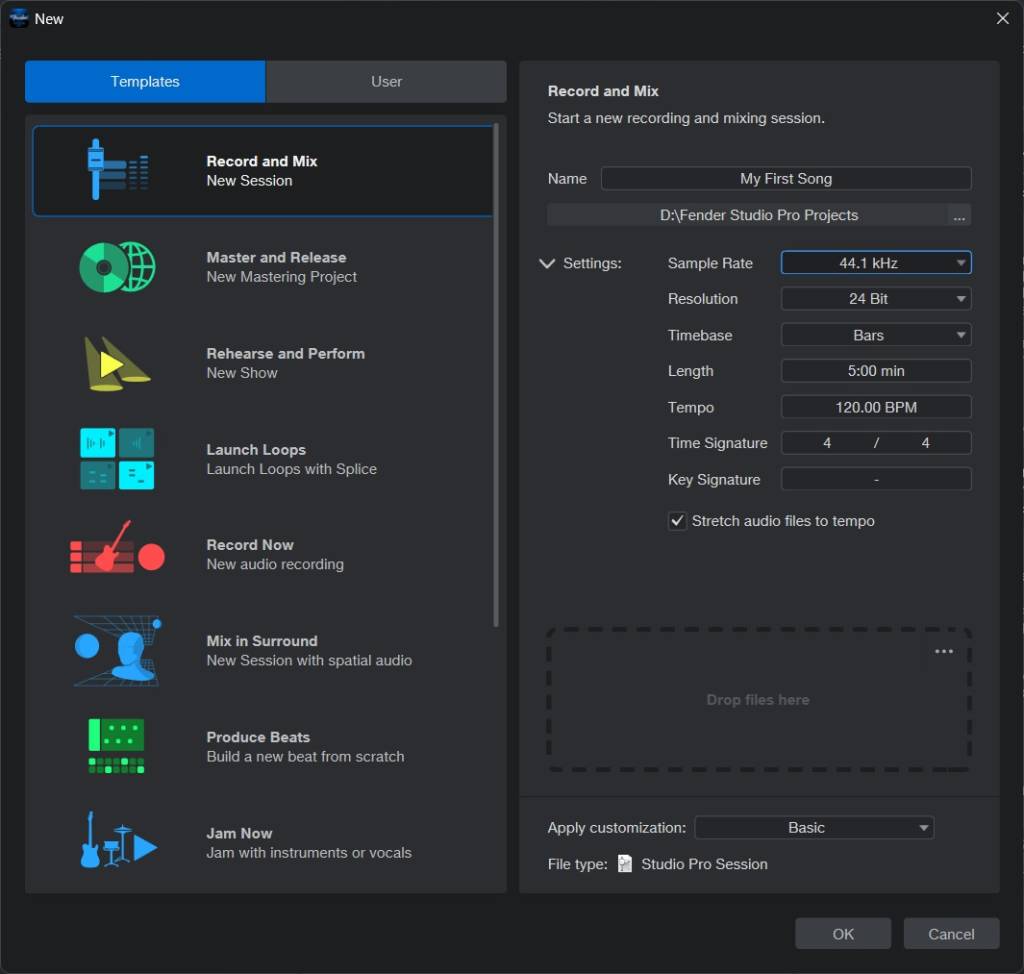
Fender Studio Pro Setup page
Update Audio Input and Output Routing
After a new song has been created, you’ll need to update the audio interface’s routing for the project, which means you’ll tell Studio Pro what input and outputs you’ll use for your project.
- Click Studio Pro from the top toolbar and click Options.
- Click Session Setup. This will take you to the Audio Input and Output page.
- Select the Audio I/O Setup tab, update your routing, then click the Make Default button in the lower left of the window and confirm the pop-up window.
- All new songs will now have this configuration for input and output mapping.
Need to update the routing in an existing song?
If you ever need to update the routing of an old song to match that of your new audio I/O configuration, you can also do so from the Song Setup menu.
- Open the project file you wish to change the routing.
- Click Session at the top taskbar and then click Session Setup.
- Click the Reset to Default button in the lower-left of the window and confirm the pop-up window.
Create and Record Audio Tracks
After you select your interface and the routing has been updated, it’s time to create an audio track. You simply need to create a stereo or mono track, update its settings, and start recording.
- Right-click the left side of the window and then choose Add Tracks…
- Alternatively, press T on your keyboard to open the Add Tracks menu.
- Update the track name, set the Type to Audio, and update the remaining settings, such as routing. Then, click OK.
- When the Auto-Color box is checked, it will automatically assign different colors to tracks you create.
- Use the FX Chain dropdown box to choose a factory preset FX chain for your track.
- Click the Record button on the track to record arm the track, then click the Record button on the transport panel to start recording. You can also use the * key on your keyboard to start and stop recording.
- To listen to yourself while recording, click the Speaker icon. This is known as input monitoring.
Inserting Audio Effects Plug-ins
If you want to add an audio effect plug-in to your audio track, click the Effects tab on the right-hand side of your project window. Locate the plug-in you wish to add, then click and drag it onto the track.
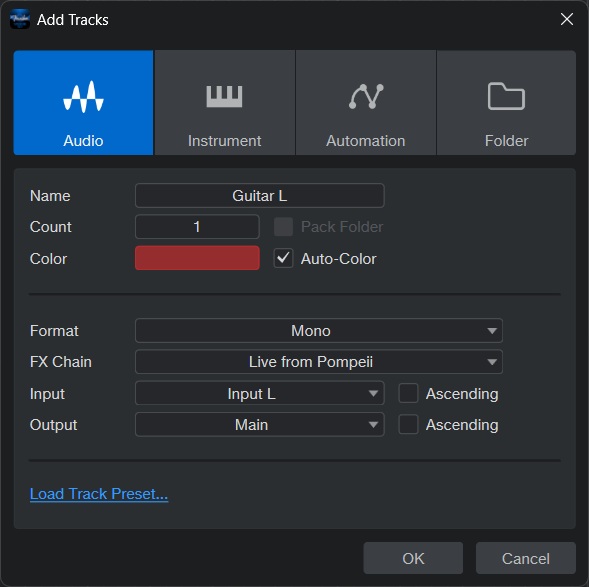
Fender Studio Pro audio track setup menu
Enable MIDI Devices
When you launch Fender Studio Pro, it will search for any connected MIDI device by default. You may need to update its settings, however. You can enable and update MIDI device settings within the External Devices menu.
- Navigate to Studio Pro in the top toolbar, then select Options.
- Click External Devices and then click Add.
- In the window that appears, click Add Keyboard or look for your MIDI controller in the vendor folder directly below. Lastly, change the Receive From and Send To from None to your MIDI controller by clicking the drop-down box.
- Press a key/pad on your MIDI device and look at the MIDI Monitor on the bottom left side of the screen to make sure that it’s triggering correctly.
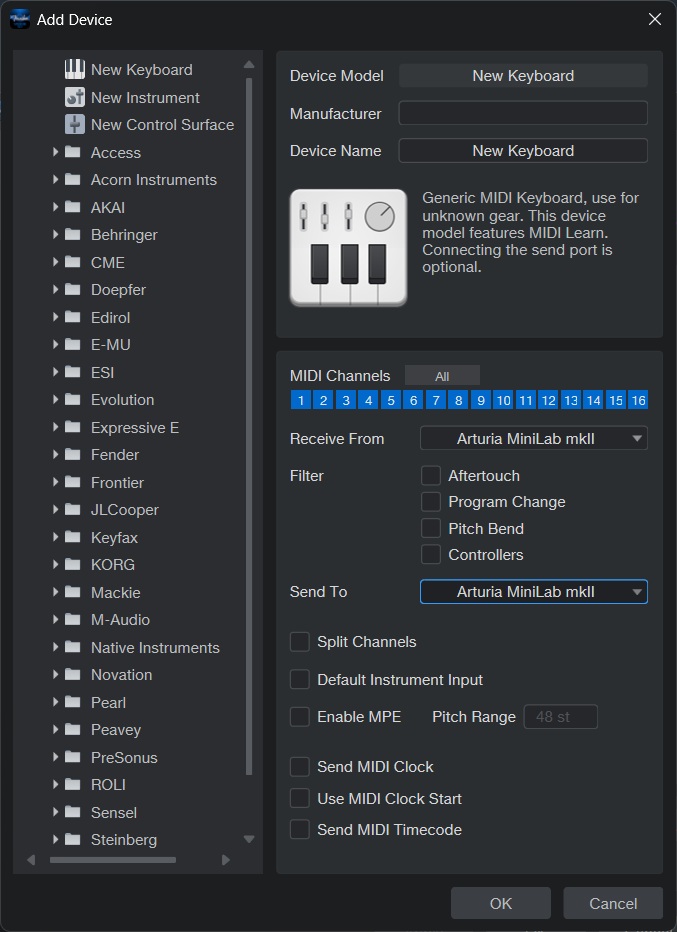
Fender Studio Pro MIDI Devices menu
Create and Record MIDI Tracks
To trigger virtual instruments or external synths in Fender Studio Pro, you need MIDI data. You can draw MIDI notes using the piano roll, as well as with your MIDI device. To record or draw MIDI data in Fender Studio Pro, you will create an Instrument track.
One great thing about Studio Pro is that both audio and MIDI data are on the same track, which means you don’t have to route it to an Aux bus or audio track. This means that you can convert the Instrument track to audio while preserving the MIDI data simultaneously. Because of this, you don’t need to create a new audio track each time you need to edit any of the MIDI data.
There are a few ways to create an Instrument track. Either by dragging a virtual instrument to the track section or by creating an empty one. Creating an empty instrument track is especially useful if you use external synthesizers.
Virtual Instrument
- Find your virtual instrument in the Browser section, then click and drag it to the track area.
- Press the Record button to arm the track, then press the Record button on the transport panel to begin recording. You can also press the * key on your keyboard to start and stop recording.
MIDI
- Navigate to Track on the upper toolbar, then click Add Instrument Track.
- If you want to add multiple Instrument tracks at once, press the T key on your keyboard, use the dropdown box, select Instrument, then update the number of Instrument tracks you want to add.
- Press the Record button to arm the track, then press the Record button on the transport panel to begin recording. You can also press the * key on your keyboard to start and stop recording.
How to Load Effects Plug-ins and Virtual Instruments in Fender Studio Pro
NOTE: Fender Studio Pro does not support 32-bit plug-ins. Make sure you have the 64-bit version installed, or else it will not load!
To apply an effect or instrument to a track, you need to insert it as a plug-in. Plug-ins come in many different file formats, and for Fender Studio Pro, you can use AU and VST3 plug-in formats. When you first install a plug-in, be sure to note the file location where it’s installed, as you will need to add this folder path to Studio Pro’s plug-in scan list.
- Navigate to Studio Pro in the top toolbar, click Options, then click the Locations button.
- Go to the VST Plug-Ins tab, click Add, then navigate to the folder where your plug-ins are installed. Once you’ve done that, click OK, then restart Fender Studio Pro.
- If you already have a song loaded, right-click anywhere in the Browser window and click refresh.
My plug-in isn’t showing up!
If you receive an error when launching Fender Studio Pro or if it’s not listed in the Effects or Instruments tab in the Browser window, here are a few things you can try.
- Click the Plug-In Manager button at the bottom of the Browser section to pull up the Project Manager window.
- Next, if the plug-in appears in the Blocklist (found in the VST Plug-ins menu), click Reset Blocklist. If it shows up in the plug-ins window, ensure it’s turned on, indicated by the white circle.
- Go to the VST Plug-Ins tab in Locations and verify that the plug-ins folder location is included in the Locations section of the window.
- Make sure that the correct format of the plug-in is installed. Studio Pro only accepts AU and 64-bit VST 3 plug-ins.
Fender Studio’s NEW Pro 8 DAW Overview
Fender Studio Pro – Creativity Amplified (Playlist)
Related Articles
When you need help, Sweetwater has the answers!
Our knowledge base contains over 28,000 expertly written tech articles that will give you answers and help you get the most out of your gear. Our pro musicians and gear experts update content daily to keep you informed and on your way. Best of all, it’s totally FREE, and it’s just another reason that you get more at Sweetwater.com.