
Behringer RD-9 Setup Guide
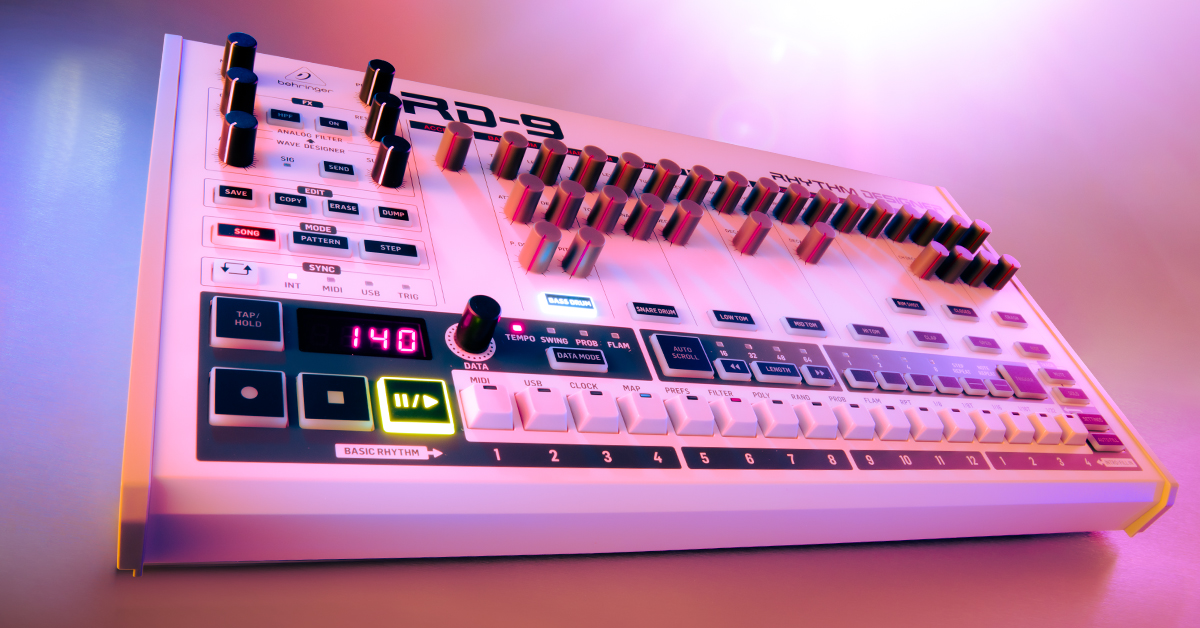
The Behringer RD-9 is a faithful clone of the RD-909 and is a great piece of gear to have in your studio and live rigs, so we will show you how to get up and running with the RD-9. You’ll learn how to register the device and about the different setup and connections to get sound out of it. Follow the sections below to get started.
IMPORTANT: You must register your Behringer RD-9 within the first 90 days of purchase to receive the three-year extended warranty.
Register the RD-9
Before we dive in, you will first need to register the RD-9 with Behringer. You will get a free three-year extended warranty when you register the device.
Follow the instructions in our SweetCare guide: How to Register your Behringer to Get the Full Warranty.
RD-9 setup and connections
The RD-9’s TRS audio outputs can easily connect to an audio interface or mixer, and you can transmit MIDI data over the USB connection or MIDI ports. This makes it easy to integrate with other hardware devices or record a MIDI performance. You can also synchronize other hardware synthesizers and sequencers with MIDI or external analog clocks.

Audio connections
There are three primary audio connections: Headphones (stereo), Mono (main), and Return. The Headphone output is stereo, while the Mono output is mono. The Return connector is an input and also mono and can be used to return an external signal back into the main output.
- The Return is an input that can be used to return an individual voice or voices that are processed externally like an external reverb, EQ, or compressor unit. This input sums with the Main output.
- All Voice outputs are unbalanced signals.
- Use the Trigger Out jacks to send +5V 2ms pulses to trigger output devices. Trigger 1 is Rimshot, Trigger 2 is Clap, and Trigger 3 is BD Assignable.
External hardware
You can incorporate the RD-9 with external synths and sequencers in a few ways. One is with the ⅛-inch (3.5mm) Clock IN and OUT jacks. Another way is with MIDI, which is helpful, especially when using a MIDI interface for DAW synchronization. Another method is via the three different ¼-inch Trigger OUTs.
Sync IN/OUT
IMPORTANT: Do not overload the ⅛-inch SYNC IN input. The input accepts a maximum incoming voltage of +15 V, and the SYNC OUT outputs should be connected to ⅛-inch inputs capable of receiving the +5 V output voltage. Overloading the RD-9 may result in damage to the unit and will require non-warranty repair.
The ⅛-inch Sync IN and OUT jacks send and receive PPQ (pulses per quarter), which is used for sequencing and automation. If you want the RD-9 to control external hardware via analog clock (using the RD-9 as the primary device), use a ⅛-inch cable and connect it from the Sync OUT of the RD-9 to the Sync IN of the external hardware.
On the other hand, if you want the external hardware to control the RD-9 (RD-9 as the secondary device), use a ⅛-inch cable and connect the external hardware’s Sync OUT to the RD-9’s Sync IN.
Changing the PPQ
There may be a time when the tempo, time, or pitch sound slightly off. This could be because the PPQ of the device you’ve connected doesn’t match that of the RD-9. By default, the RD-9’s PPQ is set to 24. To change it, you’ll need to go into the CLOCK Settings.
- Press the Settings button, then press the 3 step button to access the CLOCK settings.
- Press the TAP/HOLD button until you see Analog Clk Mode, then use the DATA knob to change the PPQ amount.
MIDI
Another great way to incorporate the Behringer RD-9 in your rig is through MIDI. MIDI will also send and receive note information similar to the SYNC I/O, which sends and receives the clock and stop/start samples.
By default, the RD-9 is set to MIDI Ch. 1. If the external hardware that’s connected is also set to MIDI Ch. 1, that will be triggered too. If you want the RD-9 to be on its own MIDI channel, you’ll need to go to the MIDI settings.
- Press the Settings button, then press the 1 step button to access the MIDI settings.
- Use the encoder knob to change the MIDI channel.
- Press the TAP/HOLD button once to change the MIDI OUT channel.
- Press the TAP/HOLD button twice to enable FORWARD to USB, which sends the MIDI output to the USB out.
- Press the TAP/HOLD button three times to turn on SOFT THRU. Turning this on will disable the MIDI OUT and turn it into a second THRU device.
- Press the TAP/HOLD button four times to set the Device ID. This is particularly useful when working with SysEx.
Computer
The Behringer RD-9 can also be connected to your computer using a USB cable. This allows you to record in your DAW and use the SYNTHTRIBE app to save and load presets and update your firmware. You can also send MIDI out from your computer to your RD-9. To update your MIDI settings, follow these steps.
- Press the Settings button, then press the 2 step button to access the USB settings.
- Use the encoder knob to select the USB MIDI channel (1-16, All, Out) for the incoming USB MIDI signal.
- Press the TAP/HOLD button once, then use the encoder knob to change the MIDI OUT channel.
- Press the TAP/HOLD button twice, then use the encoder knob to enable Forward to MIDI. This will send the MIDI output of the RD-9 to the USB OUT.
- A data loop may occur if using both a MIDI interface and audio interface at the same time.
My computer isn’t recognizing the RD-9!
If your RD-9 isn’t being recognized by a computer, try a different USB port and USB cable. If that doesn’t work, check out our article on resolving MIDI device issues in PC and Mac.
Related Articles
When you need help, Sweetwater has the answers!
Our knowledge base contains over 28,000 expertly written tech articles that will give you answers and help you get the most out of your gear. Our pro musicians and gear experts update content daily to keep you informed and on your way. Best of all, it’s totally FREE, and it’s just another reason that you get more at Sweetwater.com.