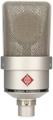
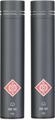
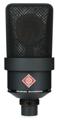
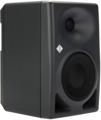
While there are many revered pro audio companies that have had a huge impact on the making of music, Neumann microphones probably should be at the very top of that list. Don’t believe me? Read on and I’ll make my case. This iconic brand has existed from the very beginning of the recording industry. Further, the silhouettes of their products are often the first thing anyone thinks of when the word microphone comes up.
While his work on audio products predates this, Georg Neumann founded his own company in 1928. Over 90 years of history casts a long shadow, and I bet that there are a host of things that might amaze you about Neumann. Among them will be the staggering number of things that Neumann created that we take for granted in audio today.
A German Legacy
I continue to be surprised by the number of people who don’t know that Sennheiser owns Neumann, and has for almost 30 years. After Georg died in 1976, the company continued on, but without Georg at the helm, Neumann had lost something in the development and direction of new products. Neumann’s family sold the company to Sennheiser in 1991. This began a new period of development in the combined manufacturing space in Wennebostel, Germany, just outside of Hanover.
Frenemies
While competition was an economic reality in post WWII Europe, the major players in the microphone business were hardly at each other’s throats. Professor Fritz Sennheiser would often come to compare notes with Neumann at trade shows. Eugen Beyer (founder of Beyerdynamic) was a quite close friend of Neumann. He helped Neumann find lodging for his family when they moved to Heilbronn and even supplied parts for Beyer’s power supplies.
Neumann’s Most Profitable Product
Neumann was a prototypical inventor who considered his role models to be people like Thomas Edison and Alexander Graham Bell. It should come as no surprise that Georg the tinkerer had interest in many disciplines in electronics, and when his son found a broken battery cell, he immediately began playing with it.
After that, he developed the manufacturing technique that would allow for completely sealed nicad batteries. This development would be revolutionary in the technological world for the entire electronics industry. Neumann used them to build Stabilyt cells, which put out a very precise 1.5 volts per cell to supply noise-free heating voltage for the tubes in his microphones.
Company Relations
The connections between Neumann, Telefunken, and Microtech Gefell can be a bit confusing. Telefunken was the US distributor for Neumann microphones, but they put their own logo on the U 47. Neumann allowed this because their agreement was that Neumann did not have to pay the licensing fees for the VF14 tube that they used in the microphone, so it was considered a good deal. When Telefunken decided to discontinue the tube, the relationship eventually crumbled.

The Telefunken version of the venerable U 47. Image courtesy of Neumann GmbH.
The connection with Gefell is more complicated. In 1943, firebombs destroyed the factory, and Neumann opted to move the remaining equipment and employees to the tiny village of Gefell in central Germany. When the company was refounded in Berlin, the Gefell factory continued to produce components for the West Berlin location until the construction of the Berlin Wall made this impossible. Since that point, there has been no connection between the companies.
Product Numbers, Names, Colors, and Badges
Early Neumann products were based on the year they were produced or created. The U 47 began development in 1947, and the M 49 and M 50 followed that format. The U 67 was originally named the U60 based on its creation in 1960, but someone decided that a connection to the iconic U 47 would help its position in the marketplace, so from unit 21 on it carried the U 67 moniker.
The K in the KM series microphones stands for the German kleine (small) to indicate the small diaphragm used in these microphones. Further, the final number in most microphones after 1964 would indicate the polar pattern, with 3 indicating omni, 4 for cardioid, and 5 for supercardioid.
In case you don’t know the meaning of the different colored badges, we clarified what those badge colors mean in our Neumann Microphones Buying Guide. Even the color of the dots on the microphones have meaning, such as the M 49 and the M 50 which were cosmetically identical except for the red or white dot.
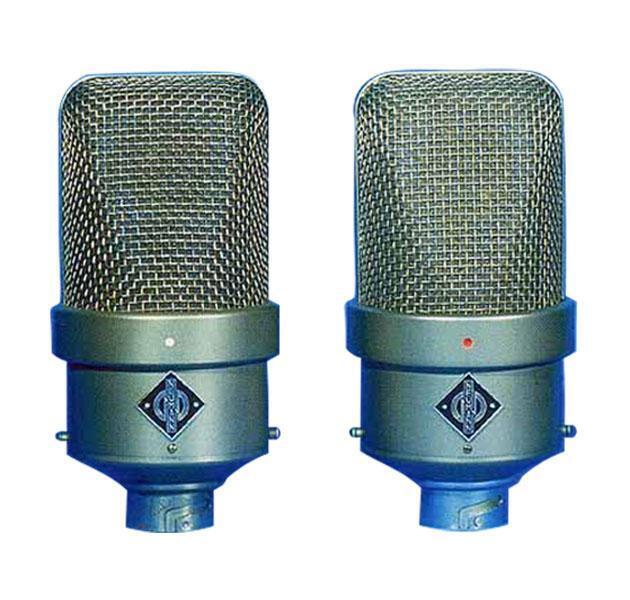
The M 50, on the left (without the red dot that characterizes the M 49), can only operate in omni. Neumann M 50 and M 49 image courtesy of Stan Coutant.
A Series of Firsts
The burgeoning radio and recording industries were calling for better input sources as their quality improved. The microphone that launched Neumann was the CMV 3, and it fit the bill perfectly. The industry was primarily centered around dynamic, moving-coil mics and carbon graphite–style mics on the telephone side of things.
Neumann hit on a method to use a lower-mass element (initially gold sputtered onto colloidan, later PVC), which was then suspended in a magnetic field. This lower-mass element allowed for greater detail and much higher frequency response than anything else available. The large, cylindrical body housed the power supply, electronics, and the tube.
The CMV 3 was the recording and broadcast standard from its introduction in 1928, and for nearly 20 years later, until Neumann released the new standard microphone after World War II.

The CMV 3’s 90-year-old silhouette is still emulated today by many manufacturers. Image courtesy of Neumann GmbH.
When the U 47 launched, it was the very first multi-pattern microphone, and it was followed two years later by the M 49, which was the first microphone to allow remote control of the pickup pattern. The capabilities were added by cleverly combining more than one element in these microphones and made them far more flexible in use.
The U 47 was discontinued when Telefunken would no longer supply the tube it used, but Neumann created the U 47 FET in 1969 to fill the role vacated by the tube version. This microphone has been used on vocals by A-ha, guitars by AC/DC, and hundreds of kick drum tracks. This shows its versatility.
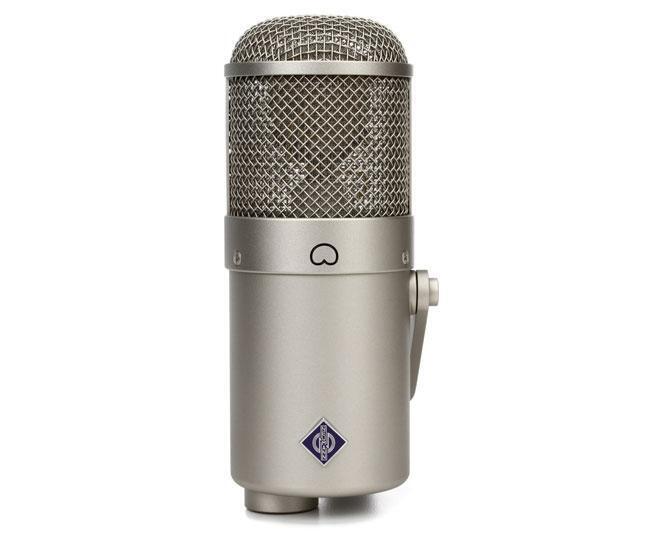
The new Neumann U 47 FET was recently reissued, sourced with original parts.
Another first was Neumann’s development of a stereo microphone, the SM 2, which was not matched by any manufacturer for over a decade.
Phantom Power and Placement
The burgeoning role of TV and movies through the 1950s drove the industry to call for smaller microphones that would be less visible on-screen. One of the biggest challenges was how to deal with the power supply necessary for condenser microphones.
Neumann engineers were actually responsible for development of phantom power, which allowed the console or mic pre to supply the power for the microphone. This standard was named because their design kept the voltage at the same potential as the audio signal, making it essentially invisible and noiseless from an induction standpoint — hence the “phantom” label. This standard won out over the competing AB standard, but you will still see Neumann microphones, like the KM 76 or KM 73, designed for that power standard. The 7 in the first position of the model number is a tip-off for the AB powering standard.
Thinking Differently
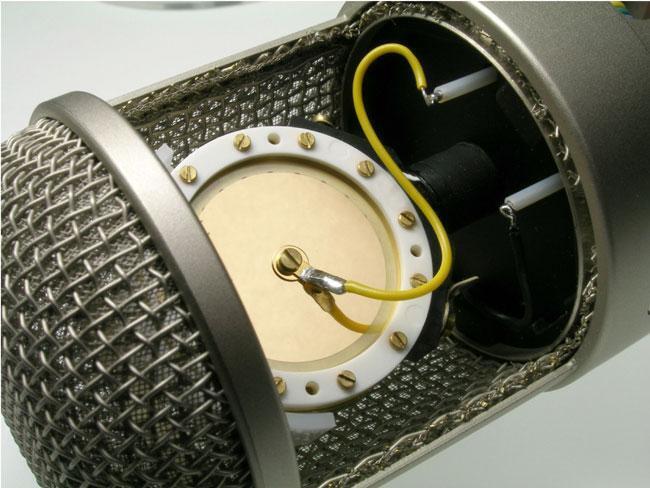
Neumann was never a company to shy away from trying something different. The M 50 (and later the M 150 and TLM 50) featured a very different approach to diaphragm design. The gold portion of the element was sputtered onto an acrylic sphere rather than the traditional coin shape. This approach locks these microphones into an omni pickup pattern, but it makes the high-frequency response rise more slowly than a traditional element. This gives the microphone a more natural sound, making it perfect for orchestral recording.
Even Neumann Couldn’t Make Quad Succeed
In 1972, Neumann modified the SM 69 stereo microphone by adding two additional elements and amplifiers to create the QM 69. This quadraphonic microphone was less than a stunning success. To quote Ernst Weiss, who worked at Neumann at the time, “Neumann has had very few flops over the years, but the quadraphonic microphone was certainly one of them.”

The odd QM 69 was soon replaced by a single-body version that looked closer to the SM 69. QM 69 image courtesy of Stan Coutant.
Wait — Neumann Made Consoles?
While it is fairly well known that Neumann made exceptional cutting lathes for record creation until 1993, they also made mixing consoles from the early 1960s until the same time period when they chose to focus instead on their core business of microphones.
They made a completely modular series of console cartridges in the N5000 series where you could completely design your own console. Also impressive is the fact that they actually built and installed the first digitally controlled analog console in 1984 at the Schiller Theater, predating the Trident Di-An by two years. The console was called the Premiere, and it featured significant recall and automation capabilities.
Bonus — Stereo Matching
We said 10, but I will leave with you with one last Neumann fact: Neumann does not stereo match their microphones for a fee as many other manufacturers will do. It is not that Neumann is not interested in that service; it is simply that Neumann is already manufacturing all their microphones to a tolerance of plus or minus 1dB, when most companies that are charging for these services are only matching them within plus or minus 3dB. Neumann simply can’t match them any tighter than they already are, so any two Neumann mics you buy can already be a stereo pair.
In closing, the most important thing is the number of microphones that Neumann has created in the past that are still in production today. Models like the venerable U 87 are still being made to the same rigorous specifications over 50 years later, and they are still highly prized.
There are many reasons that Neumann microphones cost more, but they are products that are necessary tools to make great music for decades. If you need some help picking the perfect Neumann for your studio, give your Sweetwater Sales Engineer a call at (800) 222-4700, and we can discuss all the amazing Neumann options.
Interested in knowing which Neumann microphone fits you? Check out this article: