Having the right tools can change most any job from a chore to a breeze, sometimes drastically cutting the time required and yielding better results. Here are a few studio tools I’ve discovered that allow you to achieve better results in less time.
 Quick-release Clips
Any studio or live engineer will tell you they spend what seems like hours a day just screwing mic clips onto stands or taking them back off. And when it comes to setting up or swapping out large studio condenser mics or elaborate shockmounts, it’s not only a nuisance but also potentially very costly if a mic falls. Enter the quick-release clip, such as the Ultimate Support QR-1 QuickRelease Adapter. Attach one end to the mic stand and the other to the mic clip or shockmount, and you can swap any mic onto any stand in one second flat. Just make sure you have one on every mic clip and every stand, and you’ll be hard pressed to imagine how you ever got by without them.
 Latch Lake Xtra Boom
Ever tried to fit two boom stands into a small space—such as when miking drums or putting two mics on an acoustic guitar? For situations like those, the Latch Lake Xtra Boom mic arm is a dream. With the ability to clamp on to the arm of any stand, your single boom mic stand can become a double-, triple-, or even quad-headed stand, enabling you to mic multiple toms or to multi-mic a snare or even guitar amps with a single stand and adequate base. For a singer/guitar player or any singer/instrumentalist, when stage or studio space is at a premium, these stand add-ons are a dream, in either 12″, 18″, or 24″ lengths.
 Triad-Orbit Micro 1 and Micro 2 Orbital Adapters
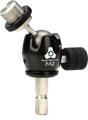
If you’ve ever tried to finagle a mic into just the right position in a tight spot, such as weaving it under the high-hat to get to the snare drum in a taut drum kit setup, you’ll appreciate the swiveling head and range of motion on the Micro 1 and Micro 2. With a joystick-like 180-degree range of motion, securing your mic in the perfect position has never been easier.
 sE Electronics guitaRF Amp/Mic Reflexion Filter
I use ribbon mics on lots of sources in the studio, from vocals to drums to guitar, upright bass, trombone, trumpet, B3, and more. Sometimes the room behind the mic is not an issue, but when it is a problem, there’s the guitaRF filter. I originally used a home-brew version of this, rigged with gaffer’s tape and a 12″ square of acoustic foam. I could put it behind the ribbon when cutting vocals to eliminate the bounce of the room coming in the back of the mic, but though it worked well, the tape would let go and positioning was always an issue. The guitaRF is an elegant solution to this problem, such as times when I use a Royer R-122 on the outside head of the kick and don’t want to hear the slap of the kick drum impact off the opposite studio wall. It’s the perfect solution.
Find out about more cool mic stand and accessory options in Sweetwater’s comprehensive Mic Stands and Accessories Buying Guide.