There’s an almost overwhelming selection of microphone stands and mic stand accessories on the market, and looking at the hundreds of options available at Sweetwater may leave you wondering where to start. That’s why we prepared this Mic Stand and Accessories Buying Guide. In it, we’ll cover different types of microphone stands and many important qualities you’ll want to look for when searching for the perfect stand. If you have specific questions, please don’t hesitate to call your Sweetwater Sales Engineer.
Standard Microphone Stands

You’ll find several basic types of microphone stands onstage and in the studio, but the most common type is the standard straight microphone stand – ideal for vocalists and a wide range of other applications. It may be tempting to go with a budget model, but depending on your needs, investing in a quality mic stand now will likely be better in the long run. Here are a few things you’ll want to look for.
Height Range

Virtually all microphone stands allow you to adjust their height, but the range varies considerably. In addition to a standard range (approximately 35″-65″), some stands are designed to go much higher and lower. A mic stand that is low enough to hold a mic in front of a kick drum (8″-12″) won’t get tall enough for drum overheard microphones. And in a tall room or auditorium, you may need a mic stand to extend to 10′ or more for choir or organ recordings.
Clutches

The other important consideration is the clutch, which is the mechanism that locks the stand’s height into place. There are two basic types of clutches on mic stands, twist and grip, with twist being far more popular. A cheap twist clutch takes several turns to tighten and still may not hold tight; whereas higher-end twist clutches, such as Ultimate Support’s quarter-turn clutch, lock tight with minimal motion for quick adjustments. Grip clutches, on the other hand, only require a one-handed squeeze to adjust them, which is a major bonus for live performance.
 One other type of clutch you’ll find on booms (including some studio booms) is a tension screw, which either tightens a collar or presses into the inner tubing to keep it from sliding. These vary greatly in quality and typically only appear where you rarely need to make adjustments. Most booms also use a kind of disc clutch at the base to allow you to adjust the angle.
Pro Tip: Any time you make an adjustment on your mic stand or boom, loosen the clutch enough to allow it to move freely before changing the position. This will not only make precision mic positioning easier, it will extend the life of your mic stand dramatically.
Base Options

Standard microphone stands come with one of two base designs: flat and tripod. Flat bases are usually made of cast steel and designed to be heavy enough to keep the stand from easily tipping over. These can be round or triangular in shape. With their smaller footprint and heavier weight, they’re not as portable as tripod bases but are equally stable from all angles. Tripods usually have a wider footprint and are potentially more stable than flat bases. Many mini mic stands intended for desktop use or for miking bass drums and guitar cabinets feature small flat bases to let them get into extra-tight spaces.
Tripod bases come in a range of sizes, and many engineers prefer them because they’re lighter and can fold down smaller than flat-base stands. As long as you keep the weight of the microphone over a leg, rather than between two legs, tripod bases are extremely stable, and when spaced correctly, you can place two tripod-base stands fairly close together.
Portability and Weight
There are many contributing factors to the weight and general portability of microphone stands. On that note, a heavier stand doesn’t necessarily mean it’s less portable — there are plenty of lightweight mic stands you’d never want to take on tour, both because they aren’t stable enough for live use and because they wouldn’t hold up to wear and tear. Features such as thicker, more stable tubing, heavy-duty clutches, or the kind of solid tripod legs featured in Triad-Orbit stands increase the weight of a microphone stand, without impacting its portability.
Specialty Microphone Stands
Studio Booms

Studio booms are designed to reach above sources such as drum kits, choirs, and orchestral performers. It’s not uncommon for these ultra-heavy-duty mic stands to reach over 6′ without the boom, which makes overhead positioning easy. A couple of features to look for in a studio boom include an adjustable counterweight to counterbalance heavy microphones and a wheeled base to make moving them around easier.
Broadcast Booms

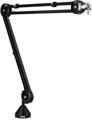
Ideal for broadcast talent or podcasters, broadcast booms use a robust version of the kind of scissor mechanism found in some desk lamps to allow you to instantly reposition your microphone. This is ideal if you need to manage sound effects or move around your desk while on the mic. Most broadcast booms clamp to your desktop and feature some internal shock dispersion to prevent vibration on the desk from traveling up the boom into your mic. They also normally include cable management.
Mic Stand Accessories
There are countless types of microphone stand accessories on the market, from boom arms that let you extend your reach to counterweights that keep your stands from tipping over. You can explore them all here at Sweetwater, but there are a handful of mic stand accessories everyone should know about. Here are some of our favorites.
Mic Stand Boom Arms
 Ideal for broadcast talent or podcasters, broadcast booms use a robust version of the kind of scissor mechanism found in some desk lamps to allow you to instantly reposition your microphone. This is ideal if you need to manage sound effects or move around your desk while on the mic. Most broadcast booms clamp to your desktop and feature some internal shock dispersion to prevent vibration on the desk from traveling up the boom into your mic. They also normally include cable management.
Pro Tip: Just as with microphone stands in general, you’ll get what you pay for from your boom. Cheap booms are notoriously hard to position and wear out quickly, leaving you with a boom that’s prone to sag; whereas quality booms deliver added stability, allowing you to achieve better positioning without worrying about drooping microphones.
Mic Pop Filters
 If you’re going to record vocals, there’s simply no excuse to skip the pop filter. A good pop filter will save your recordings from unfixable plosives while preventing your talent from choking up on the mic and incurring horrendous proximity effect. Pop filters range from simple stretched nylon to foam covers to expanded metal construction, and while the metal version generally does a better job, even a budget nylon model is a vast improvement over no pop filter at all.
Stereo Mic Bars

Stereo bars let you position two or more microphones on a single mic stand in a variety of ways. Some are simple and intended only for XY positioning and similar configurations, and others include precision measurement tools that let you position microphones at specific distances and angles. Other similar tools are also available, including an assembly that lets you easily set up a Decca Tree configuration.
Quick-release Mic Stand Adapters
 If you need to switch out microphones regularly, then a set of quick-release adapters is invaluable. These 2-part adapters screw onto the standard 5/8″ threading at the end of your mic stand or boom and allow you to pop on and off your mic clips in seconds. With enough compatible quick-release adapters in your rig, swapping out mics becomes so easy you’ll find yourself trying out more microphones than before, which can lead to a serious improvement in your sound.
Microphone Goosenecks

An often overlooked microphone stand accessory, goosenecks let you easily fine-tune the positioning of lightweight microphones. They also allow you to place microphones in tight spaces that are difficult to reach with a stand or a boom directly. Goosenecks are particularly handy when you want to mic instruments such as drums and acoustic guitar, since they allow you to quickly reposition your microphone without fiddling with the stand. They come in various lengths, and a good gooseneck can easily handle the weight of an average handheld microphone.
Portable Vocal Booths
 If you’re recording in a makeshift studio, then a portable vocal booth can be one of the best investments you make in your sound. These ingenious devices attach to your microphone stand and position a dense absorptive foam barrier just past your microphone to catch sound before it can reflect in your room. The result is a measure of acoustic treatment that can make the difference between an amateur or polished vocal sound.
Mic Stand Attachments
 If you can conceivably attach it to a mic stand, then there’s a mic stand attachment for it. Music stands, tablet and phone holders, cupholders, headphone hangers — you name it, it’s been done. Some of these attachments are real lifesavers, and being able to provide your talent with lyric sheets, chord charts, or other comforts is always a plus.
Mic Stand Carry Bags
 As simple as mic stands are, it’s still a pain to try to carry more than a couple of them at a time by hand. If you’re putting together a mobile live sound rig, then you probably want to invest in a mic stand bag or two. Not only does a carry bag make it easier to transport your microphone stands, but it also protects them in transit.
We hope you’ve enjoyed this overview of microphone stands and stand accessories, and that you’ve found it informative. If you have any additional questions about microphone stands and stand accessories, please contact your Sweetwater Sales Engineer at (800) 222-4700.