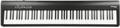
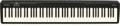
When I received the email saying “The Roland VA 76 is ready for you”, I couldn’t wait for my shift to end so that I could start to play. My first impression upon seeing it in the warehouse was that this is a substantial keyboard, leaving me wondering how I was going to get it home. After borrowing a dolly and folding down the backseat of my Saturn, it slid in nicely. I had to employ the wife to help on the other end, but finally it was on the keyboard stand usually occupied by my Roland JX-8P, which has faithfully served me for nearly 20 years. Now the fun begins…
Instant Gratification
As expected, hook up was a snap with no surprises. I’m a guy who expects instant gratification, so I tossed aside the manual and went straight to the demo page. Here I found a smattering of the 3,649 tones (patches) and 116 drum kits. For me, the true test of a keyboard is the piano sound, and the VA 76 passes this test with flying colors. It could’ve been the musicality of the demo (obviously performed by a keyboard player much better than I), but the piano tone is wonderful. Being a trumpet player, brass patches are another key element for me where (in my opinion) most keyboards leave me wanting. The trumpets in the demo page, however, are really something – very realistic throughout the range, even a little shake that would make a jazz trumpeter proud. Many patches have nuances like this, and Roland identifies them by putting a “V” (for virtual) next to the tone name. Things like finger noise across the guitar fret board add a sense of realism found only in the best sample libraries.
Music Made Easy
My next stop was the music styles demo. I listened to a couple, then got out of the demo page to try it myself, because what I heard blew me away! The Easy Routing/Virtual Band function made it simple to configure the keyboard for a music style, thickness of orchestration and lead instrument through a series of questions posed by the keyboard itself. A single note in the left hand produces a vamping accompaniment in a major key, with the note being the root of the key. Minor chords require the minor third as well as the root. You give the keyboard a minimum amount of information and it does the rest. For example, playing a Bb and a C produces a C7 chord, while a B and a C produces a Cmaj7 chord. Finally, I popped open the manual to discover a very complete chart illustrating how to make any chord using this minimalistic formula. The purpose of the intro, original, fill, variation, ending and stop/start buttons also became obvious. I decided to try this thing out with a tune I had written a few years ago, originally as a jazz ballad Now, I easily transformed it into at least 50 styles including dixieland, hip hop, funk, big band, salsa … you name it! The original jazz ballad style in 3/4 time remained my preference, but it was fun to hear it in all those different styles. Not having to worry about all of the notes in the left hand made it easy to play the melody in the right hand, and I’m not even a keyboard player! This keyboard will even harmonize your melody! If the 128 onboard styles aren’t enough, the supplied Zip Disk gives you hundreds more, and you can design your own. The Orchestrator function allows you to mix, match and morph elements from different styles, so the possibilities are endless.
If all this isn’t enough, the VA 76 also employs Roland’s legendary Variphrase Sampler technology which gives you realistic vocal performances, allowing vocal chords and repitching melodies in real time. Of course you could sample more than just vocals. It comes with 48 presets divided into melodic, rhythmic and background vocal categories, with user space for 16 more. This was my first experience with Variphrase technology, and I found it quite impressive. A single sample can be played over a wide range with very little addition of weirdness or the artifacts that you might expect, and the speed of the sample doesn’t change unless you want it to! I particularly liked that you could change the pitch in mid phrase without having it start over as it would on a traditional sampler (this was also the favorite feature of my kids). I would step away from the keyboard only to hear a pattern kick in followed by “Honey, I need you” (one of the vocal presets) played in very interesting melodic and harmonic ways. Not bad for a 7- and 3-year-old!
More Features Than You Could Shake A Stick At!
The supplied Zip disk also includes a huge number of songs in standard MIDI file format. Control over the tracks and the mix make it simple to set up a music minus one’ so you can play along. A lyrics function lets you import and display lyrics alongside your SMF. A 2-track sequencer makes it easy to lay down your ideas, while a more complete 16-track sequencer helps to tweak and finalize. A programmable D-Beam controller and touch strip make for some interesting possibilities, and the touch screen allows easy navigation. The Super Tones buttons let you recall your favorite patches quickly, and a variety of footswitch possibilities let you work the way you want. Let’s just say it has too many features to cover completely here.
In Conclusion…
The VA 76 is a powerful keyboard, workstation and songwriter’s tool that would fit right into any studio. If you’re a songwriter or composer, check out the Roland VA 76 V-Arranger Keyboard-you won’t be disappointed and “writer’s block” will be a thing of the past!