The lead singer is at the top of the pyramid when it comes to live sound. The foundation is the bass and drums, with the other instruments providing support, but the pinnacle — the spotlight — is always the lead singer. How can you make sure the singer sounds their best and stays right on top of the mix? We reached out to a handful of our smart friends who are FOH professionals and Sweetwater customers and asked for their advice. “What are your favorite techniques for getting a great live vocal sound?” We got some very insightful answers that we’re delighted to share with you.
Find the Right Mic

Eddie Mapp
Paramore, Stone Temple Pilots, Papa Roach, Evanescence
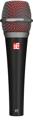
For tight dynamic vocal mics, the sE V7 or Telefunken M80 are great choices, and for an incredible-sounding handheld condenser, the Audio-Technica AE5400 is amazing!
Brad Divens
Enrique Iglesias, Kanye West, Mötley Crüe, Bob Seger, OneRepublic, Linkin Park
Picking the right vocal microphone is the most crucial part of getting a great lead vocal sound. Keep it simple when it comes to EQ and compression. Don’t get caught up in the plug-in world. Also tuning the PA is very important. I know that when the VTX A12 or VTX 25-II are firing correctly, the lead vocal will shine in the mix!
Peter Keppler
David Bowie, Nine Inch Nails, Bonnie Raitt, Katy Perry, Nicki Minaj
The first thing is matching a good mic to the vocalist, and that involves a lot: how the singer likes to approach the mic. Do they like to “eat” it? Do they sometimes sing off to the side of it? What’s going on behind that vocalist as far as stage volume? In the case of an artist with an endorsement deal, this has often meant working with the manufacturer to find the best-sounding model for the singer.
After that, I will usually use as little as I can in the channel path. I usually insert a dynamic EQ first to do some of the dirty work, which allows me to use much more gentle compression and EQ on the channel itself. Then there are vocal effects, but that really changes depending on the artist and the type of music and could fill a whole chapter… BORING. I have at times used an analog vocal chain for a certain singer — a high-quality mic-pre/EQ/compressor combo. It can make a significant difference but is also costly.
Russ Long
Amy Grant, Steven Curtis Chapman, Michael McDonald
There’s no perfect vocal mic. A mic that works amazingly well for one vocalist may be a disaster for another, so it is important that you audition several mics before making a final selection.
Rick Naqvi
PreSonus Electronics
The sound starts with the voice and the microphone. Listen to many different microphones and pick the one that works best for the vocalist’s voice totally flat with no EQ or processing.
Doug Gould
WorshipMD.com
Get the right microphone in the right place. Use the right pattern to avoid other sound sources from getting into the microphone.
Use Dynamic EQ or Multiband Compression
Scott Cameron
Greta Van Fleet, Jason Bonham, The Black Angels, Taking Back Sunday
Besides finding the best type of mic for my singer, I would say dynamic EQ, without a doubt. Something I have been using for a long time now is the BSS 901 — most digital consoles today have something similar or a plug-in built in. Having some sort of dynamic EQ like the BSS 901 on my lead vocal is something I can absolutely not live without.
Jeff Sandstrom
Chris Tomlin, Steven Curtis Chapman, North Point Community Church
Start with a good singer. Talk to them about proper mic technique. Try multiband compression or dynamic EQ, if you have it, to tame problem frequencies at louder volumes. Compression is always your friend.
Talk to the Singer About Their Mic Technique

Lynn Fuston
Sweetwater Manager of Written Content, Twila Paris, Pine Hills City Church
If you have a singer with bad mic technique, you have to address it at the source. If they pull the mic away when they get loud and their voice goes away, there’s nothing you can do to fix that at the console. If they hold the mic too far away or at the wrong angle, you’re stuck trying to fix problems instead of enhancing their sound. Approaching the singer with a constructive tone, instead of “You’re doing it wrong,” is usually welcomed. I typically try a statement like this: “You know what would allow me to make you sound even better?” Do that face-to-face privately with the singer — not shouted during rehearsal from FOH. Sometimes psychology is just as important as technology.
Switch in the Highpass
Steve Wilson
The Kentucky Headhunters
Even though I always drive the subs (<80Hz) from an aux, I keep an eye on the 180Hz–400Hz range for the vocal. Too much here eats up headroom and really masks the useful part of the frequency range. I use the LA-2A plug-in included in the Midas M32/Behringer X32 mixers to reign in the dynamic range. I’ll add just a faint hint of 120ms delay with the lows and highs rolled off and a plate reverb setting of 0.5-second decay, 90ms pre-delay, and the lows and highs rolled off.
Shawn Dealey
Counting Crows, Production Manager/FOH Audio at The Clyde Theatre
Highpass! No need for mud in the vocal. I have no issue going up to 125Hz–150Hz with a highpass filter to get a clear-sounding vocal that sits on top of a mix.
Ring Out the Mic
Kent Morris
Peavey, First Baptist Church Atlanta
Boost the mids and sweep them until the sound takes off in ringing, and then reduce that frequency to around -6dB.
Have the Right Processing Gear

Brian Pomp
Macklemore, Macy Gray, Avenged Sevenfold
Rupert Neve Primary Source Enhancer. I won’t do a gig without it now. Empirical Labs DerrEsser is the best de-essing piece I’ve ever used and also goes with me everywhere. And Inward Connections Brute Limiter sounds incredible and transparent for live vocals. Doesn’t overdo it at all and holds the vocal together really well while allowing the dynamic nature of the vocal to remain. Great control.
Compression Is Always Your Friend
Josh Fisher
Jesus Culture
Control, control, control. The voice is very dynamic, meaning it can hit -30 on your meters then immediately jump up to redline without warning. I try to get a little more consistency without sucking the life out of it. I start with a limiter, fast attack and release. I want to catch those moments where the singer “takes my head off” and, in turn, help them stay in the mix. I only need a little bit of limiting gain reduction. Then I go to a soft knee 2:1 slower compressor, 100mS attack, 200mS release, trying to get the vocal to sit in its spot without having to ride the fader as much. But I’m ALWAYS riding the fader. Then I’ll do some heavy de-essing to finish my control section. Next, I’ll go to the EQ. I try not to pull out the lows or low mids, but instead, add highs and high-mids to clear up the vocal and still keep all the tone and body that was originally there. I’m gonna add a wide Q (0.7) at 2K–3K and another at 10K–12K or 16K depending on my mood and the PA.

Lynn Fuston
Sweetwater Manager of Written Content, Twila Paris, Pine Hills City Church
One trick I use for making the vocal sit solidly in the center of the mix is using dual compressors. On the first, I’ll set a compression ratio of 2:1 (or lower) and turn the threshold WAY down so that the vocal is in the compressor ALL THE TIME, but only slightly. The dbx 560A works very well for this. Even on the soft parts, the compressor may be pulling 0.5dB to 1dB, and on the loudest parts just pulling 3dB–4dB. This way it’s almost acting like an expander and keeping the soft parts louder — just containing the overall dynamic range. I add a peak limiter like the Universal Audio 1176LN next in the chain to catch the super-loud parts. With two compressors, each working on a unique part of the dynamic range with different parameters, you can get a vocal to really sit in the pocket. This trick works on records too!
We hope you learned some tricks that you’re eager to try out on your next gig. And if you need any help with finding the gear to perfect your vocal sound, call your Sweetwater Sales Engineer at (800) 222-4700.