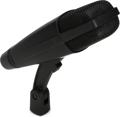
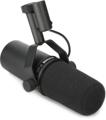
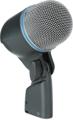
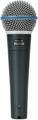
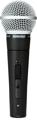
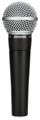
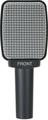
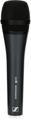
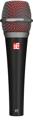
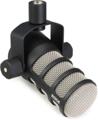
There are two major categories of microphones: dynamic mics and condenser mics. Whereas condenser microphones feature charged capsules that operate on the electrostatic principle, dynamic mics function via passive electrodynamic transducers.
The way dynamic microphones work is fairly simple. Inside the microphone capsule, a magnet creates a magnetic field that surrounds a small, movable induction coil that’s attached to a diaphragm. When sound waves enter the microphone, they push and pull on the diaphragm, which causes the coil to move, creating a voltage induced by the magnetic field. The resulting voltage is then increased by the use of a transformer and leaves the microphone as mic-level signal.
The Benefits of Dynamic Microphones
Even in the modern era of super-precise condensers and specialty mics of all kinds, dynamic microphones have a lot going for them. For one thing, their lack of active circuitry and relatively simple designs tend to make dynamic microphones inexpensive to produce. At the same time, this circuitry is far more robust than other kinds of transducers, and some dynamic mics, such as Shure’s SM57, are legendary for being virtually impervious to abuse.
Sonically, the focused quality of dynamic microphones like the Sennheiser 441 makes them more forgiving than condensers, which alternately pick up everything you can hear and more. While a condenser mic will pick up the low-frequency rumble of a truck driving down the road a block away, a dynamic mic is less sensitive to sounds that are farther than a few feet away, providing you with natural isolation that can save you from less-than-ideal acoustics.
Why Use a Dynamic Microphone?
There are many great uses for dynamic microphones, but here are a few of the most common examples. First, dynamic microphones are great for certain kinds of vocals, particularly those with more robust lower-midrange character. That’s one of the reasons mics like the E-V RE20 are so popular in broadcast studios, where their natural isolation ensures that incidental noises, such as creaking chairs or keyboard clicks, don’t make it into the audio.
This same isolation is also a real lifesaver onstage. Likewise, the focused sound of dynamic microphones makes them ideal for cutting out room reflections. One of the applications many engineers use dynamics for is acoustic guitar, where the mic will pick up the sound of the instrument, but not the guitarist’s fingers sliding across the strings. Finally, dynamic microphones tend to handle high sound pressure levels better than condensers, so they’re a natural choice for cranked guitar cabinets, snare drums, and other extremely loud sources.
Types of Dynamic Mics
There are two main types of dynamic microphones: moving-coil mics and ribbon mics, though some people don’t realize that ribbons are a subset of dynamic mics. Moving-coil dynamic microphones can be divided into small- and large-diaphragm types, and while far less distinction is made between diaphragm sizes in regard to dynamic mics as compared with condenser mics, the sonic impact is profound. Typically, the larger the diaphragm, the lower the target frequency, and large-diaphragm dynamic mics, such as the Sennheiser MD 421 II and the AKG D112 MKII, are ideal for toms, bass, kick drum, and deep male vocals. The DW Moon Mic is an extreme example of this, where the microphone diaphragm is based on a speaker cone, and the target frequency is the very low boom of bass drums. Most other dynamic microphones, such as the Audix i5 and the Blue Microphones enCORE 100, fall easily into the realm of small-diaphragm models and are generally appropriate for a wide range of applications.
Whether you’re tracking or running sound reinforcement, you’ll want to make sure you have plenty of dynamic mics to go around. If you’re not sure where to start, give your Sweetwater Sales Engineer a call, and we’ll be happy to help you find the right microphones for your needs.