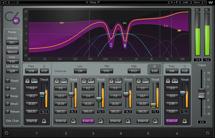
Multiband compressors, such as the Waves C6, are some of the least understood dynamics processors, and yet depending on your program material, they can be the most helpful, especially when compressing full mixes and wide frequency instruments. You may find they have a learning curve, but the results are often worth it.
Compressors are relatively straightforward: you run a signal through, and whenever the signal reaches a pre-set threshold, the signal is compressed by an amount determined by the compression ratio. However, imagine a situation in which the low-end energy of the bass frequencies is high enough to trigger the compressor, but you don’t want to compress the mid- and high-frequencies. Or a situation in which you want to compress the low end and the midrange frequencies using different ratios.
This is exactly what multiband compressors can do. They offer multiple compressors, each independent from each other, that only operate on a single frequency band. This way, you can compress one frequency band without affecting the others, you can compress multiple frequencies with different ratios, and so on. When you’re dealing with complex program material, taking the time to learn how to use a multi-band compressor might be just what you need.
Photo Gallery