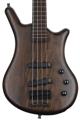
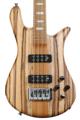
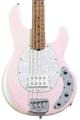
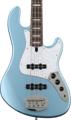
We aren’t afraid to say it: bassists are a big deal here at Sweetwater! Whether you’re a seasoned veteran or a newbie pondering a career in the low-end legion, this list has got you covered. We’ve gathered some of this year’s best bass guitars to inspire and invigorate you. There are time-tested and remixed models from classic brands — like bold innovations from Warwick and Ibanez, evergreen selections from Sire, Reverend, and much more! Regarding specifics, we dive into the core advantages that make each bass unique. If terms like “string-through” or “scale length” happen to throw you for a loop, then scroll down the page to where we’ve linked tons of our easy-to-read articles that define these terms.
How did we select the basses for this list? We used a combination of customer feedback and the expert opinions of Sweetwater bass players. We also picked bass guitars that cover a range of styles and sounds.
This list gives players options for incredible basses, no matter their budget. And, as always, if you find something on this list that has nearly everything you’re looking for but is missing a feature or two, then call your Sweetwater Sales Engineer for a personalized recommendation. If it doesn’t exist, then we can make it happen. Want to learn how to buy the best bass guitar for you? Check out our Bass Guitar Buying Advice below!
Note: At Sweetwater, we know there’s no such thing as “best” when it comes to music gear. Every player and artist has unique tastes, which is what makes selecting gear so fun! The items on this list feature some of our favorite products from top manufacturers to help you start your buying journey! Explore these recommendations and dive into Sweetwater’s massive collection of gear on our online store. For personalized picks and expert advice, please contact our knowledgeable Sweetwater Sales Engineers at (800) 222-4700!
- Ibanez Standard EHB1005F Fretless 5-string Bass Guitar
- Reverend Thundergun Bass Guitar
- Yamaha BB434 Bass Guitar
- Squier Paranormal Rascal Bass HH
- Spector Euro 4 RST Bass Guitar
- Schecter Reaper-5 Bass Guitar
- Sterling by Music Man Sterling Bass Guitar
- Fender American Professional II Precision Bass
- Ibanez Bass Workshop SRC6MS 6-string Multi-scale Bass Guitar
- Warwick Pro Series Thumb BO 4-string Bass
- Lakland Skyline Darryl Jones DJ-4 Bass Guitar
- Fender Player II Modified Active Jazz Bass Guitar
- Reverend Mike Watt Wattplower MKII Bass
- Spector Icon NS-5 5-string Bass
- Ernie Ball Music Man StingRay Special Bass Guitar
- Epiphone Thunderbird ’64 Bass Guitar
- Sire Marcus Miller U5 Alder 4-string Bass Guitar
- Sadowsky MetroExpress 21-fret Hybrid PJ 5-string Bass Guitar
Ibanez Standard EHB1005F Fretless 5-string Bass Guitar
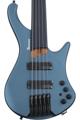
The Ibanez Standard EHB1005F Fretless 5-string bass guitar brings prolific Ibanez Bass Workshop perks to the fretless realm. A perfectly balanced, slim-carved American basswood body delivers a solid 5-string rumble with a next-generation feel. A lightweight headless design is balanced perfectly for long gigs and studio play. Likewise, the neck boasts 5-piece construction made from walnut and roasted maple for lasting stability and perfect tone, even when traveling to gigs skipping from climate to climate. Speaking of tone, dual active, high-articulation Bartolini humbucker pickups provide massive tonal range with focused lows, rich highs, and exceptional clarity for melodies and fills — the world is your oyster! Moreover, the bass’s 3-band EQ features Ibanez’s powerful Vari-mid tool for shaping midrange terrain with scoops, bumps, and everything else. The sky might be the limit with the EHB1005F Fretless, but the price of this bass is certainly down to earth!
Reverend Thundergun Bass Guitar
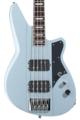
From headstock to bridge, the Reverend Thundergun bass boasts stunning features and premium electronics for a thick old-school tone with modern bells and whistles. Its proprietary 100% korina body delivers lively low end and harmonic range with big sustain, enhanced by the raised mid-section and contoured wings for perfect playability. Two custom Reverend humbucker pickups—a Thick Brick in the bridge and a Split Brick in the neck—produce a warm and rounded tone, adjustable via the onboard pickup pan knob. Hipshot Ultralight tuners made from aircraft-grade aluminum provide balance in bodyweight and sound.
Yamaha BB434 Bass Guitar
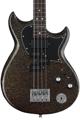
That eagle eye for budget buys should find pure gold with the Yamaha BB434 bass guitar. This bass sets lofty budget-friendly standards with a spread of versatile P/J pickups and a thin, gig-worthy build. The BB434 takes cues from California classics — an alder body and rosewood fingerboard deliver a punchy sound and familiar fretwork. However, with offset optimization that’s easy to love, the body’s distinct cutaway features surpass the playability of countless California cousins. The same is true of the BB434’s VS-series single-coil pickups — a vintage-voiced P/J set powered by Alnico V magnets for tight tone. The finishing touch is the BB434’s multipiece mahogany and maple neck. This neck profile is even thinner than the BB-series standard neck carve for stellar speeds; however, its multipiece construction keeps your setup intact, even when traveling from gig to gig across challenging climates!
Squier Paranormal Rascal Bass HH
A mash-up? A rehash? This unidentified low-frequency object is the Squier’s latest Paranormal must-have for thrill seekers and collectors! The Squier Paranormal Rascal Bass HH remixes aspects of beloved Fender basses; there’s a Mustang-inspired short-scale fingerboard, a poplar body with comfortable curves that nods to the Fender Bass VI, and there are also features beamed in from foreign realms, such as dual Wide Range humbucking pickups, which are an extreme rarity on bass guitars made by Squier. And although the Rascal lends itself to poetic description, it’s a fun bass to play. Short-scale features keep hands and shoulders comfortable during long sessions while energizing movement and speed. We also find Squier’s novel humbucker inclusions a natural fit for the sound of short-scale basses, especially in the neck position where wide, warm lows roll out with tremendous girth that only humbuckers can achieve.
Spector Euro 4 RST Bass Guitar
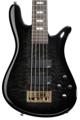
The Spector Euro series continues Spector’s decades-long tradition of innovation. These electric basses are renowned for their curvaceous body shape, unmatched playability, and impeccable tone. The Spector Euro 4 RST delivers these qualities in a stunning instrument with an eye-popping, highly figured zebrawood top. It features a 24-fret fingerboard, a super-stable 3-piece roasted maple neck, and powerful Aguilar Super Double humbuckers. The built-in Aguilar OBP-2 preamp delivers a high-headroom, low-distortion sound that perfectly complements the bass’s natural tone.
Schecter Reaper-5 Bass Guitar
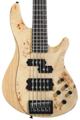
Schecter’s Reaper-5 5-string bass delivers electrifying sound crafting and masterful aesthetics to guitarists performing across various high-octane hues. Transposing the fiery ethos of its 6- and 7-string siblings, the Reaper-5 boasts superior tone-crafting possibilities in the low end. Elegant beveling and cutaways complement a gorgeously figured poplar burl top, featuring swamp ash, maple, walnut, and ebony. The maple neck features two walnut stringers, enhancing the harmonic complexity of the maple’s natural warmth with an ebony fingerboard capping it off. The Reaper-5 boasts split-coil and humbucking Schecter USA M-50 pickups, powered by a Darkglass Tone Capsule active preamp system that provides unparalleled sonic contouring, preserving the harmonic and aural character of the bass. Tone Pro M-series tuners and a top-load-capable Schecter Diamond Custom string-through bridge bookend the bass’s 35-inch scale, with a Graph Tech Black TUSQ XL nut for reliable buzz-free tones.
Sterling By Music Man Sterling Bass Guitar
Players of all stripes celebrate the return of the Sterling by Music Man’s passive Sterling bass, a versatile 4-string axe with vintage verve and sound. Built for powerful, straightforward performance, the Sterling features a single Alnico V parallel humbucker for classic punch, ideal for any player looking for a fat, punchy tone and straightforward electronics — one Tone knob and one Volume knob. The maple body delivers a balanced, resonant tone, while the maple neck and rosewood fretboard offer supreme playability. Despite its simplicity, the bassists at Sweetwater know the Sterling is ready to take on any gig.
Fender American Professional II Precision Bass
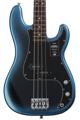
The Fender American Professional II Precision Bass, launched in 1951 by Leo Fender, draws on six decades of innovation to exceed the needs of today’s working bassists. Its smooth, rolled fingerboard edges, “Super-Natural” satin finish, and newly sculpted neck heel provide effortless access to the upper register. The new V-Mod II Precision Bass split-coil pickup delivers classic P Bass punch and growl with more articulation than ever before. A genuine bone nut and 4-saddle HiMass Vintage bridge (string-through-body or top-load) deliver solidity and sustain for authoritative tone. Lightweight vintage-style tuners with tapered shafts provide outstanding tuning stability and fast string changes. The Fender American Professional II Precision Bass offers comfort, tone, and performance with premium appointments, flawless playability, optimized electronics, and classic visuals.
Ibanez Bass Workshop SRC6MS 6-string Multi-scale Bass Guitar
If you’ve never played a multi-scale bass, then the Ibanez Bass Workshop SRC6MS 6-string multi-scale bass guitar will revolutionize your low-end life. This masterful multi-scale monster — with six strings for ultimate harmonic range — serves well for bassists who want to play fast and heavy. Its multi-scale fretboard makes simple-to-complex note reaches easier and more comfortable. Meanwhile, its pair of Bartolini humbuckers sets you up for tonal success, outputting warm, complex, low-end depth. Its Mono-Rail bridge system also aids in string isolation, ensuring each note you play rings out without interference from the other strings. Plus, it transfers vibrations to the body with maximum impact.
Warwick Pro Series Thumb BO 4-string Bass
The Warwick Pro Series Thumb BO 4-string bass is a modern bass masterpiece packed with nuanced harmonics, transparent warmth, and workhorse sustain that rings and rings. This bass prioritizes comfort with smooth contours. Hands and shoulders will relish the luxury, but the Thumb BO is no tonal couch potato. Since the Thumb’s initial 1985 debut, this bass has left many marks on diverse styles with memorable results. Part of Warwick’s appeal is its custom components designed in-house. The Pro Series Thumb BO features Warwick’s active MEC J-style pickups and a 2-band preamp, which you can bypass for passive operation and a simple tone control. Warwick also paid particular attention to the Pro Series Thumb BO’s playing surface. A wenge fingerboard offers 24 premium bell brass frets, a highly musical choice and one of Warwick’s defining signature features. Frets are treated to Warwick’s Invisible Fretwork Technology to eliminate fret sprout and deliver perfectly leveled frets matched within 0.01 millimeters across the board. Factor in an ovangkol neck with a modern C-shaped profile, and you have one of the best-playing bass guitars on Earth.
Lakland Skyline Darryl Jones DJ-4 Bass Guitar
The Lakland Skyline Darryl Jones DJ-4 bass guitar is the epitome of a workhorse bass! Its origins date back to 1985 when Darryl Jones was looking for a customized J-style bass that fit his diverse needs. The DJ-4 elevates usual bass aesthetics with fine touches, including block fingerboard inlays and a coordinated matching headstock. The body is swamp ash for a classic full-bodied tone with lots of articulate sonic punchiness, prized for both heavy styles and mellow music — which is nowhere more apparent than in Jones’s own playing! He has accompanied and collaborated with a diverse cast of major names, including Miles Davis, Sting, Madonna, and the Rolling Stones. But what makes the DJ-4 a “workhorse” bass? For one, its Dual-Design bridge allows both string-through and top-loading setups. Choose string-through for enhanced resonance and sustain, or go top-loading for a slightly softer string feel with a more present attack. For electronics, the DJ-4 boasts two well-respected Vintage Wound single-coil pickups that capture the essence of vintage J-style pickups. With plenty of low-end oomph, clarity, and bite, and the added benefit of enhanced treble clarity, this bass is an exceptional choice for any style heavy on upper-fret accents, such as pop, funk, and R&B.
Fender Player II Modified Active Jazz Bass
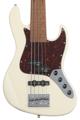
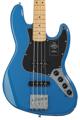
Equally current and timeless, the Player II Modified Jazz Bass infuses the J Bass’s revered heritage with modern flair, combining quality tonewoods, high-performance hardware, and reimagined electronics. It features classic construction with a modern C-shaped maple neck, smooth rolled edges, and a maple fingerboard for clear, articulate tone. Fender introduces an all-new preamp with a refined 3-band EQ optimized for sonic transparency and Active/Passive functionality for ultimate sound shaping. The Player II Modified J Bass also has newly voiced Noiseless pickups for versatile Jazz Bass growl. To finish it off, Fender adds touches like a 1.5-inch TUSQ nut, tapered shaft tuners, and a HiMass bridge for enhanced intonation, sustain, and stability.
Reverend Mike Watt Wattplower MKII Bass
When Mike Watt of Minutemen wanted a signature bass, he turned to Reverend, the Ohio-based brand that churns out hot-rodded signature instruments with sensible personal touches. The Reverend Mike Watt Wattplower MKII bass builds on the light and tight maneuverability of the original Wattplower with an expanded alternate pickup scheme. With its neck and body carved from Reverend’s stockpile of reliable korina wood, this is one of the lightest basses on our list. Tonally, korina sounds close to mahogany but tends to weigh less — this makes the Wattplower MKII great for both small players and those who like to be active onstage (a backflip off the bass amp, anyone?). Beyond feel, we love player-minded touches, like the fingerboard’s Luminlay side dots for precise fretting in dark environments. There’s also a Hipshot A Style bridge that adds clarity, attack, and sustain. The bridge can be used as a top-loading or string-through design — two options for the price of one! On the electronics side, the Wattplower MKII has an impressive but unique array of tones on tap. The P-style 2-way, 3-blade bridge pickup offers a large spread of attack-heavy bridge tones, while the neck humbucker is perfect for extra-hefty low-end thud.
Spector Icon NS-5 5-string Electric Bass
As its flagship series, Spector’s celebrated NS instruments capture the gold-standard ethos of the company’s dedication to low-frequency mastery. Spector found its niche in the music biz back in the ’80s, starting with a white NS bass that Sting used during the Police’s Synchronicity Tour in 1983. Fast-forward four decades, and now we have the Icon NS-5, Spector’s US Custom Shop spec’d design. The body is topped with quilted maple, while the alder, rosewood, and maple tonewoods undergird the electrifying sound-shaping possibilities of the Aguilar soapbar pickups, complemented by an active Aguilar OBP-2 preamp with 2-band EQ that supplies ±18dB and 16dB of adjustable boosting at the 40Hz and 6.5kHz frequencies, respectively. Across its 35-inch scale and 15.75-inch fretboard radius, the Spector Icon NS-5 features 24 jumbo frets, complementing the company’s C-shaped neck profile. The eye-grabbing double-cut design and sleek bolt-on heel join for unfettered access to the upper registers, while a brass nut, die-cast bridge, and tuning machines keep your sound buzz-free, in tune, and soaring with sustain.
Ernie Ball Music Man StingRay Special Bass Guitar
Ever since its ’70s debut, the StingRay has been something of a bassist’s bass — and we mean that as a compliment! It’s given us memorable bass lines from Red Hot Chili Peppers, AC/DC, Rage Against the Machine, and even Blink-182, to name a few. What makes the StingRay the choice of these big names? Namely, rock-solid performance paired with modern active tone-shaping tools. This Ernie Ball Music Man StingRay Special bass guitar model has all that, plus the benefit of weight-cutting innovations, like lightweight tuners, a roasted maple neck, and a revamped ash body that has hit the gym and shed a pound or two compared to its predecessors. More comfortable than ever, this StingRay Special delivers spine-shaking low end with a classic StingRay preamp system and a single massive humbucker made with neodymium magnets. Now updated to 18 volts, this preamp offers more headroom than its 9-volt predecessors, translating into unbeatable clarity, even at high volumes. With dedicated active EQ knobs for bass, treble, and mids, the StingRay Special can accomplish everything from expansive tubby lows for pop, reggae, and metal to punchy mix-cutting highs and mids that are perfect for funk, indie, and more.
Epiphone Thunderbird ’64 Bass Guitar
Epiphone is throwing it back to 1964 in grand style with this thundering Thunderbird ’64 Bass! Sweetwater looked into the specs of this bass, and we know vintage music lovers will find much to love about the classic Thunderbird body shape, 9-ply mahogany/walnut neck, and 20-fret Indian laurel fingerboard that all make for a supremely enjoyable playing experience. Bassists are also sure to find their groove with the sonics of this bass guitar thanks to the pair of ProBucker 760 humbuckers that replicate the glorious thump of Gibson’s original 1960s Thunderbird pickups. This Thunderbird model honors its legacy while bringing its build quality and electronics up to par with 21st-century bassist needs.
Sire Marcus Miller U5 Alder 4-string Bass Guitar
The Sire Marcus Miller U5 4-string bass offers exceptional comfort and playability at an affordable price. Its 30-inch short-scale design and slim profile make it easy to handle, while the alder body provides a lightweight feel and rich resonance. The hard maple neck and fingerboard deliver smooth, responsive action that’s gentle on your hands—perfect for crafting fluid bass lines. Made with a US-manufactured coil and Alnico V magnets, the Marcus Super PJ Revolution pickups produce a warm low end with a well-balanced midrange.
Sadowsky MetroExpress 21-fret Hybrid PJ 5-string Bass
The versatility of a world-class hybrid P/J bass such as Sadowsky’s MetroExpress 21-fret hybrid PJ 5-string Bass is hard to beat. Combining a Sadowsky passive/shielded single-coil J pickup and a Sadowsky passive P split-coil pickup, this bass allows you to instantly switch between bright and funky fingerstyle and driving midrange growl. The Okoume body provides a mahogany-like warm foundation while the active onboard 2-band EQ further expands the tone-sculpting possibilities. The legendary Sadowsky playability is delivered via a roasted maple neck topped with a Sadowsky Standard profile, 12-inch-radius roasted maple fingerboard. Standard hardware includes a Quick Release bridge and 20:1 ratio Sadowsky tuners for road-tested reliability.
Bass Guitar Buying Advice
Part rhythm, part melody — there’s simply no denying the importance of the bass guitar in modern music. This Sweetwater buying guide covers critical information to help you choose the right bass guitar. There’s a lot to consider when purchasing a bass guitar, so please don’t hesitate to call your Sweetwater Sales Engineer at (800) 222-4700 for personal assistance.
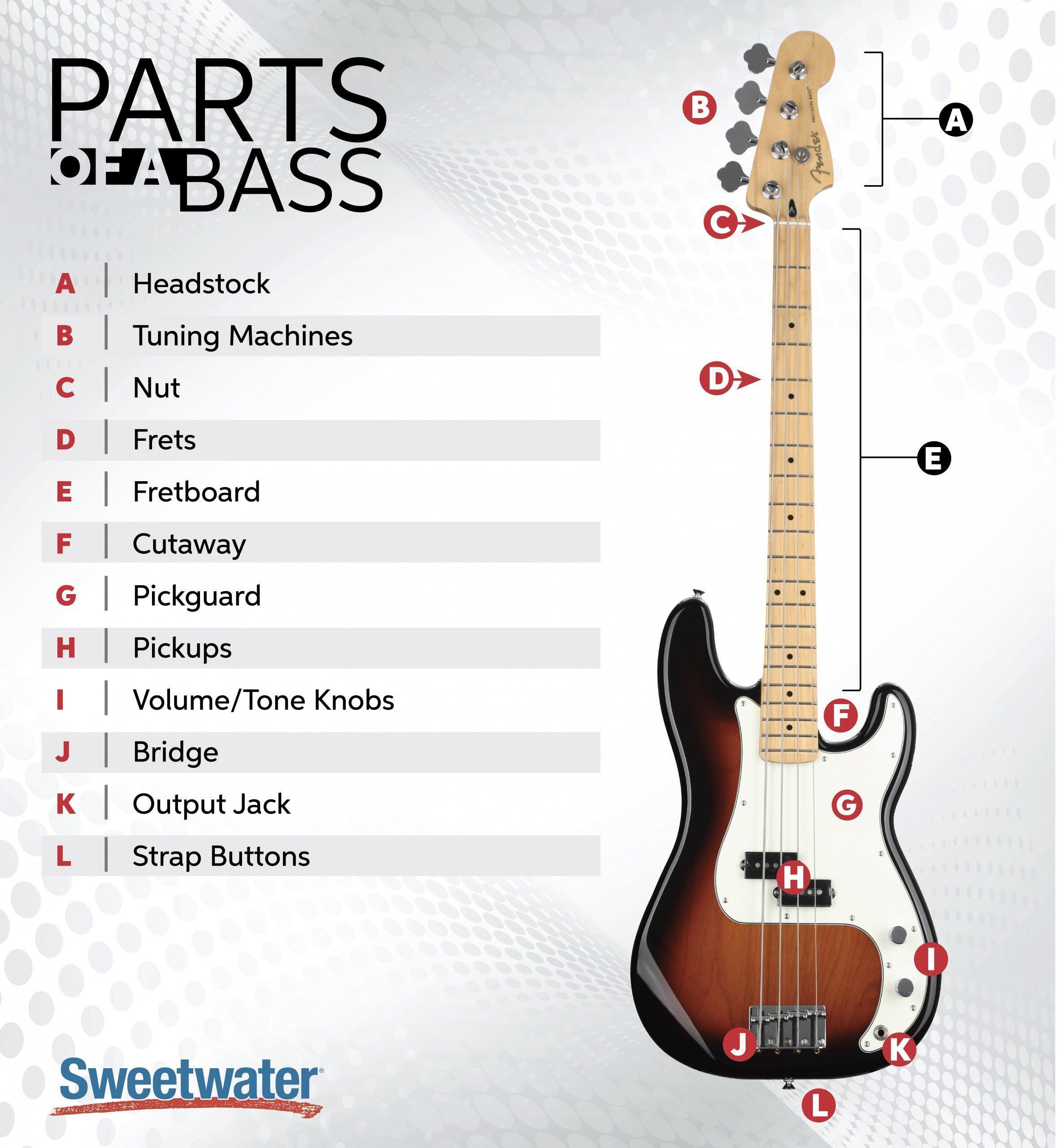
- The Anatomy of a Bass Guitar
- Tonewoods Compared
- 4, 5, or 6 Strings?
- Short-scale vs. Long-scale
- Fretted vs. Fretless
- Acoustic Bass Guitars
- Passive vs. Active Pickups
- Bolt-on vs. Neck-through
- Precision vs. Jazz Basses: Which Is Right for Me?
- What to Look for in a Bass Guitar
The Anatomy of a Bass Guitar
Tonewoods Compared
Several factors determine the tonal properties of wood. Most luthiers believe that the wood chosen for the top is the most critical factor in determining the quality of the tone of the instrument. It is also interesting to note that the wood takes on different characteristics depending on where it is on the bass guitar. But wood species can be responsible only for certain aspects of the tone of any guitar. Equally important are design, the skill of the maker, and the quality of the wood used. Tonewood selection can be a determining factor in creating a special bass guitar or a bass guitar designed for a specific purpose.
Ash & Alder
Since ash and alder are incredibly similar, both provide sustain and produce an evenly balanced tone that is resonant and rich in harmonic overtones. The most common reason guitar makers choose ash is because of its more attractive grain, which is apparent under a transparent or semi-transparent finish.
Agathis
Many wonderful entry-level basses are made from Agathis since it is relatively inexpensive. Tonally, it is a medium between ash/alder and mahogany, resonating with a rich tone that emphasizes the lower midrange over the upper.
Mahogany
Mahogany basses are best generalized as warm-sounding and full-bodied. The medium density and low resonance of mahogany give the lower register of the bass guitar a pronounced emphasis and roll off the snappier string attack that you get with an ash/alder body.
Basswood
Basswood is a favorite body wood for bassists who play a wide range of music. An interesting quality of basswood is its extreme softness, which readily absorbs vibrations. It has a shorter sustain, making it ideal for fast or more complex playing techniques.
Maple
Maple is a very dense wood, producing phenomenal sustain and a bright, crisp tone. Many bassists and recording engineers swear by maple because of the clarity and definition it gives bass guitars.
4, 5, or 6 Strings?
It’s tempting to say that if you need to ask, then you’re better off sticking to a traditional 4-string bass. Regular 4-string basses have, by design, narrower necks than 5- or 6-string basses and are tuned in standard E-A-D-G format; this makes them easier to learn to play on. However, there are some styles of music that favor 5-string basses. Modern worship music and country seem to have more songs that root in B; therefore, its B-E-A-D-G tuning is ideal. Regardless of style, 5- and even 6-string basses give bass players more room to expand creatively. A 6-string bass tuned B-E-A-D-G-C will let you pull off some fancier tricks, particularly if you perform a lot of bass solos.
Short-scale vs. Long-scale
Basses come in numerous scale lengths (the distance between the nut and the bridge). The most common scale length, long-scale, is 34 inches, as popularized by classic bass models like P and J Basses. Short-scale basses are basses with a scale length of fewer than 31 inches. Short-scale basses are ideal for young players, players with small hands, and guitarists who have picked up the bass as a second instrument. Scale length does influence the tone of an instrument. Long-scale basses are more versatile, with plenty of growl, punch, and bite, while short-scale basses are dark and rich in tone, with a pronounced low end.
Fretted vs. Fretless
There are two fretboard layouts to choose from when looking for a bass guitar: fretted and fretless. A fretted neck is the standard guitar neck, with steel frets dividing each half step of the chromatic scale. This makes finding the right notes much easier, especially if you are starting out on the instrument. A fretless bass, however, features a neck that does not have steel frets; it’s just smooth wood, similar to an upright bass or violin. While many bass players believe that fretless basses offer a smoother, warmer sound, the pitch of the note depends completely upon your finger position. Skilled players rely on muscle memory to position their fretting hand properly, but practice always makes perfect.
Acoustic Bass Guitars
If you’re looking for a bass guitar but don’t want to use an amp, then an acoustic bass guitar might be for you. Like an acoustic 6-string guitar, an acoustic bass produces sound through a resonant hollowbody. This allows you to play unplugged with a full-bodied, robust sound, which is sometimes more appropriate for acoustic music. However, many different models of acoustic-electric bass guitars exist, giving you the hollowbody sound of an acoustic bass with the ability to plug into an amp for additional volume.
Passive vs. Active Pickups
There are two kinds of bass guitar pickups to choose from. Passive pickups, which have been around since the beginning of the electric bass, provide you with a dynamic sound and a warm, full tone. The downside to passive pickups is that they give you less overall control over the tone of your instrument. That isn’t necessarily bad; if you like your bass sound fat and punchy, then passive pickups are for you.
Active pickups are a much newer development than passive pickups. Many modern bassists consider them the coolest thing since sliced bread, while others find them almost heretical. Active pickups produce a tone that is bright, percussive, and clear. Additionally, active pickups include a built-in battery-powered preamp, producing a much higher output than passive pickups. Just remember to change the battery periodically!
Bolt-on vs. Neck-through
Some controversy exists about which construction style is best for bass guitars. The bolt-on neck design is the more common and traditional construction method in which the neck is a separate piece of wood bolted onto the body. An essential advantage of this design is the ability to replace the neck if damaged.
In a neck-through design, the bass guitar’s neck wood spans the entire length of the instrument. Neck-through bodies tend to provide greater sustain and more direct energy transfer. These basses are made of several pieces of wood glued together. One upside of this design is that the wood is usually of exceptionally high quality, which increases the overall quality of the instrument.
Precision vs. Jazz Basses: Which Is Right for Me?
Fender’s Precision Basses and Jazz Basses dominate the world of bass guitars — and that’s no accident! Leo Fender and his small crew invented the first electric bass guitar more than 50 years ago. And though there have been many changes to both models over the past 50 years, the new P Bass or J Bass you buy today still carries on the tradition of the classic originals.
So, how do they differ? What makes a player choose one over the other? The primary differences can be summed up in three areas: the body, the neck, and the pickups.
Body Design
The Precision Bass was a radical design in 1951. Its deep double cutaways and forward-raked design were like nothing the guitar world had seen. In 1954, the Precision Bass, which had been a “slab” until then, adopted the contoured body of the new Stratocaster. These sculpted recessions at the bottom and top made it more comfortable to hold. The original Precision body was ash; now, you can choose from models with ash or alder bodies.
The Fender Jazz Bass, released in 1960, offered players an offset waist body influenced by the Jazzmaster guitar, which was introduced a couple of years earlier. This moved the body mass forward and out of the way of the player’s right arm. As with the P Bass, ash and alder body models of the J Bass are available.
C-shaped Neck
Most Precision and Jazz Bass production models have what Fender calls a “modern ‘C’ shape” neck. Each model’s neck is maple, with maple, rosewood, or pao ferro fingerboards available. Despite these similarities, the Precision neck maintains a fairly consistent thickness and slightly tapers as it approaches the nut. However, the Jazz starts with its strings in a noticeably narrower spacing at the nut, which gives it a distinct “tapered” feel for what some players feel is easier fingering.
Different Pickups
Upon its release, the Precision Bass had a single-coil pickup with a chrome-plated cover. Within a few years, Fender moved to a split-coil pickup that offered a more defined and solid bass sound. The Jazz Bass was released with dual 8-pole humbucking pickups, giving players a wider variety of tonal possibilities. The result? A bass that has a cleaner sound, with more tonal variation possible through the use of a knob that adjusts the balance between the two pickups.
What to Look for in a Bass Guitar
Body Style
Electric bass guitars are most commonly solidbody electrics. Although, a few semi-hollowbodies are available for a rounder and more acoustic sound.
Neck
Choosing the type of neck your bass should have depends on your hand size and feel preference. Necks come in several shapes: round, oval, flat back, “vee,” and asymmetrical (thinner on the bass or treble side).
Scale Length
Longer necks provide a more defined sound on the low strings, while a shorter scale is acceptable for 4-string basses and is suitable for smaller hands.
Tuning Machines
Enclosed machine heads resist rust and airborne corrosives and therefore don’t require as much maintenance or replacement as open tuning machines.
Intonation
Intonation determines whether the notes are in tune as you move up the neck. Suppose the distance between the frets (usually above the 12th fret) is not accurate. In that case, the bass will be incapable of playing in tune and therefore is useless as a recording or performance instrument.
Bolt-on vs. Neck-through
Neck-through basses are more robust, with better sustain and note resolution. Bolt-on necks have a punchier sound but are more likely to have dead spots.
Fingerboard
A coated fingerboard helps produce a whining, trebly “fretless sound” and longer sustain, which wears much longer with roundwound strings. Uncoated fingerboards have a warmer, more natural sound.
Number of Frets
Most basses have 21, 22, or 24 frets. Since most bass playing takes place in the lower positions, the number of frets is a matter of personal taste.
Pickups
Pickups have more effect on your bass’s final sound than the choice of wood. A pickup can give different results on different basses, and they are offered in passive and active varieties.
Wood
The critical question regarding the wood is whether you like the sound of the bass. Wood choice naturally affects the tone and weight of a guitar, so consider how you will use the bass (in other words, playing long gigs or sitting in a studio).
Get Started with a Bass Guitar from Sweetwater Today!
Whether you’re a beginner shopping for your first instrument or a seasoned player scoping out your next 4-string or extended-range electric bass, Sweetwater has the bass of your dreams! Shop our vast selection of basses from all the top brands, and if you’d like personalized shopping advice, then please reach out to one of our knowledgeable Sweetwater Sales Engineers at (800) 222-4700. They’re happy to assist in finding the right bass for you!