A British musical movement that spanned the mid-1980s to the early 1990s, shoegaze shifted the way players thought about the guitar. Rather than focusing on licks, riffs, and runs, shoegaze guitarists, including Kevin Shields and Bilinda Butcher (My Bloody Valentine), Robin Guthrie (Cocteau Twins), and Neil Halstead and Rachel Goswell (Slowdive), viewed the guitar as a carrier to be twisted and modulated to produce both ethereal and cacophonous tones.
Shoegaze guitar parts were often simple to play, but the genius behind them was using guitar pedals and studio effects in a way more common to synthesizer players and layering numerous guitar parts in a swirling wall of sound.
Like all genres, shoegaze had its tropes, such as grimy fuzz tones, shimmering delayed chords, and amorphous clouds of reverb. Often, people think of shoegaze as just a wash of tones, but the top purveyors of shoegaze were extremely intentional in how they arranged their guitar parts. They struck a perfect balance between crisp, clean sounds and murky, modulated sounds, resulting in one of the most sonically immersive genres of all time.
Today’s shoegaze resurgence (dubbed “nu gaze” by some) is concurrent with the new golden age of pedal making, and some pedal designers are crafting pedals specifically for shoegaze-inclined guitarists. In this article, I’ll break down five essential shoegaze tones created with both pedals and software effects. Let’s check them out!
The Main Rig
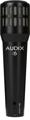
For this demo, I used two guitars: the Harmony Jupiter for humbucker sounds and my custom partscaster Strat for single-coil sounds. The amp is a Morgan PR12, which I recorded with an Audix i5 dynamic mic one inch off the grille, aimed at the center of the cone. The interface was a Universal Audio Apollo Twin MKII with a Neve 1073 plug-in instantiated on a Unison input.
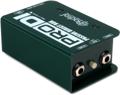
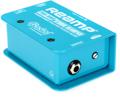
I also recorded the guitars through a Radial ProDI so I could demonstrate how each pedal in the chain affects the sounds. And I used a Radial ProRMP to send the pre-recorded tracks back out the Morgan. You might be thinking, “What? No Jazzmaster?” I know, I know. But I wanted to prove that you could gaze with any guitar, not just the Kevin Shields standard!
Shoegaze Guitar Tone 1: Bright, Flanged Arpeggio
Guitar: Harmony Jupiter – Bridge Position (picked right above the bridge)
First up, I wanted to focus on creating a bright arpeggiated guitar with some modulation — a layer that would dance on top of a dense wall of guitars and add definition. That said, this tone needed to be deliberately thin so that it wouldn’t fight with darker sounds.
To keep it consistent, I employed an MXR Dyna Comp first in the chain with the sensitivity set at 9 o’clock and the output at 2 o’clock. The MXR Dyna Comp was followed by a BOSS GE-7 with a roughly 3dB cut to the three frequency bands under 400Hz.
Now, to make it swim, I relied on a classic shoegaze stompbox, the Electro-Harmonix Electric Mistress flanger and chorus, with the flanger depth set at 3 o’clock, the chorus set at noon, and the rate set at 9 o’clock. Finally, I added the T-Rex Replica delay set to a fast slap. The point was not to hear the delay so much but, instead, to use it to thin out the tone even further with phase cancellation. Listen to each step in the clips below.
Shoegaze Guitar Tone 2: Delayed Fuzztration
Guitar: Partscaster – Neck Position
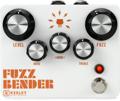
When shoegazers wanted to make dark and aggressive guitar sounds, their go-to dirt box was a fuzz pedal in any of its many forms. The Big Muff Pi is always a great choice (we’ll use Muff-style fuzz in a bit), but sometimes you want something that’s even nastier. For this next tone, I opted for the Keeley Fuzz Bender, a 3-transistor fuzz pedal with a bias control and two tone controls for bass and treble.
Fuzz pedals are super-finicky, so this proved impossible to do with a re-amp box. The Fuzz Bender did not like the signal coming from my DAW no matter how I set the gain staging. So, I had to plug straight into the Fuzz Bender and do my best to play the part the same way twice.
With crispy fuzz pedals like the Fuzz Bender, I like to start with a dark dry sound. The neck pickup on a Strat is perfect for this application, and fuzz boxes really like single-coil pickups.
One important note: some fuzz pedals are only good for monophonic lines or split octaves — and the Fuzz Bender is in this camp. When you throw in an interval, even a perfect fifth, the pedal won’t track properly, and you’ll get an inharmonious beating. That could be useful in some situations, but, most of the time, you’ll want to stick to single notes rather than chords or dyads.
In the first clip, you’ll hear the unaffected guitar. The second clip has the Fuzz Bender engaged along with a BOSS RE-202 Space Echo with a quarter-note delay for additional drama.
Shoegaze Guitar Tone 3: Shining Diamonds
Guitar: Partscaster – Bridge Position
Diamond chords are strummed chords that are held for a whole note or longer, and they’re used all over shoegaze songs, usually bathed in modulation and delay to fill the sonic landscape. Diamonds are typically one of the clean elements in a shoegaze arrangement that give a mix height and dimension.
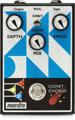
Shoegazers will often choose interesting chord voicings for diamonds, so I did the same, selecting major and minor 7ths and letting the high open strings ring. Modulation is provided by the Maestro Comet Chorus pedal. Using a stereo delay on diamond chords is a common technique. Since I was using a single amp, I took advantage of the re-amp box and sent the recorded mono track into the BOSS RE-202 and captured the delay in stereo in my DAW.
Tip: When re-amping a mono guitar part into a stereo effect, set the effect to fully wet and mix it to taste with your mono track in your DAW.
Shoegaze Guitar Tone 4: Ambient Nu Gaze
Guitar: Harmony Jupiter – Bridge Position
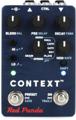
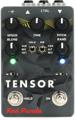
Modern gazers have many more tools at their disposal than the pioneers of the genre did. Red Panda is one pedal manufacturer (among many) whose stomps are perfect for nu gaze. In this example, I’m using two Red Panda pedals: the Tensor, a glitchy delay and time-shifter pedal, and the Context 2, a digital delay made for tweakers.
With the Tensor, I used the reverse delay setting for a warbly call and response. I recruited the Context 2 for gauzy, super-wet ambience with the grain mode, which is based on the legendary Ursa Major SST-282 Space Station rackmounted signal processor.
Shoegaze Guitar Tone 5: My Bloody Valen-glide
Guitar: Partscaster – Middle Position
Last but certainly not least, I tackled Kevin Shields’s signature guitar technique: glide guitar. Glide guitar starts with using a tremolo bar to rhythmically detune chords. Kevin is well known for his affinity for Jazzmasters, arguing that the Jazzmaster tremolo system is best for this application. However, I found that you can indeed glide on a Stratocaster.
Another element to Kevin’s sound is the use of hardware effects running in parallel to create his guitar soundscapes. It’s a trick also used by Robin Guthrie. I guess, in the studio, you would call them “rackgazers”!
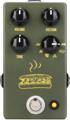
You can re-create their workflow with plug-ins in your DAW. I started with power chords wrapped in a blanket of fuzz, courtesy of the JHS Muffuletta set to Pi mode. In the clip, you can hear how the tremolo bar is used to modulate the pitch of the chords.
However, it’s in the post-processing where things get interesting. Rumor has it that both Kevin Shields and Robin Guthrie would sometimes use a dozen or more processors on a single guitar part. I chose to use five.
I set up four stereo auxiliary tracks. The first aux track included the UAD Moog Multimode Filter and the UAD Dytronics Cyclosonic Panner. On the second aux track, I instantiated the UAD MXR Flanger/Doubler and the UAD Korg SDD-3000 digital delay. I synced all the effects to the tempo of the demo track at varying time divisions. The third aux track acted as a submixer to blend the main guitar line with the two stereo effects sends. Then, I added a send on that aux track to the fourth stereo auxiliary track, which was loaded with the Valhalla Shimmer reverb.
Listen to the progression of the sound in the clips below.
Gaze Your Way
These sounds are made with some of the effects I had available, but you can shoegaze with any brand of guitar pedal. All you need to start with is fuzz, delay, reverb, and one or two modulation pedals; or dive into your plug-in folder and start layering effects. For best results with the latter method, use effects with a blend knob if you want them as inserts or employ parallel processing with auxiliary sends like Kevin and Robin did back in the day on a mixing console.
If you’re a pedal nerd, then you owe it to yourself to play around with shoegaze guitar tones. Even if it’s not your genre of choice, thinking about pedals as sound-design tools, like the shoegazers did, is a great way to learn how to get the most from your assorted stompboxes.
For any questions on the coolest pedals and plug-ins for shoegaze, reach out to your Sweetwater Sales Engineer at (800) 222-4700.