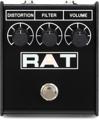
Few dirt boxes can match the ubiquity — and flexibility — of the Pro Co RAT. Deployed as a boost, overdrive, distortion, and fuzz in equal measure, this do-it-all distortion stompbox has graced pro-level pedalboards and aspiring guitarists’ bedroom floors for more than four decades. So, what makes the RAT so great? Read on, true believers.
The Famous RAT Sound
The standard Pro Co RAT is a hard-clipping distortion pedal capable of near-clean grit, ultra-saturated fuzz, and everything in between. This gorgeously raunchy sound is produced by a single op-amp and a variable-gain circuit with silicon diodes that short the output to ground, thereby clipping the source material. The secret to the RAT’s fabled sound, however, is that the op-amp is run at such a high rate that it starts distorting even before the signal hits the diodes. This is why the RAT delivers such complex, harmonic-laden distortion.
Another part of the RAT’s charm is a result of the op-amp’s poor slew rate, which yields the stompbox a spongy, amp-like feel. Throughout its lifetime, the RAT has undergone numerous cosmetic changes, operating adaptations, and component swaps. Pro Co has also released several RAT variants with different clipping diodes and advanced features.
In the Beginning
Designed by Pro Co engineers Scott Burnham and Steve Kiraly, the first RAT units were produced around 1978. An initial run of 11 proto-RAT pedals, often referred to as the “Bud Box” model, was assembled. A total of 12 circuits were built; 10 pedals housed one circuit each, and an 11th was a double pedal containing two circuits. The original RAT contained a Motorola LM308 op-amp, 1N914/1N4148 clipping diodes, and tantalum capacitors along with Distortion, Tone, and Volume knobs. The first production RAT was produced in 1979, employing the same circuit topology as the Bud Box minus some tweaked pot values, a few extra resistors, and the original’s FET input buffer.
Goodbye Tone Knob, Say Hello to Filter
The RAT underwent several aesthetic changes during its early years; however, the circuit design remained the same with a few minor alterations, including the eventual use of electrolytic capacitors in lieu of tantalum caps (something that, according to RAT designer Scott Burnham, has zero effect on the unit’s sonic performance). Beyond that, the 1981 version of the RAT swapped its predecessors’ Tone control for a lowpass filter circuit labeled “Filter.” From a user standpoint, the Filter control acts as a reverse tone knob. Thus, turning the Filter knob clockwise decreases treble rather than increasing it as with a typical tone control. Most current RAT models retain this streamlined 3-knob control set.
Great Things Come in Small Packages
The RAT’s biggest cosmetic change came in 1984, when the pedal was packed into a smaller, pedalboard-friendly enclosure. These original “White Face” units, while containing the same circuitry as previous generations, are highly coveted on the used market for their aesthetics and subjectively superior sound quality. Subsequent generations of standard RAT pedals employ the now-familiar “Black Face” look.
The Noisy Rodent, Part Deux
By 1988, the folks at Pro Co knew it was time to give the RAT a contemporary facelift. Thus, the RAT 2 was born. Most notable was the addition of a status LED inside the “A” of the RAT logo. This LED utilized a millennium bypass circuit, which enabled it to switch on and off without even touching the pedal’s input signal. Except for the LED, the RAT 2 employed an identical circuit to previous units. Nonetheless, many RAT connoisseurs swear that pre-RAT 2 stompboxes sound better than later units. The RAT 2 also includes slick-looking glow-in-the-dark graphics, and later versions boast an ergonomic sloped enclosure.
LM308 vs. OD07DP: Battle of the Op-amps
In the early aughts, RAT 2 production moved overseas to China. It was at this time that the standard RAT underwent the first significant circuit modification since its inception, when Pro Co replaced the stompbox’s LM308 op-amp with an OD07DP. Many RAT enthusiasts consider LM308-equipped pedals to sound superior to later models, claiming that OD07DP-loaded units sound brighter and shriller than their vintage counterparts.
Josh Scott of JHS pedals — one of the world’s leading experts on the RAT — disputes this claim. According to Josh, OD07DP op-amps perform comparably to LM308 op-amps with identical response, slew rate, and frequency attenuation. Thus, your modern RAT 2 and a vintage RAT should yield similar sound and performance. To punctuate his argument, Josh also notes that no two RAT pedals sound exactly the same, making comparisons between units from different generations a moot point anyway. “You can pull any two RAT pedals of any era together with consecutive serial numbers, made on the same day by the same builder, and they will still sound slightly different with the knobs at the same positions,” Josh explains.
A Massive Rodent Infestation
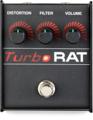
There have been many variants of the Pro Co RAT even though the standard model has been in continuous production since its introduction in 1979. First introduced in 1989, the Turbo RAT utilizes red LEDs instead of silicon clipping diodes, supplying you with extra output. If you want to use your RAT to boost an already-distorted amp, then the Turbo RAT is the way to go. The Deucetone RAT, which was first produced in 2002, packs two independent channels of RAT-style dirt into a single chassis. You also get switchable voices based on popular historic RAT iterations plus Deucetone-exclusive sounds.
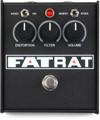
In 2004, Pro Co released the You Dirty RAT, which replaces the standard silicon clipping diodes with germanium. If you want RAT-style distortion with extra saturation and compression, then you’ll love the You Dirty RAT. 2014 brought us the FAT RAT, which pairs traditional RAT topology with a switchable MOSFET clipping circuit. You’ll appreciate the FAT RAT’s smoother upper midrange, amp-like tone, and bass-enhancement circuit — if you’re a bassist or a purveyor of down-tuned riffage, then this is the right RAT for you.
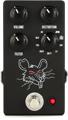
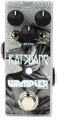
Got a crowded pedalboard? If that’s the case, then 2021’s Lil’ RAT squeezes a RAT 2 into a micro-sized stompbox. There are also several excellent third-party reimaginings of the RAT, such as the JHS PackRat, Walrus Audio Iron Horse V3, Catalinbread Katzenkönig, and Wampler Ratsbane.
The RAT: Real-world Examples
The Pro Co RAT is arguably one of the most popular dirt pedals ever created, right up there with such venerable stompboxes as the Ibanez Tube Screamer, BOSS DS-1, and MXR Distortion +. As such, you can find it on an endless array of classic recordings. James Hetfield front-loaded his Marshall 1959SLP with a RAT on Metallica’s Kill ‘Em All, ostensibly creating the prototypical thrash-metal guitar tone. Likewise, Extreme’s Nuno Bettencourt parks a RAT in front of every Marshall he plugs into (his signature amp includes a built-in clipping circuit at its input to accomplish the same thing). Alex Turner of Arctic Monkeys runs two RAT pedals in series (one into the other) to create his signature cacophonous noise. When Pink Floyd’s David Gilmour needed a sustain boost on the Division Bell Tour, he stepped on — you guessed it — a RAT. Blur’s infectious single “Song 2” features a massive, grunge-flavored guitar sound powered by a Pro Co RAT. Those mammoth riffs on R.E.M.’s Monster? Also a RAT. Beyond that, Thom Yorke of Radiohead employs a Turbo RAT to cover all his distortion needs.
These are but a few examples. Some variation of a RAT has been used by Buckethead, Jeff Beck, Jerry Cantrell, Nels Cline, Kurt Cobain, Rivers Cuomo, Robert Fripp, Dave Grohl, Buzz Osborne, Joe Perry, Kevin Shields, Andy Summers, and a whole host of others. Essentially, anybody who’s anybody has used one of these incredible stompboxes at some point — nothing else sounds quite like it!
So, what are you waiting for? Give your Sales Engineer a call at (800) 222-4700 and get your hands on a Pro Co RAT. You’ll be in excellent company!