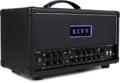
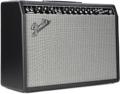
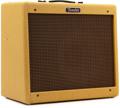
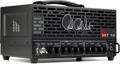
Here at Sweetwater, we’re often asked how much wattage a guitar amp should have. The correct answer is 350 watts — every time. Just kidding. Seriously, the answer depends on your application and the sound you’re aiming for. For example, bedroom and studio guitarists have different needs than gigging guitarists. And club performers have different needs than arena-touring acts. Beyond that, jazz guitarists who vie for loud clean tones will likely fancy a different amplifier than a heavy-metal guitarist who’s shooting for a scorching, saturated sound. In this article, we’ll dive into tube and solid-state guitar amplifiers of different sizes and shapes as well as general applications for each category.
Tube vs. Solid-State
Let’s get this out of the way first: Despite common belief, tube amplifiers are not louder than solid-state amplifiers. That said, tube amps definitely sound louder than their solid-state equivalents. This is due to the differences between how tubes and solid-state circuitry distort when you push them. When tube amplifiers are driven hard, they produce harmonics that, for the first 12dB or so, are perceived by the human ear as volume rather than distortion. This means that tube amps are often perceived as being 12dB louder than an undistorted amplifier. Solid-state amplifiers distort at the same signal level as their tube counterparts. The difference, however, is that the distortion is obvious — the signal sounds fizzy rather than louder.
Basically, if you crank equally powered tube and solid-state guitar amplifiers to the point of breakup, the tube amp will sound relatively clean and loud and the solid-state amp will sound fizzy and distorted.
More Wattage Means More Volume — Right?
There’s also a misconception that wattage alone is responsible for determining a guitar amplifier’s volume. This isn’t the case. While wattage certainly contributes to an amplifier’s output, it’s not the only factor to consider.
For starters, you need to be cognizant of the efficiency of the speakers you’re running your amplifier through. What’s efficiency, you might ask? Simply put, it’s a measurement of a speaker’s ability to convert power into sound, expressed in decibels (dB). This is important because a lower-efficiency speaker will be quieter than a higher-efficiency speaker, even if each speaker is being powered by an identical amplifier with identical settings.
It’s also important to note that doubling the wattage of your amplifier won’t double its output — a 200-watt amplifier isn’t twice as loud as a 100-watt amplifier. Rather, you only gain 3dB each time you double your amplifier’s wattage. Hence, a 200-watt amplifier is actually 3dB louder than a 100-watt amplifier when driving the same speaker.
What Is Headroom and How Does Wattage Affect It?
I’m sure you have heard people mention headroom and how the amps they have offer plenty of it. But what exactly is headroom? Simply put, headroom is the difference between the normal operating level of a device and the maximum level that device can pass without distortion. With tube amps, you will find a correlation between higher wattage and cleaner headroom due to it taking more power to push the speakers. Solid-state amps, on the other hand, are synonymous with their high headroom because they are pushing transistors instead of tubes and speakers.
The Amps
Amplifier/Cabinet Simulators and 0 Watts
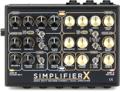
First and foremost, let’s start with the black sheep of the group: amp and cab simulators. They have zero watts and are nearly the perfect choice for musicians due to their versatility and ability to play without speakers. Many Sweetwater guitarists and bassists go with amp and cab simulators because they can fit right on your pedalboard and can be sent to the front of house, meaning no more lugging around amps and cabinets! Another attribute to enjoy is the ability to plug straight into your audio interface and achieve studio-quality sounds without worrying about mic placement or outside noises messing up your take. Some sims even have headphone outputs, so you can rock out and practice without disturbing anyone around you. If you are looking to ditch those heavy amps and cabinets for a quiet alternative without sacrificing sound quality, then you’ll want to check out amp and cab simulators.
1 Watt
Now let’s get into some watts! If you want to attain hard-rocking tones at bedroom volumes, then a 1-watt tube amplifier will deliver the goods. You’ll be shocked at how loud and full a 1-watt tube amp sounds in a small space. These amps will achieve power-amplifier saturation rather quickly, so if you’re aiming for jazz-like cleans at top volume, then a single watt probably won’t cut it. Conversely, if you’re hoping for some old-fashioned speaker breakup, then you’ll probably want an amp with more power. A 1-watt tube amp will also struggle to keep up with drums during rehearsals, even if you play with a mild-mannered drummer.
5 to 15 Watts
If you want crystal-clear cleans at bedroom levels, then a 5- to 15-watt tube amp will put a big, cheesy smile on your face. Plus, the wattage is still low enough to generate power-amp distortion at a manageable volume. Provided you’re using a reasonably efficient speaker, these amplifiers offer enough output for rehearsals and small gigs, and they can keep up with a moderately restrained drummer. That said, a 5- to 15-watt tube amplifier will have a difficult time maintaining a clean tone at rehearsal and gig levels. If you’re aiming for high-volume clean tones, then you’ll want an amplifier with more power.
20 to 45 Watts
For gigging guitarists that play in smaller bars and clubs, a 20- to 45-watt tube amp is a terrific choice. These amplifiers yield enough clean headroom to keep up with most drummers, they can produce nifty speaker breakup with lower-efficiency speakers, and they generate rock-ready power-amp distortion at higher volumes. A 20- to 45-watt solid-state amp, on the other hand, will struggle to keep up with a hard-hitting drummer. A solid-state amplifier in this range is best used as a practice amplifier, much like a 5- to 10-watt tube amp.
50 to 90 Watts
If you play jazz, funk, or ska or if you simply demand maximum clean headroom, then a 50- to 90-watt tube amplifier is just the ticket. These amps are also ideal for hard rock, metal, and shred-style guitarists who rely on preamp distortion rather than power-amp distortion. These are gig-worthy amplifiers. They’re not appropriate for apartment or suburban living. But hey — that’s what attenuators are for, right? A 50- to 90-watt solid-state amplifier is roughly comparable to a 15- to 20-watt tube amp, making it suitable for small gigs. Some of these solid-state amplifiers will strain in the presence of a heavy-hitting drummer, however, and are generally not recommended for larger gigs. There’s a caveat to that statement, however — if you love the sound of your favorite lower-wattage amp, then you can always park a microphone in front of it onstage or play through an amp simulator.
More Than 100 Watts
For arena tours and extra-loud bands, you’ll want a 100-plus-watt tube amplifier. These are the big guns, tailor-made for pummeling your audiences into submission with brutal riffs and scorching leads. If you’re shooting for a classic wall-of-Marshalls sound, then this is the range you’ll want to explore. 100-plus-watt solid-state amplifiers can be quite beastly, as well; although, you’ll need a higher-wattage model to keep up with a tube amp of lower wattage. A great thing about a high-wattage solid-state amp, however, is that they sound roughly the same at any volume — if your solid-state amp sounds great cranked, then it will likely sound just as great at bedroom levels. Conversely, tube amplifiers sound drastically different depending on what volume they’re set at.
Amps with Power Control
For many musicians, it’s normal to have separate amps for practicing and gigging. But what if I said that amp manufacturers have been working diligently to supply amps that allow you to control the output power with the turn of a knob? For instance, the BOSS Katana-100 MkII is a 100-watt amp, but it has a power-control section that allows you to turn it down to 50 watts and 0.5 watts. That means you can practice and gig with just one amp! No more changing your pedal settings for different amps! Now you can have the same exact sound no matter the venue or practice space.
Got Questions? Sweetwater Has Answers!
So many amazing guitar amplifiers, so little time . . . we get it! If you have questions about which amp would best fit your needs, give your Sales Engineer a call at (800) 222-4700. We’ll be glad to delve into your individual situation and give you a tailor-made recommendation.