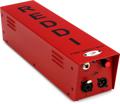
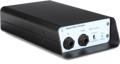
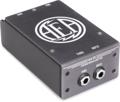
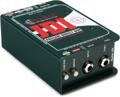
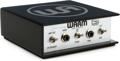
DI boxes — a.k.a. direct boxes — are a pro audio staple. Indeed, every audio professional has one, if not several, in their toolbox. There are countless models of DI boxes available (a site search for “direct box” on Sweetwater.com brings up over 250 products as of this writing), falling into two distinct categories: passive and active. In this article, we’ll explore the inner workings of passive and active DI boxes, discuss their pros and cons, and highlight common uses for each type.
What Is a DI Box?
Before we delve into the minutia of passive and active DI boxes, we should explain what a DI box is and what it does. A DI box (short for “direct inject”) is a hardware device used to convert an unbalanced, high-impedance signal into a balanced, low-impedance signal. This enables you to plug an instrument, such as an electric guitar, bass, or synth, directly into a microphone input on your mixing console or audio interface. This is especially important to do near the instrument if you’re transmitting a signal over long lengths of cable since low-level, unbalanced signals are highly susceptible to electromagnetic interference. While DI boxes are mandatory in live sound scenarios due to the cable lengths involved, they’re also used in the studio, for example, to direct inject an electric guitar into your recording setup.
A simple passive DI box consists of a small, impedance-matching transformer. More sophisticated designs (such as active DIs) employ electronic gain stages similar to the input section of a modern instrument amp. More elaborate DI boxes (either passive or active) may also include ground-lift switches, pads, equalization switches, level-matching switches, isolated line outputs, polarity inversion, or other advanced features.
Passive
Passive DI boxes utilize a transformer to match the instrument’s output impedance to the input impedance of a microphone preamp. Passive DIs are ideal for instruments with strong outputs and short cable runs because they don’t amplify the signal. However, there are other advantages to passive designs: no noise will be added by active circuitry, they don’t require power, and, in some cases, the transformer imparts a desirable sonic coloration. They’re also typically less expensive than their active counterparts.
Active
An active DI box includes an amplifier section to boost the signal level. It can effectively handle lower-level signals and longer cable runs. What’s more, active DIs can be extremely quiet and tonally transparent with advanced signal routing and higher headroom than their passive counterparts. Some active DIs are “color boxes” and add their own distinctive coloration to the sound. Active DI boxes need to be powered by batteries, a dedicated power supply, or +48-volt phantom power. Beyond that, they’re typically more expensive than passive DI boxes.
So, Which Should I Use?
These days, there are many excellent DI boxes — both passive and active. Passive DI boxes are typically fine unless you’re working with a particularly low-output instrument or running a very long cable between the DI box and the mixer or stage box. So, if you’re getting a low or degraded signal with a passive DI box, then it’s worth trying an active DI box instead. At any rate, it should be noted that pro-level studios and sound companies typically keep an assortment in their arsenals so that they can match each source to the best DI for the job.
Not sure which DI box is best for your needs? Give your Sweetwater Sales Engineer a call at (800) 222-4700!