

Banjo Tuning Guide — How to Tune a Banjo
How to Tune a Banjo
1. Check Each String’s Pitch
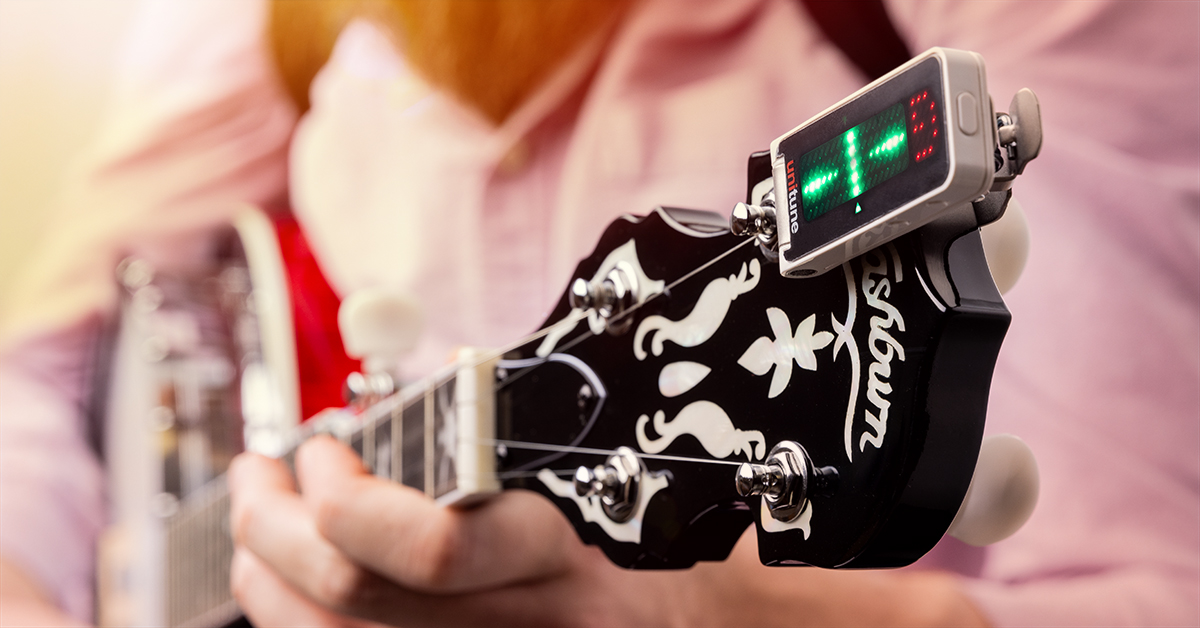
- Use a clip-on tuner to check each string’s current-sounding pitch.
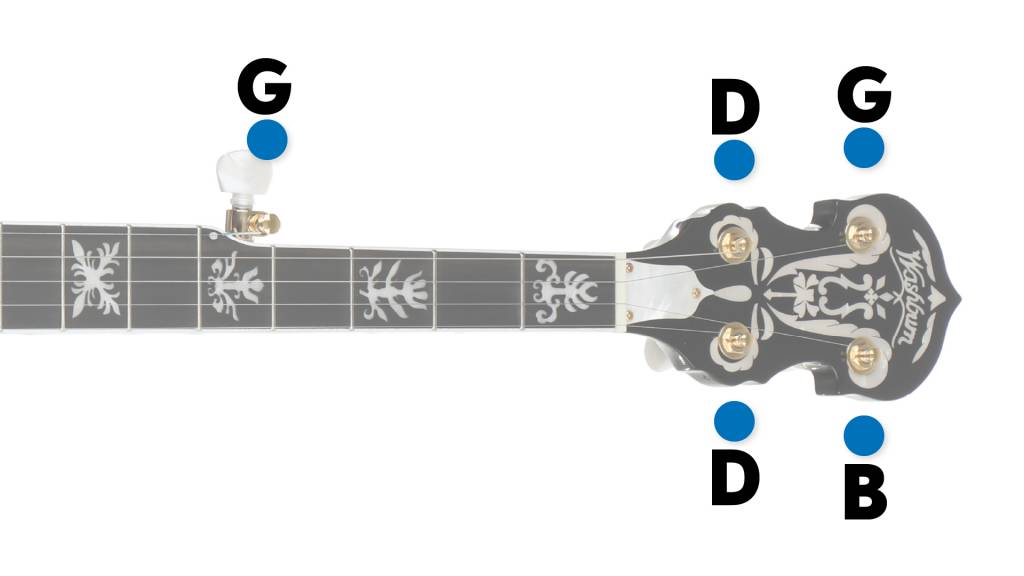
- The standard tuning for a banjo is:
- 5-String Banjo: GDGBD
- 4-String Banjo: CGDA
Important! — Use a tuner app or invest in a quality banjo tuner
Listening and staying in tune are two critical elements of making music. If your banjo is out of tune, it will sound like other instruments and voices are out of tune, too. That’s challenging to sing with and just as difficult to listen to. Use a free tuner app for your smartphone or get a clip-on tuner to help you keep your banjo in tune.
2. Tighten if Flat, Loosen if Sharp
- If a string is lower than the intended pitch, or flat, tighten its tuning peg to raise it to pitch.
- If a string is higher than the intended pitch, or sharp, loosen its tuning peg to lower it to pitch.
Important! — Tuning peg position and string tension
Always bring a string UP to pitch by loosening it first, and then tightening, to maintain its tension and tuning peg position. So, if a string is sharp, lower the string slightly below the desired pitch, then raise to the desired pitch.
3. Tune Each String and Adjust
- Tune each string, repeating until all strings maintain their intended pitches.
- Other strings may adjust to tension and change pitch as you tune the next string.
Important! — Adjusting Banjo Intonation
While the open string can be tuned to pitch, the pitch each fret produces is managed by adjusting the banjo’s bridge position. The measurement from the center of the twelfth fret to the edge of the bridge should match and be equal to that from the center of the twelfth fret to the edge of the nut. Loosen the string tension prior to adjusting the bridge, and then use a pencil to mark its location once in position.
Frequently Asked Questions
The Importance of Tuning
How often should you tune?
A banjo should be tuned every time it’s played. Whether practicing or performing, musical instruments require tuning to produce their notes at the correct pitches. Stringed instruments have multiple strings which require tuning, and maintaining their respective pitches is necessary for all the notes to “sound right.”
Can you tune a banjo by ear?
A banjo can be tuned by ear, but we recommend using some type of tuning tool. Whether recording or playing in an ensemble, music requires instruments to be in tune with one another, otherwise the sum of all the differences is a noticeably “less-in-tune” result. Free app tuners, affordable clip-on tuners, and quality professional tuners are available at all levels.
What is the difference between Sharps and Flats?
Sharps and Flats are music notation markings used to communicate which notes an instrument plays (e.g., C♯, B♭). They are also used while tuning to describe whether a string is too high or too low. Sharps (♯) mean the note is higher in relation, and flats (♭) mean the note is lower in relation. In practice, that means if a string is too low, it is flat and needs to be raised to its intended pitch. If a string is high, it is sharp and needs to be lowered to its intended pitch.
Can you tune a banjo with a guitar tuner?
Most tuners will work with a banjo. Some tuners, especially clip-on tuners, may perform better based on where and how well they’re connected to the headstock. Using your phone’s microphone and a free tuner app will also work, but it may not be as accurate or consistent as a clip-on, handheld, or cable-connected pedal tuner, especially in loud or noisy environments.
What is standard tuning for 4- and 5-string banjos?
Standard tuning for a 5-string banjo is GDGBD and a 4-string banjo is CGDA. While 4- and 5-string banjos have standard tunings, there are many alternate tunings appropriate for certain songs and genres, too.
Shop Tuners for Banjo
Whether you’ve got an assortment of guitar tuners or already found your favorite one, it seems like it never hurts to have one around (they’re so useful!). If you’re looking for your first tuner, an upgrade, or another tuning tool for your instrument collection, Sweetwater has the tuning tool right for you.
Clip-on Tuners
Clip-on tuners are the go-to solution for guitarists and one of the most convenient tools for tuning your banjo. Attach one to your banjo’s headstock, and it will display each string’s pitch as you play. This is the musician’s go-to tuning solution, and you might consider clipping one onto each instrument so that you never forget and are always tuned up.
- Korg Sledgehammer Pro Clip-on Tuner
- TC Electronic UniTune Clip Clip-on Chromatic Tuner – Noir Sweetwater Exclusive
- Peterson StroboClip HD High Definition Clip-on Strobe Tuner
- Snark Rechargeable Tuner
- Snark Son of Snark Mini Guitar and Bass Tuner
Tuner Pedals
If your banjo has a pickup with an output jack (¼-inch connector), a pedal tuner is great so that the tuner is connected and powered along with all the other pedals. Besides, if you’ve got a tuner on your pedalboard, you don’t have to use a clip-on tuner.
- Korg Pitchblack Custom Pedal Tuner
- Boss TU-3 Chromatic Tuner Pedal with Bypass
- Peterson StroboStomp HD Pedal Tuner
- TC Electronic PolyTune 3 Noir Mini Polyphonic Tuning Pedal
Handheld Tuners
Handheld tuners come with a variety of features not found in the clip-on and guitar pedal formats. Specifically, they often feature a ¼-inch instrument cable input, a built-in metronome, and even a speaker to hear a tuning pitch like A440.
- Korg GA50 Guitar and Bass Tuner
- Boss TU-30 Metronome and Tuner
- Peterson StroboPlus HDC – Chromatic Handheld Strobe Tuner
Learn More About Tuning a Banjo
We’ve shown you’re a lot about tuning a banjo, but there’s even more knowledge available! Check out these hand-picked videos we found both interesting and useful when learning how to tune a banjo.
How Does A Strobe Tuner Work?
How to Place & Install a Banjo Bridge | Fender
How to Tighten a Banjo Head | Fender
Related Articles
When you need help, Sweetwater has the answers!
Our knowledge base contains over 28,000 expertly written tech articles that will give you answers and help you get the most out of your gear. Our pro musicians and gear experts update content daily to keep you informed and on your way. Best of all, it’s totally FREE, and it’s just another reason that you get more at Sweetwater.com.