An Essential Part of Your Rig
Few things peg you as an amateur player faster than an out-of-tune instrument. Whether or not you can crank out “Flight of the Bumblebee” at 650 bpm, keeping your instrument in tune is vital to a great performance. That’s why you need an electronic tuner in your rig. It enables you to tune up quickly and efficiently even in loud stage environments.
An electronic tuner detects your pitch and indicates via digital meter, analog needle, or LCD/LED display whether your instrument is tuned higher or lower than your preferred pitch, so you can adjust accordingly. Tuners are available in a variety of sizes and shapes ranging from pocket-sized units to rack units. This guide will help you navigate the world of electronic tuners and help you find the one that’s best for you.
Many Sizes and Shapes
Handheld

Since the ’70s, both electric and acoustic guitarists have relied on handheld tuners. These pocket-sized units typically feature a 1/4″ jack for plugging in your guitar and a built-in microphone for picking up your acoustic guitar. These tuners range from simple devices that display the six notes used for standard guitar tuning to full-blown chromatic tuners that recognize all 12 chromatic pitches. Many handheld tuners boast an internal speaker for generating reference tones that make it easy for large groups of musicians (such as orchestras) to tune their instruments simultaneously. Some handheld tuners even have onboard metronomes for sharpening your timing.
Clip-on

The built-in mics on handheld tuners are great when you’re in a quiet place, but on a loud stage — not so much. Unless you want to unplug your guitar from your live rig and plug it into your tuner (then unplug it from the tuner and plug it back into your rig) every time you drift out of tune, you’ll be back to begging your keyboardist for assistance. And acoustic guitars? You’re out of luck.
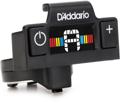
Fortunately, in the mid-’90s, a new breed of tuners emerged. Suitable for both acoustics and electrics, these tuners attach to your guitar’s headstock via spring-loaded clip and employ a built-in transducer to sense the pitch of your instrument. While clip-on tuners are typically not as feature-rich as their handheld brethren, their convenient design often makes up for it.
Pedal

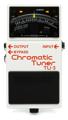
If you’ve got a pedalboard, then a stompbox-style tuner is another convenient option. Like clip-on tuners, pedal tuners can be used on a loud stage. And these road-worthy tuners are usually housed in durable metal or heavy-duty plastic, so they’ll withstand the torture associated with gigging — the kind of punishment that would tear your clip-on tuner to pieces. These tuners utilize a foot-operated switch to toggle the device on and off.
Pedal tuners vary from bare-bones to fully loaded, but one feature you should look for is true bypass. A true bypass design prevents the tuner from coloring your tone when it’s not in use.
Rackmount
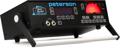
Pedal tuners are great, but what if you prefer rackmount gear? No problem — there are scores of rackmount tuners available. A great additional benefit of rackmount tuners is that their larger size leaves room for a bigger display and other advanced features. These tuners are especially useful in a studio setting, where they can be placed conveniently in a rack among the other gear. Many rackmount tuners even boast multiple inputs and outputs, making them appropriate for huge, complex rigs.

Soundhole

For acoustic guitarists, a soundhole tuner offers the ultimate in discreet placement. Like clip-on tuners, soundhole tuners utilize a built-in piezo sensor to recognize the pitch of your instrument, so they work well in noisy environments. Unlike clip-on tuners, these devices are placed inside of your guitar’s body, invisible to everybody but you. And placing the sensor so close to the source yields ultra-precise performance that can’t be matched by clip-on tuners. Some acoustic-electric guitars already have built-in internal tuners that work in much the same way as soundhole tuners.
App

If you’re ever caught in a bind without your tuner, there are numerous tuning apps available for your smartphone (there’s an app for everything these days). In a pinch, these apps are useful. That being said, most of them aren’t very good. The internal microphone on a smartphone is built for speech, not instrument tuning, so tuning accuracy of these apps should be taken with a grain of salt. And they don’t work in loud environments. So for quick and dirty tuning at the coffee shop, an app may do the trick. On a noisy stage, however, you will want to rely on a real tuner.
Learn more about the BOSS Tuner App
Strobe

The first electronic instrument tuner, dubbed the Stroboconn, was released in 1936. The Stroboconn utilized strobe tuning, which provided amazingly accurate pitch measurement. Strobe tuning historically employed a light shining on a disk. Slots on the disk create a stroboscopic effect, as it spins at a very precise speed. When a pitch is in tune, the slots appear to freeze or stand still. While incredibly accurate, old-school mechanical stroboscopes are inconveniently heavy and have a fragile tube-based design, so they’re not very practical for everyday use. Modern stroboscopic tuners utilize an LED array strobe in place of the rotating disk, yielding similar results without moving mechanical parts.
It should be noted that the “strobe mode” on most LCD/LED tuners, while it emulates a stroboscope, is not as accurate as a true strobe tuner. It merely provides an alternate type of visual feedback.
Advanced Features
Calibration and Temperament

Simple tuners indicate whether you’re sharp or flat compared with standard concert pitch, which in the US is the A above middle C tuned to 440Hz. That being said, many orchestras don’t adhere to this standard. For example, the New York Philharmonic uses 442Hz as their reference pitch. The Boston Symphony utilizes 441Hz. German and Austrian orchestras employ 443Hz, and on the Internet, there’s a group that is pushing for 432Hz as a new standard. Advanced tuners allow calibration to frequencies other than concert pitch as a reference, ensuring that you are in tune with the ensemble you’re playing with.
Another feature you’ll find on high-end tuners is adjustable temperament. Temperament refers to how individual notes are tuned in relation to each other. Most Western music relies on equal temperament, in which each octave is divided into 12 equal parts. This causes the frequencies between adjacent notes to be exactly the same. Equal temperament allows your instrument to sound in tune in every key.
Changing your tuner’s temperament setting displays “sweetened” tunings that enable musical possibilities unattainable using proper intonation. The downside is that your instrument will sound in tune in some keys and out of tune in others, making modulating between keys difficult.
Polyphonic Tuning

A relatively new tuner option is polyphonic tuning. This allows you to tune all six guitar strings with a single strum, which is an excellent time-saver. Polyphonic tuners are available in handheld, pedal, and clip-on formats. TC Electronics offers the PolyTune 3 which is perfect for this.
Tuners Are Essential to Success
Without a tuner, you won’t sound your best. At worst, your out-of-tune playing will make you look like a complete greenhorn, and even your most incredible guitar lick won’t be able to rescue your performance. A tuner is a relatively inexpensive investment. You owe it to yourself and your music to play in tune.