Whenever someone mentions a green guitar pedal, everybody assumes we’re talking about a Tube Screamer. The Tube Screamer isn’t the only green stompbox in town, however. There’s another contender for the title of “the world’s most ubiquitous green guitar effects pedal.” The stomp in question has been a mainstay on pedalboards — from bedroom noodlers to arena-class performers to viral experimental YouTube phenomena — for more than two decades. Of course, we’re talking about the Line 6 DL4 Delay Modeler. In production for over 20 years, this pedal has long been lauded for its forward-looking features and its reasonable price tag.
A Digital Pedal for Analog Junkies
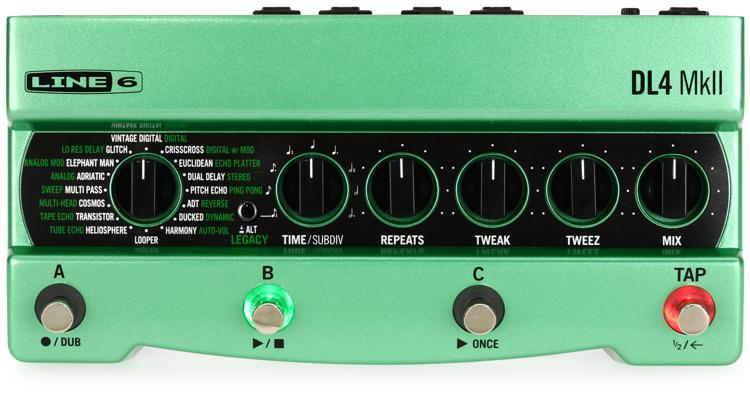
First introduced around the year 2000, the Line 6 DL4 — later dubbed the Big Green Monster — was the first of its kind. Most guitar pedals in this era fit squarely into one of two categories: a simple, one-function analog stompbox or a bloated, digital multi-effects unit. The DL4 is different. It’s a digital device. That said, it boasts an analog-like simplicity. Rather than relying on a squint-and-you’ll-miss-it LCD screen that requires deep-sea menu diving, the DL4 operates via a straightforward, 16-position mode selector knob plus another five knobs for adjusting your sound. Four typical, analog-style footswitches round out the DL4’s controls. If you can operate a standard guitar stompbox, then you’ll have no trouble navigating the DL4.
The Big Green Box o’ Echoes
The Line 6 DL4 is an old-school-style stompbox that houses 24-bit, true-stereo digital models of coveted delay units such as the TC Electronic 2290, Roland RE-101 Space Echo, Electro-Harmonix Deluxe Memory Man, and Maestro EP-1 Echoplex. Beyond that, you get a cache of Line 6’s own creative effects algorithms — many legendary in their own right — such as the Auto-Volume Echo and Reverse delay. One of the DL4’s most used selections is its Rhythmic Delay mode, which yields you tight, percussive Edge-esque delay repeats with selectable time subdivisions. Ear-grabbing ping-pong delays and mind-bending panned effects are right at your fingertips. The DL4 also features Tweak and Tweez knobs, which permit you to adjust modulation, distortion, and tape-artifact characteristics, depending on which emulation you’re using. The DL4’s built-in tap tempo is another feature considered highly innovative two decades ago.
A 14-second Musical Revolution
In addition to supplying a large cache of delay effects, the DL4 also includes a 14-second looper — a rarity at the time of the original unit’s release, especially at its relatively modest price point. Guitarists, vocalists, drummers, bassists, keyboardists, and musicians in the entire musical spectrum have used the DL4’s looper for practice as well as for live, real-time overdubbing onstage and in the studio. You also get half-speed and reverse looping modes, supplying you with a lot of ammunition for experimental forays into the unknown. Courtesy of its easily accessible looping capabilities, the DL4 helped, at least in part, to spark a massive array of exciting, new technology-centric musical genres centered around real-time sound-on-sound performances.
Building the Perfect Beast
At the time of the DL4’s unveiling, Line 6 had released a couple of digital-modeling guitar amplifiers, but the company was primarily known for their groundbreaking POD: a digital guitar-amplifier modeler packed into a portable processor. The idea of building a delay modeler was originally conceived by Greg Westall, Jeff Slingluff, and Patrick O’Connor as a four-preset design housed in a stompbox housing similar to a vintage BOSS CE-1.
An engineering team consisting of Michel Doidic, Nigel Redmon, and Jeff Slingluff continued to develop the product. Jeff Slingluff is credited with most of the DL4’s sound design. Industrial designer Lucian Tu was responsible for creating the pedal’s final look and feel. And Jeorge Tripps (of Way Huge fame) was brought onboard in 1998 to manage the project. Jeorge has been recognized for implementing the DL4’s built-in tap tempo, and he also contributed to the unit’s looper functionality.
The Big Green Monster’s Rise to Ubiquity
Many — and quite possibly most — pro guitarists have used the DL4, and many still have one on their pedalboards today. It’s safe to say that, if you listen to almost any popular album from the aughts, you’ll hear it. A cursory search on Equipboard serves up a veritable who’s who of well-known players, including Dave Grohl, John Frusciante, Thom Yorke, Noel Gallagher, Mike McCready, Stone Gossard, Les Claypool, Ed O’Brien, Buckethead, St. Vincent, Brent Hinds, John Scofield, Kenny Wayne Shepherd, Peter Buck, Alex Skolnick, and many more. Even old-school axe slingers like Ace Frehley and Joe Perry have had the DL4 in their rigs. Contemporary guitarists like Yvette Young and Scott Holiday have also made the DL4 part of their sound.
Many artists have found creative, novel uses for the DL4. Dave Knudson, guitarist for Seattle-based indie rockers Minus the Bear, deployed four DL4s to achieve an ear-grabbing, loop-infused sound that was ahead of its time. It wasn’t just guitarists that embraced the DL4 either. Indie-rock multi-instrumentalist Andrew Bird has been known to use one or more DL4s to craft mind-bending violin loops. And Tyondai Braxton used DL4s to fashion a unique vocal sound as a member of the NYC-based experimental band Battles.
The DL4 Delay Modeler, Part Deux
Two decades is a long time for a product to be in production with zero revisions. But, with the release of the DL4 MkII Delay Modeler, this situation has been satisfyingly rectified. This pedal features a similar layout to its predecessor along with all the original’s sounds and features. The MkII ups the ante, however, with 15 new HX-derived delay models, a selection of immersive reverbs, and 1- and 4-switch loopers with up to 240 seconds of recording time, which is expandable to several hours via the pedal’s microSD slot. Additional upgraded features include an XLR microphone input, comprehensive MIDI connectivity and control, switchable true/buffered/DSP bypass, and an expression-pedal input.

Line 6 DL4 MkII Delay Pedal: A Legend Is Reborn

Line 6 | DL4 MkII | Overview
If you’re a fan of the original Line 6 DL4, then you owe it to yourself to take the MkII for a test drive — it’s everything its forerunner was plus a whole lot more. And, if you’ve never owned a DL4, now’s the perfect time to jump onboard. So, give your Sweetwater Sales Engineer a call at (800) 222-4700 and join the thousands of satisfied DL4 aficionados with a Big Green Monster permanently planted on their pedalboards.