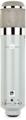
The REDD Mic – A Mic Unlike Any Other
 In November 2016 Chandler Limited announced the release of the REDD Mic, the company’s first ever microphone to join their extensive lineup of re-creations of classic vintage gear. As the only company in the world authorized to make and market “official equipment” of EMI/Abbey Road Studios, their product line includes enhanced versions of classic gear that are becoming classics in their own right, like the REDD.47 Mic Amplifier and RS124 Compressor, reproductions of classic Abbey Road gear that weren’t available to the public.
The new REDD Mic is a handcrafted large-diaphragm tube condenser microphone with a platinum diaphragm, and most curiously, it includes a REDD.47 mic amp right inside the mic body. That means it outputs a line-level signal and doesn’t require an additional outboard preamp. With dual patterns (Cardioid, Omni), a 10dB pad, polarity reverse, variable gain switching right on the mic (nine steps from +4 to +33dB of gain), a “Drive” switch, continuous output control, and low-contour control all built in, the microphone is ready for any challenge right out of the box.
When I read the press release and learned about how Wade Goeke, founder and principal designer of Chandler Limited, decided to design a microphone worthy of wearing the Abbey Road and EMI logos, I had questions. As the first new EMI/Abbey Road mic in 50 years, it is extremely intriguing, especially given Wade’s success in creating such amazing-sounding gear. I’ve heard lots of Chandler gear over the last 15 years and have been impressed by all of it, but I wanted to know more about this new mic so I decided to go straight to the source. I called Wade to find out “the rest of the story” about this new original mic design – a mic unlike any other.
Lynn Fuston: Wade, this is a good looking microphone, but it looks very reminiscent of a U47. Based on looks alone, I’m guessing that most people might expect it to sound like a 47.
Wade Goeke: Well the only thing that’s meant to look like a 47 is the grille. The rest of the mic is something completely different and was always intended to be different. Everything – the capsule, the circuit, the transformer – all of that is specifically different from any vintage mic ever made. It wasn’t meant to copy any of them or be derivative in any way, really.
This was never intended to sound like any other mic. It just sounds like an incredible vintage mic.
Is there a specific mic in the Abbey Road collection that inspired this mic?
That’s a long story. I started experimenting with mic circuits probably six years ago. Pretty soon after that, I came up with the mic/preamp combination idea. So many of the things that Abbey Road has done have become famous, and I thought Abbey Road deserved to have their own microphone, something as good as all the gear that they already use. To do that I thought it should have a circuit that is historically correct. I decided I could take my mic/preamp idea and use the REDD.47 circuit, and I spent the last three years doing that, trying it different ways – different applications of the circuit, different capsules, every combination I could think of. So no, there’s no mic at Abbey Road that it was designed to duplicate or sound like.

What was it like shipping a brand-new mic to Abbey Road for them to scrutinize, recognizing that they have some of the best mics ever made?
When I shipped it to them, the first thing they did was put it up against the John Lennon U47. That was tough, because I knew that’s what they’d be doing. Thankfully, they agreed it was on par with the mics they use every day, that they’ve been using for decades. That was a relief.
People always ask, “Does it sound like a C12? Does it sound like a U47?” No. It’s not meant to – not even a little bit. Does it have similarities? Sure. It sounds like an incredible vintage mic. I’ve listened to it beside my C12 and M49. Abbey Road has compared it to their U47s, U48s, C12s. We were never going for “Does it sound similar?” but we were trying to achieve “Is it on the same level as those mics?” From the start I didn’t want to remake anything. I wanted it to be its own thing. I wanted to do something historically significant.
In my 40 years in the studio, I’ve only ever seen one mic that had a line-level output. The biggest question I think most people will have about a mic with a preamp built in is “Why?” What’s the reasoning for that?
I wanted it to be its own thing – something historically significant.
I knew we were trying something new and different. When Mirek Stiles, the Manager of Abbey Road’s Audio Products division, heard it, he commented about how it could change the whole paradigm of picking mics and preamps. For me, the two main advantages are 1) the sound it produces and 2) the value that it adds.
As far as the sound, it’s just much more sensitive. We’re cutting down the amount of wiring, transmission lines, and circuitry. The wiring is reduced because it’s only half an inch between the mic and the preamp. Then you don’t have dozens or hundreds of feet of mic cable running a low-level signal between the mic output and the preamp input. The circuitry is reduced because you don’t have redundant amplifiers. And it’s less susceptible to EMI and RFI because that low-level mic signal is boosted to line level before it ever leaves the mic.
When you get to the value part, the customer gets increased value, because instead of buying a separate mic and preamp for a similar cost, now you can just buy the REDD Mic instead of springing for a $2000 mic and a REDD.47 preamp for $2300. With the REDD Mic, you can take it and just plug it straight into a line-level input on your audio interface or your tape machine.
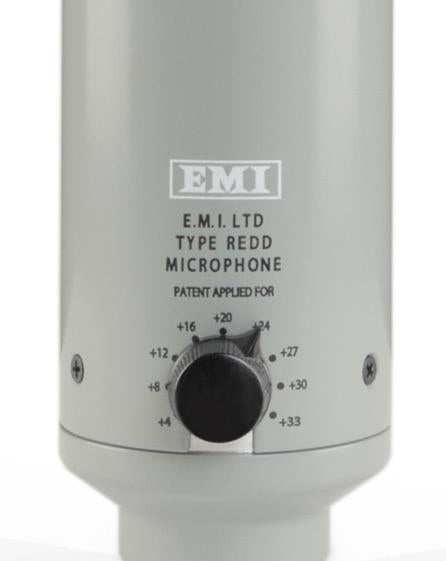
What about makeup gain if someone needs more gain than the 33dB on the mic? I frequently use more than 33dB in the studio.
If you have a really quiet acoustic guitar or a quiet singer, or you’re using it in omni for a room mic, you might need additional gain, but in the studio I’ve never needed it. In most cases I’ve had to use the facilities on the mic to turn it down.
The output impedance of the unit is 200 ohms, so it functions just like a microphone would, and you can run it to anything else you want just like a microphone. If you need some extra makeup gain, you could put a preamp in line mode and bump it 5dB or plug it into a 1200-ohm input and add as much gain as you like. If someone says “I love how my XYZ preamp sounds,” then they can just back down the gain on the mic and just plug it in to their preamp like they normally would. It’s designed to work as a standalone unit. Plus it’s not a ribbon or a dynamic mic that typically needs 50 to 60dB of gain.
That begs the question: What would the REDD Mic sound like through a REDD.47 preamp?
If you use the REDD.47 pre, it’s a 200-ohm input, so honestly I’d recommend having the pad on at the very minimum; otherwise, it can squish the front end of the REDD.47 preamp pretty easily. You might rather use the TG Channel or TG Microphone Cassette or TG2. I did that early on, running the mic into a preamp and overdriving it, to get that distorted vocal sound on the REDD.47, and it’s pretty neat sounding.
Well, here’s another question about plugging the REDD Mic output into another mic preamp. What happens if I accidentally turn on the phantom power on the preamp? Can I blow up the mic or damage the output stage?
No, you can’t damage the mic that way.

And for other processing, you can just take the REDD Mic output and patch it straight into the line-in on a compressor or EQ, totally bypassing the console?
Exactly. The shorter the signal path the better.
Why the platinum diaphragm, instead of the more standard gold diaphragm?
It adds a nice smoothness to it. A lot of mics these days are bright. Some of my favorite mics are C12s, and I have a vintage one that’s not really bright. I was going for the balance between brightness and smoothness.
Did you try any other capsules/diaphragms?
(Laughs) I tried about every capsule under the sun, including remade vintage ones of various types, and then decided on this one of our own, which is completely hand-milled and handmade for us in Europe. This was the last capsule we tried actually. I tried everything in existence before that and decided none of them would work for what I wanted. If I told you how much the capsule itself costs, you’d know we’re not skimping on the capsule.
Ok, here’s a question because I know a lot of people will ask. Can you give me any specifics about tubes and transformers?
Tubes? Yes. There are two. And transformers? Yes, custom-made for us.
Everything – the capsule, the circuit, the transformer – all that is specifically different from any vintage mic ever made.
I noticed the Output control is labeled from 0 to -10. Is that an active control with gain or a passive fader?
The output control is a fader and goes all the way down to infinity, just like a console fader. You use it to trim the output. If someone is using it in the control room, they can just use that as their fader to turn down the input to their recorder.

I saw “Pull for Low Contour” screened around the Output control on the power supply. Is that the same as the rumble filter on the REDD.47 preamp?
It’s not the rumble filter from the REDD.47 preamp. The circuitry is sort of different. It’s meant to achieve a different purpose. It tweaks the highs a bit too. I was envisioning this mic being used in studios where they don’t have a big microphone selection, so it has to cover as many bases as possible. I use it on acoustic guitar. It brightens up the highs a bit. It’s not like a filter; it’s actually a global change on the mic and adds another aspect of versatility. By combining that with the Drive function, you start to get options you don’t have on any other microphones.
Tell me more about the Drive circuit. Does it only work at the top end of the gain range?
No. It’s designed to be more of a tonal change, instead of a gain boost. It’s like the Fine Gain control on the REDD.47 preamp. It’s like if you took the Fine Gain control on the REDD.47 and turned it all the way up. It adds a density to the sound, and it’s a touch brighter, but just barely. It changes the taper of the control as well. It’s a different mode to try and see what tone you want. It’s less pristine with the Drive on – more alive and girthy sounding.
What have the engineers who have heard it so far said? What was their impression?
Everyone comments on how sensitive it is. And smooth. What we hear a lot is that they don’t need a de-esser. That lack of sibilance is one thing that most everyone has commented on. It’s just a really balanced sound.
It’s actually a lot less expensive than a vintage mic plus a great preamp.
Instead of comparing this mic to other mics in a similar price range and adding the cost of a preamp, should people think of this more on the level of the vintage original mics, some of which trade for more than $10,000?
Definitely. There’s a huge desire for those classic mics, and they’re just out of reach for most people. All the clones are just mimicking the originals. This is a totally new design. It’s a tribute to the past, inspired by those historic mics, but it’s a mic for the future, designed to be on par with those timeless classics.
Finally there’s a new mic worthy of the heritage of Abbey Road and EMI – the Chandler REDD Mic. The only question is whether you’ll be one of the first to have one in your studio. If you’re the kind of musician/producer/engineer that appreciates the sound and legacy of Abbey Road and all the amazing artists that record there, then this microphone will no doubt be near the top of your list. And when it comes to any of Chandler’s amazing gear know that Sweetwater is your source. Give your Sales Engineer a call and order yours now. (800) 222-4700.
Sweetwater is Your Source for Chandler
NOTE: Despite the fact that the REDD Mic does include a REDD.47 preamp, it does NOT have an XLR mic input, meaning you can’t plug another mic into it.