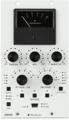
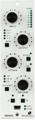
Imagine your dream studio, where your 500 Series processors are seamlessly integrated with your digital audio workstation. You have complete control of the analog rack hardware from your computer, with every setting, every tweak, every automation move controlled via computer and saved with your DAW session for instant recall. If you’ve just pinched yourself to make sure you’re not dreaming, let us assure you – you’re not. This technology is no pipe dream: it’s here today at Sweetwater.
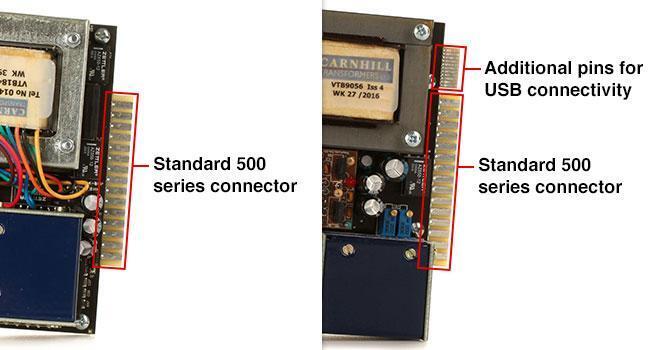
WesAudio, a company masterminded by Radoslaw Wesolowski and headquartered in Poland, is spearheading an initiative they call ng500. The “ng” stands for next generation. The company’s ng500 product line starts with modules that have an extended connector, a longer version of the one found on all 500 Series modules but with extra connections for USB control. These extra USB-control connectors are mirrored in the WesAudio _TITAN NG500 Recall Chassis. On its rear panel, the _TITAN is fitted with a USB jack for connection to your computer, as well as Ethernet for networked setups. All ng500-compatible modules in the rack will be able to communicate with your computer via a single data cable. Each module includes free downloadable software that appears in your DAW session as a standard plug-in and lets you control your analog hardware with software precision. Every setting and automation move is saved along with your DAW session file.

The _TITAN NG500 Recall Chassis is backward-compatible with standard 500 Series specifications, so you can use it as a conventional 500 Series rack and even mix and match most standard and ng500 modules. But here’s the really exciting part: WesAudio designed ng500 as an open system, and they provide a comprehensive free developer kit to companies that wish to develop for their GCon protocol implementation. This has appetizing implications for the future of recording: no longer will we have a binary choice of analog or digital; we’ll be working in a true hybrid studio that leverages and thoroughly integrates the unique potentials of both hardware and software.
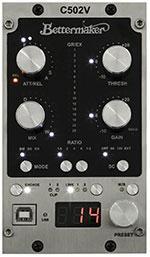
Another company that was a pioneer in the area of digitally controlled analog rack hardware is Bettermaker, which includes USB connections right on the front panel of their 500 Series modules and the back of their 19″ rackmount signal processors. They offer 1-touch digital recall right on the front panels, with 399 memory locations for your own custom presets. As with WesAudio, there is downloadable dedicated control software for each unit. You use the software as a plug-in in your DAW; all your settings and automation data are stored with your session. As there’s no “smart rack” involved, however, you would have to repatch USB cables to control different hardware units.
Pro-audio manufacturer Fredenstein takes a slightly different approach. Their 500 Series modules pass control data to the company’s Bento 10D and 6DS racks, which feature an LCD control panel and rotary encoder that allow you to link adjacent modules and set and recall parameters more confidently and precisely than you could by simply eyeballing it directly on a module. Solid State Logic, a renowned console company that needs no introduction, has their X-Rack, a proprietary modular smart-rack system with Total Recall. The Fredenstein and SSL racks do not have provision for complete, real-time module control via computer, but they are “smart racks” nevertheless. All considered, these developments give us an enticing glimpse into where we think the industry is headed.
At Sweetwater, we keep our eyes (and ears) out for promising leading-edge trends in pro audio, and analog hardware that shuttles digital control data to and from a computer network is one that’s definitely on our radar. Today, we take for granted the total recall capabilities of our music software; but to truly appreciate how far we’ve come, consider that as recently as the 1970s, session “automation” often consisted of Polaroid photos of the console, stored along with the multitrack tape. Yes, we’ve come a long way – and the next step is total hardware-software integration. For that to happen, an open standard – like WesAudio’s GCon protocol – needs to be embraced by manufacturers and achieve critical mass. Looking back at the development and industry adoption of MIDI as an example, it may not take long. Meanwhile, as you set about building or upgrading your studio or live rig, pick up the phone and have a chat with one of our expert Sales Engineers at (800) 222-4700. It promises to be a stimulating – and productive – conversation.