Brass instruments have taken a long time to evolve into the forms we now know and love. Today, it’s hard to imagine a trumpet, tuba, or French horn without any valves. But it wasn’t until the last 150 years or so that valves became a standard feature on these instruments.
Since then, two major valve types have dominated the landscape: pistons and rotors. They both allow brass instruments to play chromatically but in slightly different ways. Come along with us as we explore the history of brass-instrument valves, how they work, and how piston and rotary valves affect the way you play your instrument.
A Brief History of Brass-instrument Valves
Brass instruments trace their origins back to ancient cultures such as Rome, Greece, and Egypt. Back then, they were used for military, ceremonial, and religious purposes. The instruments were much simpler back then — essentially, they were straight, narrow tubes that you buzzed your lips into.
Eventually, brass instruments grew in popularity during the Baroque and Classical eras. Composers like Bach, Haydn, and Mozart wrote many works featuring early trumpets, horns, and trombones. But these instruments still didn’t have any valves. Instead, players would either swap out crooks to change the instrument’s fundamental pitch or use extended techniques like hand stops and lip slurs to play chromatic notes.
Finally, inventor and horn player Heinrich Stölzel developed the first working valves in 1814. And, in the following decades, valves quickly became a basic feature on trumpets, cornets, French horns, tubas, and a host of other brass instruments.
Piston and Rotory Valves: How They Work
Your instrument generates a tone based on the length of tubing you’re blowing through. Both valve types work by diverting the airstream into additional tubing, thus changing how far it travels. By pressing down one or more valves, you change the horn’s fundamental tone and harmonics. And, while they perform the same function, rotors and pistons work slightly differently from each other.
Piston Valves
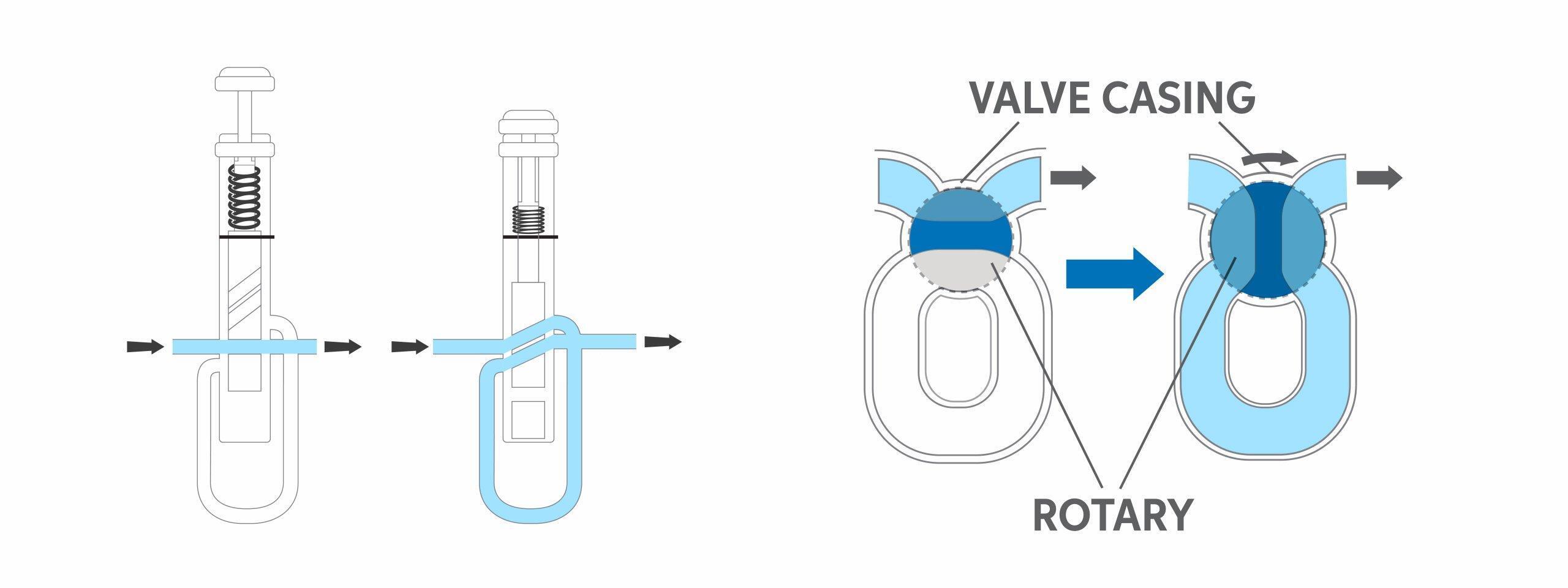
Pistons are the most common type of brass valve and were the first ones developed. They work by moving a cylindrical stock up and down the valve casing. The stock has ports that, when pressed down, line up with the slides on your instrument.
You’ll typically find piston valves on trumpets, cornets, euphoniums, tubas, and other instruments in their families.
Rotary Valves
Instead of moving a stock up and down, rotary plugs rotate in place by 90 degrees. The plug is flat and round with two ports cut through it to divert the airstream. In most designs, you engage the valve by pressing down a lever, which then rotates the plug.
Rotary valves are most common on French horns but can also be found on F-attachment trombones, German-style tubas, and other instruments. Rotary-valve trumpets are also the standard trumpet in orchestras from Germany and Austria.
Axial flow valves (sometimes called Thayer valves) are another type of rotary valve. They were first developed by Orla Ed Thayer and Zig Kanstul in 1976. You’ll find them on some models of trombone, like the Bach Stradivarius 42FG.
Typical rotary valves deflect air through the instrument at least four times, creating more resistance. Axial flow valves aim to solve this problem by using a cone-shaped plug that diverts the airstream only once at a 25- to 30-degree angle. This gives the instrument a more free-blowing feel, which some players prefer.
Differences in Sound Quality and Playability
Pistons and rotors aren’t just functionally different; they have subtle effects on a horn’s sound quality and playability, too. Of course, other design elements might be at play, such as bore taper or bell size. But, in general, piston instruments tend to have a more direct, focused sound, whereas rotary instruments have a broader, mellower sound.
As far as playability is concerned, each one has some advantages over the other. Piston valves have a faster and cleaner action than rotary valves, making them ideal for complicated passages where every note needs to be heard. A piston’s travel distance and spring tension also allow players to perform techniques like “half valving.”
By comparison, rotors have a smoother action than pistons. This lends itself well to playing more lyrical pieces of music, such as John Williams’s “The Force Theme” from Star Wars.
Maintaining Piston and Rotary Valves
Whether your instrument uses pistons or rotors, you need to take care of them. Valves require regular lubrication and maintenance to work properly. Here are some quick tips for taking care of your instrument’s valves:
- Keep your valves lubricated. Like the Tin Man from The Wizard of Oz, valves will have a hard time moving if they aren’t oiled properly. Oil them to keep them working properly and to prevent them from getting scratched inside the casing.
- Choose the right oil for your instrument. Valve oil comes in a variety of different blends. Some oil is made specifically for brass rotors, while others are used for pistons. Check with your music teacher or local repair technician if you’re not sure which one to use. If all else fails, then stick with the same oil that came with your horn.
- Clean the surface of the valve.* Every now and then, it’s a good idea to remove all the oil and give your valves a fresh start. When you remove the piston, clean the surface with a microfiber or polish cloth. This will get rid of dirt and gunk.
- Clean out the casing.* Once a piston’s removed, clean out the inside of the valve casing using a lint-free cloth and a cleaning rod.
- Get your instrument regularly serviced. Regular and preventative maintenance will do wonders for the health and longevity of your valves. At least once a year, take your instrument into your local repair shop for service.
*Note: Tips 3 and 4 apply to piston instruments only. Rotary valves should not be disassembled without help from a certified repair technician.
You can find everything you need to take care of your instrument valves in one of these handy care kits, including valve/rotor oil, brushes, and polishing cloths. And, if you want more instructions on taking care of your brass instrument, check out our Trumpet Care and Maintenance Guide.
Final Thoughts
Both piston and rotary valves are truly remarkable innovations in the world of brass instruments. Knowing how they work and how recently they were developed leads to a deeper level of appreciation for your horn. Whether you’re looking for essential care items to maintain your trumpet pistons or splurging on a new French horn with a pristine set of rotors, let our Sweetwater Sales Engineers help you by calling (800) 222-4700 — they’ll take care of you and your horn!