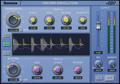
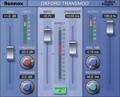
Last time, we discussed the Overshoot control and how it can tune the response of the Sony Oxford Trans Mod to the program material (see TTOTD 4-6-06). The next control we’ll discuss is the Recovery control.
The Recovery control adjusts the envelope processing of the Trans Mod over time. Its function is closest to that of the Release control of a compressor. Recovery controls the length of time that passes before the Trans Mod will act on another transient. Small recovery values will allow action to almost each and every transient, even if they occur in very rapid succession. Longer recovery values will gently and progressively reduce the action depending on the rate at which transients occur. Setting a long recovery value can prevent excessive action on small, rapid transients in the signal, such as a hi-hat figure, which directly follows large transients from kick drum or snare hits. Thus, if you need to bring up the snare hits without hyping the hi-hat, you can do so. Since the action of the Trans Mod is program dependent, in the absence of large transients, (kick, snare, etc.) the small transients in the quieter sections of the program material will be progressively included back into the Trans Mod’s processing action. The effects produced by the recovery control are usually quite subtle.
Small to medium-range settings will work best for most popular music material.