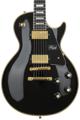
Today we celebrate what would be the 101st birthday of one of the most important figures of modern music, Lester William Polsfuss, better known as Les Paul. Many know Les Paul for his extensive catalog of hit records, while others know his inventions in the recording studio that still define how we record music today. And guitarists, of course, know him for his contributions to the solidbody electric guitar and the iconic instrument that has been adorned with his name since 1952. Every one of those things changed the course of popular music forever. So it goes without saying that 101 years later, Les Paul may still be one of the most influential figures in music history.
Childhood
Les Paul was born in Waukesha, Wisconsin, in 1915. Though he showed an immediate affinity for music, his first attempts were less than inspiring to his parents or music teachers. Undeterred, Les worked at teaching himself the banjo, harmonica, and guitar. He quickly found regional success playing country music of the time. But his love affair with music also spawned his need to constantly tweak and tinker with his instruments to improve their original designs and explore new sounds and possibilities. Les Paul the musical inventor was born.
Music and Television Career
In the mid 1930s, Les’s interest in country music was waning, and he made the move to a career in jazz. He quickly found success, playing with the incredibly popular Nat King Cole, Bing Crosby, and others. But realizing that he still didn’t have a sound of his own, Les went to work finding ways to reproduce the musical sounds in his head, things that had never been heard before. His next recordings changed the sound of modern music forever. Every bit as groundbreaking as Jimi Hendrix or Eddie Van Halen, Les’s pioneering use of electric guitar effects, such as delay, reverb, phasing, and pitch modulation, heralded a new era of the electric guitar.
In an effort to reach a wider audience than with his instrumental guitar recordings, Les began a search for the perfect vocalist to accompany him, and he quickly found his musical and romantic soul mate, Mary Ford. The couple married, and in 1950 they became massive stars with a long string of hit recordings and their television show Les Paul and Mary Ford at Home. Though the couple split in 1965, their legacy lives on as one of the most important duets in music history. Les Paul continued to find success in the following decades, first scoring a Grammy award in 1976 for his guitar duet album Chester and Lester, with the iconic Chet Atkins, and later being inducted into the Rock and Roll Hall of Fame in 1988. As a matter of fact, up until a few weeks before his passing, Les could still be found onstage at the Iridium in New York City every Monday night, playing the music he loved.
Innovations
But music was only one aspect of what this musical giant contributed to the world. Every music fan in the world owes him a great debt of gratitude for pioneering the instruments, technology, and processes that we know as modern music today. Here are a few of his monumental creations.
Sound on Sound
While married to Mary Ford, Les created a method called Sound on Sound (multitrack recording) for using his Ampex reel-to-reel tape machines that enabled him to layer his guitar performances, a technique never used before. His song “Lover” is a masterful example of how he used this technology to create lush guitar-based orchestrations. Today, almost every album produced uses the multitrack process to record and layer sounds. But it was Les and his Sound on Sound techniques that paved the way for what we know as music production today.
Solidbody Electric Guitar
Believe it or not, Les’s first solidbody electric guitar wasn’t a guitar at all. It was part of a railroad track that he added a string to as a child. Even at that young age, Les was looking for the purest tone possible from a vibrating string. In the early 1940s he went to work (after hours at the Epiphone guitar factory) crafting what most accept as the first solidbody electric guitar, affectionately known as The Log. The Log was little more than a guitar’s neck, hardware, and electronics mounted to a 4″ x 4″ chunk of wood. He then attached body wings to give the instrument a more traditional look. This new guitar resisted feedback at higher volumes, had greatly increased sustain over hollow designs, and gave Les the pure string sound he had been searching for. Though Fender beat him to the punch in mass producing a solidbody, Les’s The Log predated Fender’s designs by almost a decade.
Home and Mobile Recording
Yet another monumental contribution Les Paul made to the musical world is the concept of home recording. After Bing Crosby gifted him with an Ampex reel-to-reel, Les realized that he and Mary Ford could take their Sound on Sound technology on the road. Not only were they able to build a functional studio in their home, the couple even kept the necessary equipment in their car for writing and recording in hotel rooms while traveling. Because they were often recording in untreated spaces, they began experimenting with using different rooms for different sounds, new concepts in microphone placement, and much more. The next time you sit down comfortably in front of your DAW in a home studio, just know that Les Paul was there decades ago.
Gibson Les Paul Electric Guitar

Perhaps Les’s most iconic and visible design is the legendary Gibson Les Paul solidbody electric guitar. When Les initially brought his design for a solidbody to Gibson in the 1940s, Gibson disregarded the instrument. But in the early 1950s, Fender found popularity with their Esquire, Broadcaster, and Telecaster models. This led Gibson to quickly reach out to Les for help designing an instrument that would compete with Fender’s models. The resulting instrument remains one of the most successful guitar designs in history, and the single most lucrative and long-standing guitar endorsement of all time.
Gibson SG Electric Guitar
Believe it or not, Gibson’s famous SG body style also came from Les Paul’s relationship with the company. In the early ’60s, the original Les Paul design was fading in popularity. So Gibson redesigned the Les Paul guitar with a double cutaway, sharper contours, a much thinner body, and no maple cap. Les didn’t immediately take to the instrument’s new construction, asking for his name to be removed from it. The new guitar was then dubbed the SG (for Solid Guitar) and went on to be one of the most famous Gibson electric guitars of all time.
The Les Paulverizer
During his time with Mary Ford, Les created a device that would allow him to demonstrate the duo’s Sound on Sound technique live and on the air. He called this device the Les Paulverizer. The Les Paulverizer became a huge hit and a major part of the duo’s live act. So Les went to work refining the device into a small black box that he attached to his guitar. Now he could play one of his parts and instantly record another part on top as the first pass looped over and over. Today looping is a major part of live guitar performance, but many people don’t even know that this is yet another musical option that can be traced directly back to Les Paul.
Delay Effect
The use of delay has become integral to the signature tones of many of today’s guitarists. Again, Les Paul was there first. Les realized that by feeding the output of the playback head back to the record head on his reel-to-reel tape machine, he could achieve a repeating echo sound. Not only did that add a new tonality to his playing, but he could now play a phrase and immediately play over it in another octave. This was one of his very first steps into multitrack recording and layering sound.
Harmonica Holder
That’s right, one of Les Paul’s first inventions that we still see used widely today is the around-the-neck harmonica holder. As a young teen, Les wanted the ability to play his harmonica while also playing guitar. So he went to work fashioning a holder out of a metal coat hanger and some wood. Today you’ll find these around the necks of singer/songwriters around the world.
Les Paul’s Continuing Legacy
Les Paul was such a relentlessly creative and motivated person that writing about his every song, record, award, guitar technique, recording technique, and studio invention would take pages and pages. It is likely that there is not another person who is more responsible for what we know of music today than he is. His contributions span every genre, are found in the studio and on the stage, and permeate every musician’s life daily. And besides all that, he was a great songwriter and guitar player. So remember, every single time a musician sits down with their Gibson Les Paul, in their home studio, to lay down an overdub of a previously recorded guitar part that is drenched in delay, wondering how they’ll re-create that layered effect live, that musician owes it all to the one and only Les Paul. From everyone at Sweetwater: Happy 101st Birthday, Les.
For more information about Les Paul, visit the Les Paul Foundation site.
*Photo credit: William P. Gottlieb