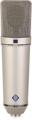
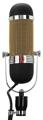
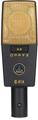
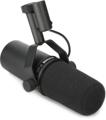
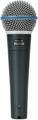
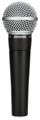
From handheld stage dynamics to high-dollar large-diaphragm studio condensers to tour-ready contemporary ribbons, there are lots of microphones out there. At Sweetwater, our customers often ask us how microphones work. This article examines the most common varieties of microphones, explains how they capture a source and turn it into an electrical signal, and explores common uses for each type.

Dynamic Microphones
Dynamic microphones — a.k.a. moving-coil microphones — work via electromagnetic induction. They employ a magnet that surrounds a small, moveable induction coil that sits inside that magnetic field. Attached to the end of the coil is a diaphragm, a lightweight membrane, which vibrates back and forth when sound waves encounter it. As the diaphragm moves, those vibrations are transferred to and move the coil, which causes an electrical current to be produced at the microphone’s outputs. A transformer is used to step up the very low-level signal to achieve a mic-level signal. If you’re familiar with how loudspeakers work, then you’ll notice that dynamic microphones utilize a similar design, just reversed.
While dynamic microphones are simple devices, especially compared to high-performance studio condensers, they have many advantages. For starters, they’re inexpensive to produce. Their natural isolation safeguards against unwanted pickup in noisy environments, and they can handle high-SPL sources, such as cranked guitar amps and snare drums, with aplomb. They’re also extremely robust and resistant to moisture, and cardioid and hypercardioid versions offer excellent gain before feedback — must-have characteristics for onstage use.
Beyond that, there are situations where a dynamic mic simply sounds right — even more so than a top-dollar condenser microphone. There’s a reason why Quincy Jones and Bruce Swedien opted to use the Shure SM7B — a $400 dynamic broadcast mic — on Michael Jackson’s voice for his chart-busting Thriller album. With sales figures in excess of 66,000,000, Thriller is the best-selling album of all time. This demonstrates that even a humble dynamic microphone can deliver a multi-platinum sound!
- Further reading: Dynamic Microphones: How Do They Work?
Condenser Microphones
Condenser microphones — a.k.a. capacitor microphones — contain a thin, stretched conductive diaphragm positioned close and parallel to a metal back plate. This arrangement effectively creates a capacitor. When sound waves enter the microphone, it causes the diaphragm to move. As the distance between the membrane and back plate vary in distance, the variance results in capacitance changes, which in turn leads to the output signal of the microphone.
An amplification circuit, which is driven by an external power source (either phantom power or a dedicated power supply), or an internal battery is then used to attain a sufficient signal level. The lion’s share of modern condensers uses a solid-state circuit for amplification. That said, condenser microphones with tube-based electronics remain coveted items due to their ear-pleasing harmonic characteristics.
If you want to record a source with full detail and clarity, then reach for a condenser — that’s its stock in trade. Thanks to their microns-thin diaphragms, condenser microphones capture high frequencies that evade dynamic mics. What’s more, in addition to a unidirectional cardioid polar pattern — the standard for most dynamic mics — many condensers include figure-8, omnidirectional, and other polar patterns for added versatility.
Because of their high-end sound, industry-renowned condenser microphones such as the Neumann U 87 and AKG C414 are studio staples — you’ll find nary a professionally engineered recording without one of these types of mics on it. They’re the go-to solution in an endless array of applications.
- Further reading: Condenser Microphones: How Do They Work?


Ribbon Microphones
Ribbon microphones — a.k.a. velocity microphones — are a type of dynamic microphone. Thus, they operate via electromagnetic induction. Ribbon mics eschew the dynamic microphone’s induction coil for a thin strip of metal — a ribbon — that is suspended in a magnetic field. The ribbon acts as both a diaphragm and a transducer element, yielding a condenser-like sensitivity and transient response but with a character all its own.
Classic ribbon mics feature a passive design, and therefore very low output level, meaning that they’re gain-hungry beasts. They’re also highly sensitive to a preamp’s input impedance. If you’re using a ribbon microphone, then it’s important that your preamp has a high enough input impedance to reproduce its full range as well as enough gain to generate a sufficient signal level. Modern active ribbon microphones such as the sE Electronics VR2, Royer R-122 MKII, and AEA R84A are also available. Active ribbon mics include onboard electronics that permit maximum performance regardless of your preamp’s input impedance.
Historically, ribbons have been delicate — and expensive — microphones relegated to high-end studios and gear museums. That’s no longer the case, however. Present-day models, such as the Technical Grammy Award–winning Royer R-121, are battle-ready brutes that can handle anything you throw at them. In fact, modern ribbons are standard issue for miking guitar cabinets. You’ll be delighted by the smooth-sounding highs and the muscular low-mid punch a ribbon lends to a roaring amp stack.
- Further reading: Ribbon Mics — How They Work and When to Use Them
Both onstage and in the studio, microphones are among the most important tools that an engineer deploys. After all, unless your projects are all in the box and limited to virtual instruments, you can’t record music without at least one mic! If you have any questions about microphones — or recording or live sound in general — your Sales Engineer will be happy to help. Give us a call at (800) 222-4700 to get started!