

As the first of Fender’s cutting-edge ’60s creations, the Jazz Bass is perhaps the last truly uncontested design the company released in their pre-CBS golden era. Standing up to the might of the Precision Bass is no small order, yet the Jazz Bass quickly proved its worth as not only the equal to the world’s first mass-produced electric bass but also as a perfect complement — where the P has punch, power, and vibe, the J has growl, versatility, and finesse. Join Sweetwater as we explore the origins, elements, and players that have made the Jazz Bass a household musical name for more than 60 years of ground-shaking tone.
- Built on a Precise Foundation
- Fender’s Second 4-string Creation
- Sleek Offset Body Shape
- Dual Single-coil Growl
- Narrow Down the Neck
- Metal & Foam
- The First 10 Years
- The J Bass Finds Its Groove
- One-half of the 4-string Whole
- Variations on a Theme
Built on a Precise Foundation
While the Fender company began life in the post-war production boom of the ’40s, the ’50s was the decade where Leo Fender found his stride. In 10 short years, Fender’s three main solidbody guitar inventions — the Telecaster, Stratocaster, and Jazzmaster — had dramatically transformed the idea of a solidbody instrument from a gimmick into arguably the standard for an electric guitar. That’s not to suggest it was easy — Fender faced plenty of adversity in the early days.
Perhaps the most remarkable example of adversity was Fender’s (and the world’s) first mass-produced solidbody bass: the Precision Bass. You’ll note that Fender designed three legendary 6-strings during this period but was content to leave the world’s first mass-produced electric bass all on its lonesome. Frankly, this is primarily a result of the Precision Bass’s thoroughly tepid reception by the day’s high-minded upright players. Why bother building a second bass model when the first one wasn’t selling?
Instead, Fender tried an iterative approach, drastically modifying the Precision Bass throughout the ’50s, culminating with a bullet-biting wholesale redesign in 1957. It was right around this time that the rock ‘n’ rollers and surfers of the late ’50s first adopted the Precision Bass as their own, and the popularity and sales of the electric bass began its assured ascent to low-end dominance.
Fender’s Second 4-string Creation
And so, nine long years after the launch of the Precision Bass, it was high time for a second 4-string to enter the Fender stable. Shortly after the P Bass’s late bloom, Fender launched the Jazz Bass at the turn of the decade in 1960. It was initially titled the “Deluxe Model,” intended to be an upscale version that would replace the Precision Bass’s no-nonsense utility with a more elegant look and feel.

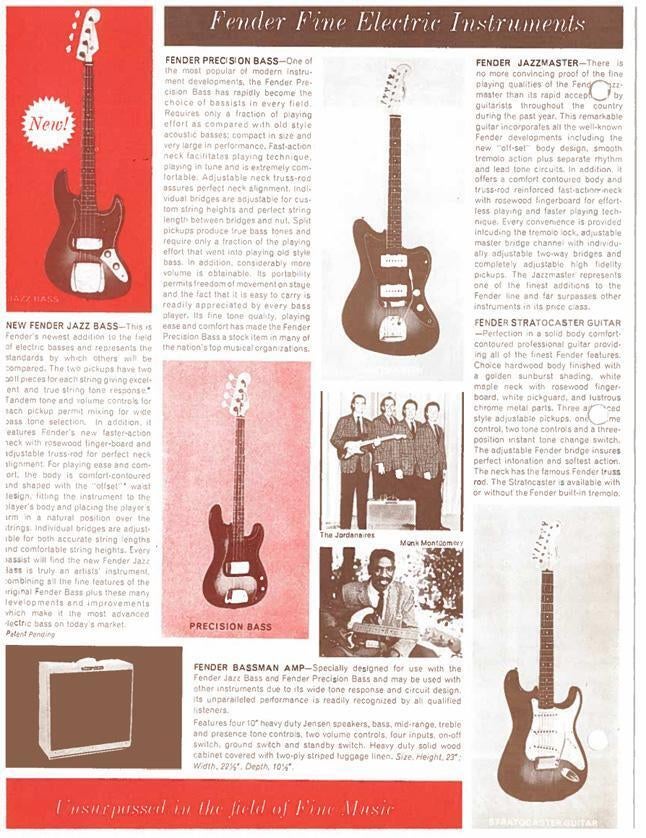
The facts concerning the Jazz Bass’s initial inception and design are fuzzy at best — a problem shared by just about every other Leo-era Fender design. The most likely story comes from Don Randall, president of Fender Sales and the marketing mastermind behind Fender’s first era — though Randall and Fender rarely saw eye to eye. Renowned guitar historian Tony Bacon conducted several interviews with Randall on the early history of Fender. Here, Randall claimed that the Jazz Bass was conceived primarily as a marketing tactic.
After establishing that bass guitars would sell and that people wanted them, then the next thing was to make a prettier one, a more elaborate one . . . the Jazz Bass wasn’t Leo’s idea particularly, it was more of a marketing idea.
Don Randall
Now, that’s no slight to the Jazz Bass — Randall admits in that same interview that Fender’s business philosophy was “always market-driven.” But Randall is only half of the equation, and the Jazz Bass boasted plenty of design innovations that justify its existence far past the purpose of marketing. Who was the brain behind those innovations? We’ll let you take a wild guess.
Like the close family ties between the Telecaster and the early Precision Bass, the Jazz Bass takes many cues from its fellow jazz-inspired sibling, the Jazzmaster. Let’s consider how the Jazz Bass is distinctly different from the utilitarian P Bass.
Sleek Offset Body Shape
The most significant visual departure is undoubtedly found in the Jazz Bass’s offset waist body, which is clearly inspired by the Jazzmaster. Both the Jazzmaster and the Jazz Bass were marketed (successfully or not) toward more “serious” jazz musicians who, at the time, primarily played sitting down. Fender’s idea was that the offset waist offered a far more comfortable feel when sitting down — surely a strange idea for jazz bassists coming from the upright who were serious exceptions to the seated jazz rule. This is also a primary factor behind Fender’s decision to swap many of its instruments’ fingerboards to rosewood — instead of the company’s standard maple — for a more “grown-up” look.
Like the rest of the Fender lineup, early Jazz Bass models were largely made of alder. Why alder when the Precision Bass was first designed with ash? As much as we’d like to tell you it was some conscious tonal shift, the truth is that Fender made the swap because its ash supplier was drying up. Plus, alder was cheaper and more plentiful. Later on, in the ’70s, ash would become the norm for the Jazz Bass, exacerbating the already robust weight of the J’s big body.
Dual Single-coil Growl
By the time the Jazz Bass came around in 1960, the Precision’s pickup configuration was completely redesigned from a lone Tele-style single-coil to a much more elegant hum-canceling split-coil. That design has remained more or less stable for more than half a century, so it’s clear the P Bass pickup didn’t particularly need fixing or updating. So, why not try something entirely new?
The Precision Bass’s split-coil is essentially comprised of two single-coil halves placed right next to each other, with the top primarily placed under the E and A strings and the lower section mostly under the D and G strings. Both sides combine into a single hum-canceling, super-sized split-coil, providing what’s possibly the most iconic bass tone in music history. It’s an incredibly versatile tone in function — few genres can deny the raw, punchy charm of a P — but a single-pickup instrument will always be sonically limited compared to a dual-pickup design.
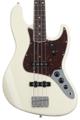
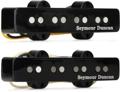
Fender’s most popular guitar designs all had two pickups, so it only made sense to extend that form to the 4-string. The Jazz Bass boasted two 8-pole (two for each string) single-coil pickups placed with quite a bit of distance between them for a far greater spectrum of sound. Like it was for the Jazzmaster, pickups could be played solo for a true single-coil sound or in tandem for a hum-free operation. Fittingly, the first Jazz Bass prototypes came equipped with wide Jazzmaster-style single-coils. However, they were replaced by the thinner form we’re all familiar with today.
More importantly, how did the tone differ from the P Bass? The Jazz Bass’s dual single-coils have a brighter, more defined response, with a signature “growl” on the treble and middle position that ironically offer a more precise tone than the P. The main difference is that the Jazz Bass is a tonal chameleon, allowing for a wide variety of sounds depending on how you blend the two pickups. In a pinch, a Jazz Bass can offer a decent approximation of a Precision Bass’s tone; a P Bass will always sound like a P Bass.
As for the control scheme, the very first Jazz Bass models sported two stacked concentric knobs, allowing tone and volume controls to be placed on a single control. Instead of a clean sweep, each tone control offered 10 predetermined positions. It’s a somewhat odd layout that’s made quite a comeback over the years, with players such as Flea of Red Hot Chili Peppers opting for it on his signature Fender Flea Jazz Bass. Regardless, stacked knobs were soon phased out for the now-standard volume/volume/tone setup that Jazz Basses almost universally feature today. Still, Fender continued to make them until around 1962.
Narrow Down the Neck
If you’re coming from a guitar-playing background, then this one might stick out as being a bit strange. Strats, Teles, Jazzmasters, and Jaguars — depending on the vintage, you’re likely to find a distinct variety of nut widths on these guitars, with no single spec particularly tied to a particular model.
This is in stark contrast to the world of Fender basses, where the drawing line is clear: Precision Basses have a 1-5/8-inch nut width, and Jazz Basses have a slimmer 1-1/2-inch nut width.
Unfortunately, Fender’s long-standing goal of marketing instruments toward traditional jazz musicians was spotty at best. The Jazz Bass was by no means a misstep when it came to reeling in the jazzers (after all, their choices were mostly limited to uprights, Precision Basses, or Jazz Basses at the time). Still, there’s a funny parallel in that many jazz players wound up preferring the neck of the Precision Bass.
Why? It’s simple — at the time, essentially all traditional jazz bass players came from an upright background, where the nut width was far more substantial than either a P or J Bass. The fatter neck and fuller grip of the Precision Bass neck felt more familiar than the so-called “pencil” neck found on most Jazz Basses.
Metal & Foam
For all his engineering brilliance, Fender never actually learned to play on any of his guitars or basses. This didn’t impede his design genius, but it did result in a few, let’s say, questionable choices when it came to the less critical aspects of his creations.
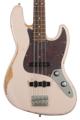
See those metal covers over the pickup and bridge plate of the Fender Custom Shop Limited Edition ’60 Jazz Bass Relic? Just about every Fender instrument in the company’s golden era came equipped with some shiny bridge cover, and while they certainly look rather slick, they’re not conducive to playability. This wasn’t a huge deal on guitars — tear the cover off your Tele or Jazzmaster bridge, throw it in the case, and then go about your business. Unfortunately, this was never quite so simple on Fender’s bass designs. They’ll come off, but you’ll need a screwdriver and a couple of minutes to come to terms with the fact that your shiny new bass now has a couple of gaping screw holes in the top.
Now, you might ask yourself: “How did Leo intend for bassists to palm mute with a giant cover over the bridge?” One word: foam. As the upscale take on the Precision Bass, the Jazz Bass featured far more refined foam mutes that were individually adjustable under each string. As you might expect, these were typically removed from the bass straightaway. Even Fender’s most exacting vintage replications of its golden-era instruments generally forgo the foam and cover — a blessing, as the whole idea was one of Fender’s rare missteps. But not all bassists have given up on foam! The Fender Custom Shop Sean Hurley Signature Precision Bass features a custom Jaguar-style mute to cop the low-sustain tones of the past.
The First 10 Years
The first year or two of Jazz Bass history is riddled with spec changes (e.g., slab to laminate boards, the control scheme change, custom colors, and many assorted cosmetic modifications), but by 1962, the formula solidified. 1965 saw the sale of Fender to CBS, and the Jazz Bass experienced all the cosmetic hallmarks of that era, including binding, blocks, new tuners, and a maple fingerboard in the late ’60s.
So, how did bass players of the day receive the Precision Bass’s space-age successor? Unfortunately for those of us who love the drama, myth-building, and storytelling aspects of Fender’s history, the Jazz Bass’s initial launch was solid and stable, and it’s remained that way ever since.
The Precision Bass dominated the ’60s, to be sure, but the Jazz Bass quickly established itself as a worthy alternative. Moreover, let’s not forget that some still held the electric bass with a hint of trepidation in the early days. The technique and tone of the electric bass guitar were still very much being codified, so for many bassists, chances were that it was less about which model was superior and more about which model you could get your hands on.
Still, there’s no shortage of iconic Jazz Bass lines from the ’60s canon. The stutter-step march of Jefferson Airplane’s “White Rabbit” was performed by Jack Casady in 1967, and two years later, John Paul Jones of Led Zeppelin would follow with the “Dazed and Confused” descending drive. However, the most potent example of the J Bass’s role in ’60s rock came from the hands of the Who’s John Entwistle during the iconic bass solo of “My Generation.”
Supposedly, Entwistle had attempted to record the song’s hard-hitting solo with his 6-string Danelectro bass but kept breaking strings on the instrument’s short scale length. Reluctantly, he broke out his Jazz Bass — a good thing, too, considering “My Generation” was almost certainly the first proper bass solo any aspiring rocker was likely to hear at the time. He wouldn’t be the first (or last), but Entwistle’s pummeling J Bass solo aided the electric bass’s transition from a root-note rhythm machine to a proper showpiece instrument.
Outside of the rock world, legendary session bassist Jerry Jemmott can be seen as a sort of Jazz Bass flip side to James Jamerson’s and Carol Kaye’s P Bass prowess. Jemmott’s J Bass graced the records of Aretha Franklin, Ray Charles, Freddie King, and countless others. One of Jemmott’s most memorable roles came by way of the inimitable B. B. King on B. B.’s 1969 album, Completely Well. Jemmott’s Jazz Bass backs up B. B.’s vocal-like lead lines on the blues standard, “The Thrill Is Gone” — a monumental track in the history of blues that would ever after serve as B. B.’s signature song.
The J Bass Finds Its Groove
If the ’60s was the decade of the P Bass, then the ’70s unquestionably belong to the Jazz Bass. The instrument experienced a few changes common to most ’70s-era Fenders — heavy ash bodies, natural finishes, more maple fingerboards, and so on. However, in the late ’60s or earlier ’70s, the bridge pickup was pushed back 0.4 inches toward the bridge, resulting in what some players believe to be a drastic change in tone. Simply put, the Jazz Bass’s growl took on an even more aggressive turn toward a positively vicious snarl.
We’ll leave the tonal debate to the world’s J Bass fanatics, but right around this time, a new style of bass playing was beginning to take hold — a style that might never have taken off without the Jazz Bass’s unique treble-biased tone: slapping. The story goes that bassist Larry Graham was playing in a trio where the drummer dropped out, and, to fill the percussive space, he began aggressively slapping and popping the strings.

Larry Graham, slapping on the Jazz Bass.
This technique is not exclusive to any model of bass, but the Jazz Bass’s uniquely bright and cutting character made it arguably the choice for slappers, especially back in the ’70s when 4-string alternatives to Fender were few and far between. One of the earliest examples can be heard on Graham’s cut with Sly and the Family Stone’s “Thank You (Falettinme Be Mice Elf Agin).” Slapping became the de facto bass style for ’70s funk in record time, and it was almost a rare sight to see a prominent slapper playing anything other than a Fender Jazz Bass during this period.
Ten odd years after being launched, the Jazz Bass finally found a home in the genre it was originally designed for: jazz. The quick-fingered finesse and dense arrangements of ’70s jazz fusion music often favored the Jazz Bass’s sharp, mix-cutting tone. There’s no better example than perhaps the most famous J Bass player of them all, Jaco Pastorius.
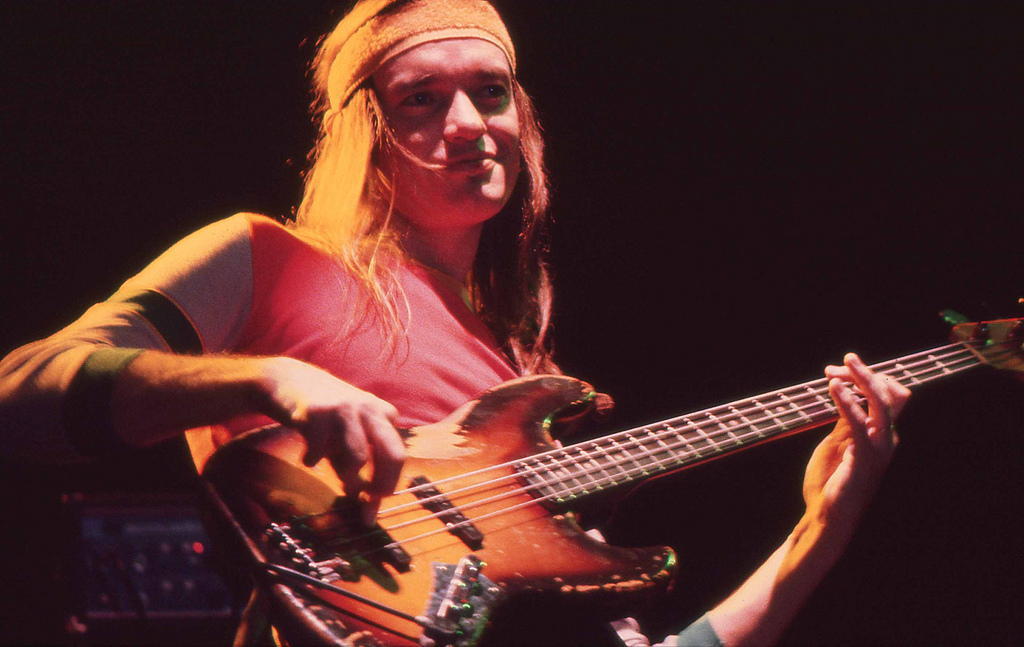
Jaco Pastorius with his “Bass of Doom.”
As the self-proclaimed “best bass player in the world,” Jaco’s virtuosity was more than up to the task of matching his limitless ego. Jaco’s number-one instrument across his trailblazing solo work and collaboration with jazz fusion group Weather Report was far and away his so-called “Bass of Doom,” a highly modified 1962 Jazz Bass. The story goes that Jaco received the instrument at the age of 21 and then decided to honor the world’s vintage purists by carving out the frets with a butter knife. In a way, Jaco was taking the Jazz Bass back to its fretless, upright roots, although his incredibly technical fingerstyle playing was anything but traditional.
The Jazz Bass’s treble-heavy tone perfectly matched Jaco’s melodic playing and extensive use of harmonics. His music would influence generations of bass players across the entire style spectrum, including Robert Trujillo of Metallica, the current custodian of Jaco’s “Bass of Doom.”
One-half of the 4-string Whole
By the end of the decade, if not much sooner, the Jazz Bass had cemented itself as an equally popular alternative to the prestigious Precision Bass. On Fender’s end, the company saw a welcome return to grace when Bill Schultz took over from the CBS era. Fender quickly rectified the challenging state that CBS had left the company in, by and large returning the brand to its roots and dramatically upping the quality of its production. This is where Fender’s modern era begins, and the Jazz Bass has ever stood by as one-half of the Fender 4-string whole.
But what about the music? The ’80s saw the rise of recording and stage legends, such as Marcus Miller and Will Lee. The Jazz’s versatility often made it the preferred choice for studio musicians tackling varied musical applications.

Another player certainly worthy of a spot in the Jazz Bass pantheon is Rush’s Geddy Lee, who made a wholehearted switch to the Jazz Bass after long favoring the gritty grind of his Rickenbacker. 1980’s Moving Pictures albumprominently features a ’70s-style Jazz Bass (modified bridge pickup position and all) on such all-time classic tracks as “Tom Sawyer.” You’ve probably noticed by now that the Jazz Bass is a regular choice among bassists with busy, technical styles — a mold that Geddy certainly exemplifies.
After this point, having a Jazz Bass or two in the studio locker was all but a prerequisite. Cataloging the nearly inexhaustible list of Jazz Bass players after this point would be a losing proposition — instead, we’d like to spotlight a few of our favorite artist signature Jazz Basses on the Sweetwater site.
Variations on a Theme
At a certain point in the Jazz Bass’s history, it effectively ceased to be a strictly Fender product and became a veritable institution. While most bass players tend to fall on the P or J side of the spectrum (or “R” for Rickenbacker!), whether or not they play a Fender is a hazier proposition.
All of Fender’s designs have a long, long history of being tinkered with and modified by other brands, using Fender and company’s creations as starting points for further innovations. Companies such as Sire, and Lakland produce top-notch takes on the Jazz Bass — each company offering its unique twist on the formula.
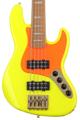
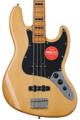
Still, Fender has dominated the world of Jazz Bass variations with countless 5-strings, fretless models, and modded-out masterpieces. One of the most prominent of these creations is surely the endlessly flexible PJ-style bass — a design that ends the age-old debate of P vs. J by cramming both pickup styles onto a single instrument! Factor in models, such as the Gold Foil Jazz Bass or the Squier Contemporary Active Jazz Bass, and you have a nearly limitless array of instruments to choose from.
Join In on the Jazz Bass’s 60-year Journey
And thus, the Jazz Bass chugs along, as popular as it’s ever been and as a rock-solid staple of studios worldwide. Whether you’re looking to pick out a Jazz Bass in its earliest 1960s-style incarnation or a decidedly modern J-style instrument, call your dedicated Sweetwater Sales Engineer at (800) 222-4700 for expert advice on picking out a J Bass of your own!
.jpg)

