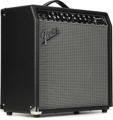
Our final Fender tremolo effect is found on the so-called “black panel” amplifiers of the 1960s, and it’s unlike any of the circuits we have discussed thus far. In this scheme, the preamp signal was used, but instead of the tube oscillator controlling the bias of a specific tube, the pulsating signal was used to operate a photoresistor circuit. There were two main components in this circuit: a small neon lamp that would vary in brightness in sync with the oscillator, and a light-dependent resistor placed close to the bulb. For stability, both pieces were sealed together in special heat-shrink tubing. Rather than changing the gain of a tube, this new method allowed for the preamp signal to be grounded out, which produced the tremolo effect.