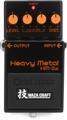
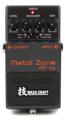
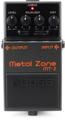
Mirror, mirror on the studio wall, which is the fairest metal pedal of them all? Given sales of more than one million, its searing tonal capabilities, and an undeniable cult-classic standing, the direction of the devil horns unequivocally points to the BOSS MT-2 Metal Zone.
Since its debut 30 years ago, the MT-2 has added its patented layer of dense, saturated distortion to the rigs of bedroom beginners, professional-level guitarists, and modern-day YouTube sensations alike. Along the way, it weathered numerous musical-genre sea changes, made the jump from effects pedal to meme and Halloween costume, and even claimed the distinction of being bizarrely (and falsely) linked to the COVID-19 pandemic.
Success and conspiracy theories aside, the Metal Zone has also garnered its share of criticism. It’s no secret that you’ll often see it lumped into lists rounding up the “worst” effects pedals of all time. Comb through any gear-forum topic or video demo on the MT-2, and you’re likely to stumble upon opinions along the lines of comments such as “They attract bees,” or “Sounds like solid-state clipping. In other words, a fizzy mess.”
No matter where you stand, with BOSS recently introducing a celebratory 30th-anniversary iteration, it’s the perfect time to reset the MT-2’s polarizing impact and formidable legacy.
1991: The Metal Zone Makes Its Debut
In 1991, Terminator 2: Judgment Day reigned at the box office, Tim Berners-Lee published the first website, and Michael Jordan’s Chicago Bulls captured their first NBA title. In music, the rock and metal genres were in a state of transition. Platinum acts such as Bon Jovi, Mötley Crüe, Poison, and Skid Row gave way to the grunge scene emanating from Seattle, led by the likes of Nirvana, Pearl Jam, and Soundgarden. Meanwhile, Metallica and Guns N’ Roses released immensely popular LPs with Metallica and the Use Your Illusion albums respectively.
In the thick of all of it, BOSS debuted the MT-2 Metal Zone, a stompbox leveraging one year of research and development with the capability to seemingly fit into any rock context. The company’s 1991 print advertisement invited users to “step on it” while promising the MT-2 would deliver “hard rock crunch and awesome tube distortion, plus precise tonal control from the 3-band EQ.”
Sensitive Controls
The MT-2 was unquestionably designed to produce scintillating high-gain tone. Housed in the familiar BOSS casing with a black color scheme featuring orange lettering, the controls include Level to adjust the volume of the effect and Distortion to adjust the intensity of the distortion.
The main calling card of the MT-2, however, is its onboard 3-band equalizer. Knobs labeled High and Low command the higher and lower frequencies; a Middle knob adjusts the boost/cut on the mids; while the Mid Freq knob sets the middle-range frequency (200Hz to 5kHz).
“Up until the ’70s, it was more common to create guitar tone using just the amp. By the ’80s, guitarists started to shape their sound more meticulously using different gear like stompboxes and outboard processors, moving away from making sound only on the amp,” BOSS President Yoshi Ikegami tells us. “Meanwhile, the role of the stompbox was getting more important as a part of a guitar rig to form a guitarist’s personal tone. We added this powerful tone shaping to the MT-2 in order to open up the possibilities of tweaking and tailoring the tone more freely and aggressively and to allow players to make their signature tones with any combination of gear.”
Of course, with such potential comes responsibility. The Metal Zone’s controls are extremely sensitive — even the slightest turn of a knob can greatly impact your tone. Couple this with the desire of many new MT-2 owners to dime the knobs right out of the box, and the pedal earned a reputation for sounding harsh and abrasive.
BOSS actually telegraphed the Metal Zone’s dangerous potential in the instruction manual, cautioning: “If you set this [Distortion] knob too high, the noise will increase and oscillation may occur.” During our demo of the MT-2W Waza Craft edition, Sweetwater’s Nick Bowcott clarified the pedal’s potential pitfalls.
“The trouble is, with that amount of gain and that amount of variance, your typical metal kid would get it and put the gain on 12 . . . boost the mids to 15, crank the treble, cut the mids if they could find the sweet spot, and [it would] sound like bees in a jar,” says Bowcott.
Some guitarists attribute misuse as the primary reason the Metal Zone developed such a questionable reputation. “I think it’s just a matter of people not knowing how to use it,” Solar Guitars founder Ola Englund tells us. “And with that came the love/hate relationship for [the Metal Zone].”
From Disturbed to Prince — Artists Who Have Used the MT-2
Alongside alternative music and boy-band pop, nu metal took charge in the late ’90s and into the early aughts. Appropriately, the MT-2 found a second wave of popularity. Guitarists such as Korn’s James “Munky” Shaffer and Disturbed’s Dan Donegan, as well as extreme metal acts like At the Gates and Cannibal Corpse, used the Metal Zone to supercharge their tone in the studio and onstage.
In an interesting cross-genre twist, the Metal Zone has been linked to some very “unmetal” contexts. The Grammy-winning electronic duo Daft Punk reportedly employed the MT-2 through a Roland Juno-106 to produce the rough-and-tumble synth sound on the track “Rollin’ & Scratchin'” from their debut album, 1997’s Homework. There’s even a YouTube demo that reproduces the sound in a convincing fashion.
You also might be surprised to learn that none other than Prince got crazy with the MT-2 as it found its way onto his pedalboard in the mid-’90s. Additionally, Warren Haynes of Allman Brothers Band fame is purported to have used the Metal Zone in his live rig.
More recently, Kurt Ballou, guitarist for Massachusetts-based punk rockers Converge, and Biffy Clyro front man Simon Neil have ranked as two of the Metal Zone’s modern-day stalwarts.
Tonal Versatility
This diverse pool of talent proves the Metal Zone can do more than metal, giving credence to the versatility of this controversial stomp. While everything from Metallica Master of Puppets–era mulch to propulsive Pantera power and beyond is certainly within reach, the instruction manual provides settings tips for overdrive, fuzz, and British-rock tones. Those looking for other applications can find a variety of MT-2 tutorials spanning from blues to Steve Vai–inspired tones. (Bassists can even take a crack at using the MT-2.)
“Many guitarists may think the MT-2 only creates the heavy and aggressive tones found in metal music based on its name ‘Metal Zone.’ However, the MT-2 covers quite a wide range of tones from crunch overdrive to deep distorted sounds,” says Ikegami. “Its wide gain range and semi-parametric mid control also enable you to tweak sensitive frequencies, which characterizes guitar tone markedly and generates various sounds depending on the setting. We think this is the reason that the MT-2 is loved by various types of guitarists and genres, not only by high-gain-style guitarists.”
Less Is More
Speaking of high gain, contrary to the popular metal credo: less is definitely more when it comes to the Metal Zone. Of course, your guitar, pickups, amp, and playing style will all have an impact on the sound you get from the MT-2. But, for starters, backing off the gain to around 12 o’clock is advised. In engaging the EQ, peppering a little boost to the upper mids can help bring you forward in the mix. Meanwhile, cutting the lower mids can tighten your sound and reduce muddiness. Essentially, a light hand will help you get the most out of the Metal Zone.
“Guitarists tend to turn things all the way up, but, as with most gear, that’s not typically the best way to use an MT-2,” Ballou tells us. “I typically start with the EQ controls centered, then boost some mid and sweep the frequency control until I find a frequency that reinforces the root note of the song, then add a little bit of bass and treble for extra bite. It’s a great way to make a vintage tube amp shred!”
During a visit to “That Pedal Show,” Simon Neil professed that “every millimeter on this thing counts.” Indeed, “little tweaks” on the MT-2 constitute the secret sauce of his tone, which he conjures by pairing the pedal with “the clarity and the punch” of a Fender Strat.
“The secret is to be very careful using the EQ,” Englund says. “The best tone in my opinion is when everything is set to default. Adjust the settings gently because this pedal has a lot of range!”
As Bowcott aptly summarized: “You can make [the Metal Zone] sound really, really bad. But you can, if you’re smart, make it sound really, really good.”
The YouTube Era Turns the Tide
If you traverse popular gear forums like The Gear Page and Ultimate Guitar, then it’s clear that the Metal Zone has more than its share of detractors. However, with the advent of gear-related content creators on YouTube, a variety of demos from the likes of Englund, Pete Thorn, and Rabea Massaad has helped set the record straight on the MT-2.
Case in point, Englund scored a viral hit with his Metal Zone demo video that he subtitled “WORST DISTORTION PEDAL EVER?” After admitting to not getting a stellar sound out of the MT-2 in the ’90s, the Swedish guitarist proceeded to plug multiple axes into a Randall Satan 50. He was particularly taken aback by the tone he harnessed by plugging the pedal into his amp’s effects loop.
“To be honest, I think it sounds really good in the effects loop,” Englund said during his demo. “Why does it have such a bad rep? I have no idea.”
For his demo, Thorn recorded an instrumental song that featured multiple guitar tracks all employing the MT-2W. As he detailed, he made ample use of the higher and lower gain settings and boosted and cut various frequencies. “I was really blown away with the tones I was able to get out of [the Metal Zone]. I think it’s a pretty great-sounding distortion pedal,” said Thorn.
“The EQ is so powerful,” said Massaad following his MT-2W demo. “You can really mold it how you want to mold it. [Using it] with a baritone, that’s what left me really, really impressed. It handles extended-range tuning like it’s no problem whatsoever.”
As they say, the proof is in the pudding. Convincing testimonials — and tones — such as these have surely helped to legitimize the Metal Zone as a viable tone-shaping tool. “A lot of people shrug when they hear talk about the Metal Zone . . . but YouTubers have had a role of bringing the legacy back into the spotlight,” says Englund. “The Metal Zone is definitely one of the more misunderstood pedals of all time.”
Ikegami believes that this flurry of YouTube content, not to mention the endless online chatter, has cemented the MT-2’s standing.
“We have seen tons of videos, comments, discussion, [and] even memes. I feel this is a bit of evidence that shows the MT-2 is loved by a lot of players,” he says. “[Its] unique characteristics and features make the MT-2 a high-gain icon that has continued to capture the hearts of many guitarists for three decades.”
Become Part of the Metal Zone Legend
Whether you prefer the sound of the Metal Zone ultimately comes down to a matter of taste. However, in turning the big 3-0, there is no denying it has passed the ultimate proverbial test: the test of time. It’s also transcended stompbox status — after all, what other pedal can lay claim to being used by Prince and being made into a Halloween costume?
It’s this one-of-a-kind legacy that makes the Metal Zone a must-have for any pedal collection. Contact your Sales Engineer at (800) 222-4700, grab your MT-2, and become part of the legend.