Boris and Uniform’s collaborative LP Bright New Disease bridges the distance between New York and Japan. It grapples with pandemic upheaval while constructing testaments to friendship and artistic survival during times of plague. Warning: reading this may demonstrate ways that cowriting at a distance can sustain musicians during harsh times.
- Setting the Stage
- Friends: The Keys to Collaboration?
- Inside Circular Ruin with Cofounder Ben Greenberg
- Fuzzy Feelings with EarthQuaker Devices’ Jamie Stillman
Setting the Stage
Sweetwater connected with members of each band: Boris’s double-necked-guitar-and-bass titan Takeshi, who spoke via email (with Japanese-English translation done by Kasumi Billington), and Uniform guitarist and engineering wizard Ben Greenberg, who was at Circular Ruin, the commercial studio and self-described “sound temple” he recently cofounded and where Bright New Disease was mixed. We’ll also quote band members from the album’s press materials. For the richest reading experience, check out the digital and/or physical copies of the album on Bandcamp or Spotify.
Additionally, Jamie Stillman of EarthQuaker Devices lets us peek at the creation process behind the company’s Wata/Boris-inspired Hizumitas fuzz/sustainer pedal, which is based on a tattered lawsuit-era pedal that’s torn to shreds (in the best possible way). Exploring the Hizumitas collaboration adds unique Sweetwater flavor to this look at Bright New Disease.
Note: EarthQuaker Devices features heavily later in this piece, though the company didn’t initiate, steer, or influence the content within. A mutual appreciation for EQD (among artists and the writer) emerged during the process, meaning the decision to highlight relationships with an outstanding pedal manufacturer arose organically.
Friends: The Keys to Collaboration?
For a moment, everyone seemed to have a “lockdown record” in the works. That was doubly apparent to our Sales Engineers at Sweetwater when our customers dove deeper into recording and tackled new mediums like podcasting. Pro Tools and other DAWs offer a sense of control that’s rarely there in the “real world,” so it’s hardly surprising artists turned there for solace during uncertain times. What is music if not medicine at its best and pleasant distraction at its worst?
On its surface, Boris and Uniform’s collaborative album Bright New Disease reads like a lockdown record. “Disease” is in the name, and both bands attest to writing and recording it during “the darkest days of the pandemic.” But what does that process look like when bands that are more than 6,000 miles apart in different countries work together? Having released an album of my own just before North America’s COVID-19 debut, taking a creative breather during that time gave me fresh eyes for investigating such matters. Much of what I found challenges the prevailing notion that lockdown records were unadorned, lo-fi novelties born of solitude.
Bright New Disease truly began before COVID in 2019 when Boris invited Uniform along for six weeks of shows. Remembering how a friendship grew during the tour, Takeshi says, “Uniform had aesthetics and values we could relate to . . . creating work with them has been fun and brings happiness.” The bands bonded through discussions of the extreme genres they love — industrial, metal, Japanese hardcore, and D-beat, to name a few — but watching each other perform was where the bond became real. By the tour’s last leg, Uniform was joining Boris onstage for joint encores and performing Boris’s song “Akuma no Uta.” These moments onstage felt right, and, wanting more, Boris approached Uniform about doing something bigger.
Takeshi gracefully takes me to task when I call these joint tour encores a “reimagining” of “Akuma no Uta,” writing that “‘newly construct’ is a better term to describe the performance . . . rather than just reimagining songs.” Though I’ve never loved the term “reimagining” specifically in music, I’ve never stopped to think up a more accurate phrase that captures the depth of work often at play. I thank Takeshi for providing the alternative of “newly construct.” Takeshi also points out that Bright New Disease is part of Sacred Bones Records’ acclaimed collaborative Alliance Series, but that was not always the plan. For a while, the bands focused solely on the music without label involvement or a business plan, which all came later.
Collaborative music in the form of artist features is getting trendy, even in unusual places, as artists look to reach fans and support their livelihoods in the age of streaming and social media. But is this a trend or an economic imperative — one borrowed as underground scenes’ precarity goes mainstream? In early hip-hop, collaboration was essential (one performer coaxes breakbeats from turntables while another raps), and despite many tech-driven evolutions, collaboration is still a thriving genre distinction. Likewise, punk and hardcore have long embraced collaborations big and small: multi-artist 7-inch splits, synergistic tour packages, concerts organized with limited resources, and mics passed off to passionate crowds. Each of these plays a part in making heavy music survive and/or thrive.
When asked if these traditions inspired the approach to the album, Takeshi speaks to how music often honors a certain genre starting point — usually a band, an attitude, or both — but adds that “ethics and values are constantly updating.” Takeshi points to the tumult of the pandemic (the likes of which few contemporary artists had dealt with) as a global event bound to mark creative processes along the way.
“We were confronted with the reality that individuals cannot survive unless they think and make decisions for themselves,” he says. This led Boris and Uniform to ask, “What do we do to ensure our way of expression stands strong in this type of situation?” Boris and Uniform searched to answer the question for themselves. Takeshi says they kept the work earnest by drawing from a “shared common consciousness” that looks something like retooling the axle that artistry’s wheels turn rather than the wheel itself. For instance, Boris’s drummer Atsuo recalls the absence of live performance as an inspiration for the opening track “You Are the Beginning,” a ferocious smash-and-grab that pairs vinegary vocals from each band with drums and guitars that steamroll ears with reverence for the power of stage volume.
Bright New Disease looks beyond the individual band, brand, or genre, and Takeshi says it “couldn’t have been born without the heavy situation we faced the last few years.” When asked how COVID limitations influenced the experience and result, Takeshi continues, “This work is significant and produced great results precisely because it was not face-to-face. We’re not interested in collaborating for the sole purpose of business and/or hype. Friendship and respect for each other — that’s where the collaboration always blooms.” Uniform’s Michael Berdan says as much in a different way, having called this album “a testament of friendship and hope in the face of a world on fire” — a no-frills zinger that could not be more accurate.
Inside Circular Ruin with Cofounder Ben Greenberg
We had limited time to email with Boris, but Uniform’s Ben Greenberg kindly Zoomed us into Circular Ruin — where he mixed Bright New Disease — to talk details about collaborating, mixing, and pro audio at large.
Now in his mid-30s, Greenberg’s passion for audio engineering began at age 15 while working at Systems Two, a Brooklyn studio specializing in jazz at the time. (Greenberg recalls working a session for Ravi Coltrane on his last day there.) “At the time, it was gigantic, a real successful Brooklyn Studio,” Greenberg says. He also worked closely with Mike Marciano, the Grammy Award–winning engineer known for working with heavy acts, such as Type O Negative and Agnostic Front, and film projects. “They had a platinum record of the Howard Stern Private Parts soundtrack on the wall,” Greenberg recalls.
The genre gumbo at Systems Two — jazz, New York hardcore, metal, and soundtracks — clearly fed Greenberg’s omnivorous passions and the various projects handled at Circular Ruin. Heavy music is a unifying passion inked on the résumés of Circular Ruin’s three cofounders: Greenberg, Randall Dunn, and Arjan Miranda. The trio’s output also covers film and TV audio, with work on the Guillermo del Toro’s Cabinet of Curiosities series being one of many notable highlights.
Greenberg is quick to note that it was a strange transitional time when he started at Systems Two in the early 2000s. Home recording was less accessible, and commercial studios still used analog workflows while learning the nuances of software like Pro Tools. When few engineers grasped the studio’s first Pro Tools rig, 15-year-old Greenberg humorously earned the pros’ confidence because he was familiar with pencil-tool editing on a free version of the primitive DAW Cakewalk. But there was also old-school learning, a social experience in a bustling, well-equipped space that came with what Greenberg calls “the oral tradition stuff,” like learning how to push console faders, how to hook up a patchbay, and the intricacies of tape. “Learning analog tape hands on changed my whole life . . . it’s such an integral part of the records I make and how I think about sound,” Greenberg says.
After Systems Two, Greenberg moved on to producing records by himself on the cheap, using reel-to-reel tape machines as they fell out of favor with the pros. “I barely had a real Pro Tools system my first five or 10 years making records,” he says. These days, Greenberg’s production credits are prolific. He recently wrapped up production on a self-titled LP by Wicca Phase Springs Eternal, the main songwriting vessel of GothBoiClique cofounder and former Tigers Jaw front man Adam McIlwee. As a longtime fan of McIlwee’s work, I confidently feel that Greenberg’s production makes for one of Wicca Phase’s most diverse and compelling releases since 2018’s Suffer On.The beat-driven track “Farm” perfectly demonstrates how Greenberg’s production work looks within a genre quite distinct from Bright New Disease.
Between Uniform’s hard-edged music and Greenberg’s engineering talents, it’s easy to see why Boris quickly felt comfortable pursuing acollaboration. Takeshi recalls finding even the Bright New Disease rough mixes fresh and inspired: “We were very excited and knew this collaboration would be great.”
Instead of working as individual contributors, the bands worked somewhat separately (as bands, not as individuals). They discussed internally and wrote in batches. Boris kicked off the initial exchange with a suite of demos. Uniform then added parts and composed some original demos that went back to Boris in a big batch.
As friends who trusted each other’s instincts, there was plenty of room for surprise contributions like this, and keeping plans loose helped keep the album process fun amidst pandemic stresses. Several tracks feature drummers from both bands: Atsuo of Boris and Mike Sharp of Uniform. When planning Bright New Disease, Boris was not concerned if Uniform, which now tours as a four-piece, would contribute from their semi-fluid lineup or include only cofounders Berdan and Greenberg.

“When Uniform makes records, we write with Mike Sharp, who doesn’t tour. The three of us spent a bunch of time listening to what Boris sent, coming up with ideas together, so it made sense for the three of us to work on it,” Greenberg says. Though Boris hadn’t anticipated the double drums twist, they welcomed it, and Takeshi compliments Sharp on “perfectly syncing” his initial drums to the Boris demos, which were recorded without a click track. It’s easy to imagine some flabbergasted but grinning looks in the room when Boris sat down with that initial dub.

Photography by Ebru Yildiz
Mixing two kits involved adding cohesion using panning and compression that honored each drummer’s parts. “The drums that Boris sent us came in really warm and analog,” Greenberg says. “Mike Sharp’s drums were really bright by comparison. I split up the studio’s outboard gear, doing Atsuo’s drums with solid-state compression and Mike Sharp’s drums with tube compression to bring them closer together.”
Circular Ruin’s hardware collection spans everything from classics to eclectic vintage oddities. For Atsuo’s drums, Greenberg favored solid-state classics, including Universal Audio 1176 and Neve 33609/N compressor/limiters. For Sharp’s kit, Greenberg relied on such compressors as the Empirical Labs EL8-S Distressor and the tube-filled Manley Variable Mu to add saturation and warmth. Greenberg mixes on an API 1608 32-channel console, which, paired with two eclectic Western Electric transformers from the 1940s, is a big part of what gives his work at Circular Ruin a sonic signature. For the curious, the vintage transformers are mounted in a passive rack with attenuators.
Panning was handled more surgically. Some tracks called for both kits slammed and on the verge of competition for supernatural thickness. “I generally mix drums pretty wide. On a lot of songs, it’s just two really wide drum kits, but on some songs, I would do one kit really narrow,” Greenberg says. “A lot of it is in EQ and the way they share space. I envisioned this propulsive, transient, low-mid power-cannon feeling, especially on the slower songs.”
Uniform sprinkled in contributions from local peers, too. Steve Moore (bass) and Randall Dunn (synthesizers) helped shape the operatic snarl of “The Look is a Flame,” which kicks off the album’s more spacious middle sequence. “Steve is such a shredder,” Greenberg says. “When we felt like there were things that needed bass, it made sense. And at the time, we had a really amazing Oberheim OBXA that was in very good condition that was like Randall’s lightsaber.”
Each group marvels at how tracks exceeded what either group had the personnel or know-how to accomplish individually. “There were certainly sounds that we couldn’t have created on our own,” Takeshi recalls, and Berdan has pointed to “Narcotic Shadow” as one example track that Uniform initiated and Boris transformed. Takeshi has seen incorrect assumptions about who brought which tracks to the table and set the record straight, saying, “Boris did the basic songwriting for tracks one, two, four, five, eight, and nine. Tracks three, six, and seven were by Uniform.” Attribution errors by the critics speak to how well Bright New Disease gels sonically.
Fuzzy Feelings with EarthQuaker Devices’ Jamie Stillman
Jamie Stillman, EarthQuaker Devices, Boris, and Uniform all enjoy a strong relationship. Wata and Takeshi deploy EarthQuaker Devices’ pedals onstage, Greenberg uses them at Circular Ruin for tasks like re-amping, and Stillman’s band Relaxer previously toured Japan supporting Boris.
In Japan, EarthQuaker’s retail presence also thrives, thanks to, as Takeshi puts it, “a large company called Yamaha” that smooths over the difficulties of transpacific import and distribution. “You’ll see [EQD] in any guitar shop you walk into, and there’s a larger awareness,” Takeshi says. He also points out that Japan’s pedal culture is vibrant and even essential because many musicians do not own amplifiers due to dense urban housing and the price of private homes. Instead, they rely on rental rehearsal spaces outfitted with amps, where pedals offer a portable, convenient way to personalize the sound of a prescribed amp.
Stillman and Boris started working on Wata’s signature fuzz pedal back in 2018. When Relaxer joined Boris that year for a Japanese tour, Stillman brought along a Hizumitas prototype. Stillman recalls the band’s reaction went something like: “This isn’t it, but this is what we want.”

Photography provided by EarthQuaker Devices
The Hizumitas collaboration largely mirrors the process of Bright New Disease in that it began around the same time and took longer than anticipated. Stillman set out to faithfully re-create Wata’s go-to fuzz pedal, the Elk BM Sustainar — a lawsuit-era 1970s clone of the prolific and well-documented triangle muff circuit. Wata’s playing has brought significant prestige to the clone. Original Elk Sustainars, distinguished by swooshing Disney-esque font and a lawsuit-ready name, now fetch $2,000 or more online — a surge largely driven by interest in Wata’s tone. The increase signaled that a newly constructed version might be satisfying for fans and lucrative for EQD.
Once Boris rejected that first prototype Stillman took to Japan, Stillman strapped in for revisions while the pandemic introduced new obstacles that made feedback and tests more difficult. Using his own personal Sustainar pedal as reference, Stillman built several prototypes and mailed them to Wata, only to find the elusive X factor missing with each of Boris’s tests. According to Stillman, “It was the exact same version Wata had. But we discovered mine sounded wildly different.” It was a shocking revelation for an experienced builder like Stillman but a necessary one that inspired a more detailed look at Wata’s pedal.
Stillman decided he’d need hands-on time with Wata’s pedal. So, the Sustainar was shipped anxiously from Japan to Akron, Ohio, due to long-distance shipping risks and the fragile condition of the pedal. The hands-on experience did the trick and then some, and Jamie had a near-final version within two weeks. Ultimately, unusual EQ qualities are what make Wata’s Sustainar so unique. Stillman found Wata’s “sounds like a Hizumitas, really grinding and midrange-y.” His own Sustainar sounds more muffled and bass-heavy by comparison. “Every vintage fuzz pedal sounds different from the next. But I didn’t expect it to be so drastic,” Stillman recalls, noting that “[muff] circuits all sound pretty close . . . even if they’re the same model.” When asked specifically what gives Wata’s Sustainar that unusual midrange power, Stillman says it’s age and everything that comes with it. “Parts drift. There’s a lot of electrolytic caps in that [pedal], and they just go bad.”
Simply put, the declined prototypes sounded vastly different than Wata’s pedal because they didn’t account for age, wear, and tear that change component tolerances, thus altering the sound. Some would call this “mojo,” a dated bit of musician’s slang that refers to the positive effects of aging. The concept of “aura” put forth originally by Walter Benjamin in his 1935 essay The Work of Art in the Age of Mechanical Reproduction offers a more muscular understanding.
Art and commodities like pedals and guitars can have strong auras — unique qualities determined by the object’s history and user(s). These qualities often evade, resist, or problematize mass reproduction for the consumer markets. For instance, printed copies of the Mona Lisa can capture the original work pixel for pixel while lacking everything that drives tourists to Paris’s Louvre to see the original. Speaking about the chemistry between Neil Young and “Old Black,” the artist’s famous, customized, and battered Les Paul, Crazy Horse producer David Briggs offers a solid example of musical aura: “axe in hand, his aura becomes solid. He’s the gun.”
Whether we know it or not, all musicians grapple with aura — whether we’re re-creating the sound of a favorite artist, shopping for gear, or even building pedals. In the case of the Elk Sustainar, Stillman found himself caught between two auras, initially chasing the original character of his own Sustainar but eventually finding that Wata, previous owners, and the passage of time had basically created a new aura he needed to explore. The Hizumitas’s sound is that of a familiar circuit once its components feel the strain of gigs, traveling, recording, climate, and more. In a larger sense, the Hizumitas also highlights the audio industry’s passion for auras and its ability to preserve and distribute them on a mass scale. Where else do builders strive to study unique auras with such accuracy the way they do in today’s pedal markets, digital plug-in spaces, and so forth?
You Survived — Have a Pedal!
Be sure to check out Bright New Disease and the rest of Boris’s and Uniform’s music, along with a full assortment of EarthQuaker Devices gear and apparel available here at Sweetwater. Our knowledgeable Sweetwater Sales Engineers are here to help with gear tips, shipping concerns, financing, and more — call them at (800) 222-4700!
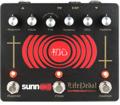
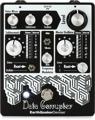
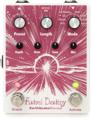
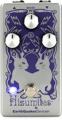
We’ll leave you with these pedal suggestions from our interviewees. Besides the Hizumitas, Takeshi suggests the Acapulco Gold, a simple but powerful distortion based on the doom-approved sound of vintage Sunn amplifiers. Takeshi says, “I like that when you connect it to the tube amp and turn the knob right, it turns into a loud, ferocious sound, like being hit hard with a blunt weapon.” Lately, when Greenberg uses pedals for studio processing, he reaches for the Astral Destiny, Data Corrupter, and Avalanche Run. He’s also been experimenting with the Sunn O))) Life Pedal V3, which he expects will play a defining role in the guitar tone of a future Uniform release.