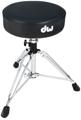
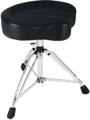
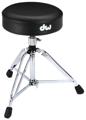
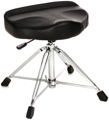
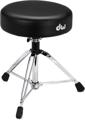
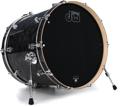
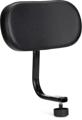
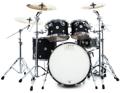
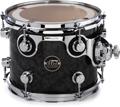
Drum Workshop, “DW” to their friends, started out as a drum instruction studio in Santa Monica, California, in 1972. Founder and President Don Lombardi quickly realized that his real calling was to help drummers improve by providing them with better products. The new business kept the original name, The Drum Workshop, and the first product was a height-adjustable trap case seat. Today, products such as the 9000 Series pedals have made DW a household name for drummers looking for cutting-edge gear.
We were lucky enough to catch Senior Planner Brook Dalton and Education & Events Planner Juels Thomas on a rare break, and they shared their thoughts on work, music, and of course — drums.
Who are you and what do you do at DW Drums?
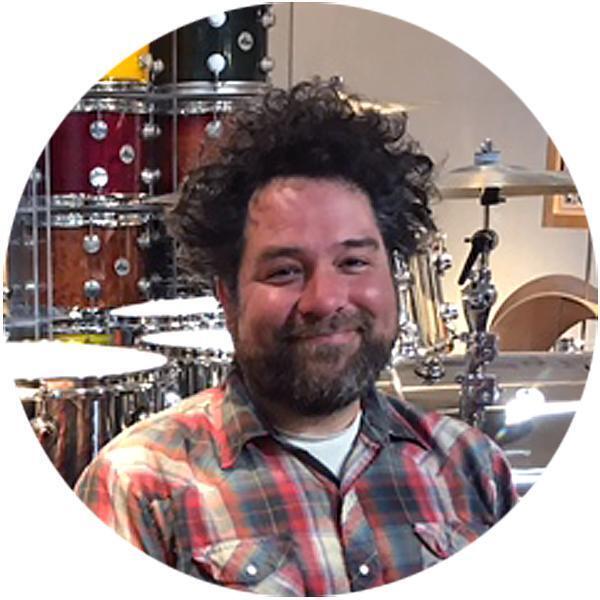
Brook Dalton: My name is Brook Dalton and I’m the Senior Planner at Drum Workshop. While I wear a lot of hats here, my focus lies on figuring out how many components and items we need to order in relation to DW hardware and DW drums. I work with the Purchasers in order to make sure that things run as smoothly as possible. I’m also considered a Product Specialist and assist different departments with questions they have concerning our gear.

Juels Thomas: I’m Juels Thomas, the Education & Events Manager Worldwide for all Drum Workshop Brands. Which, in a nutshell, means managing all aspects of our involvement in trade shows, clinic tours, drum festivals and events.
How does your experience as a drummer influence how you build drums?
Brook: After playing drums for years on a wide variety of kits, it becomes clear which brands put the necessary care and time into making their instruments correctly. I remember playing on kits that were so precarious, I didn’t know if they were going to fall apart in the middle of a gig! That’s why I constantly appreciate DW’s sturdiness and reliability. I love the build-quality and attention to detail that we put into our products. We are constantly looking for ways to recognize problems and offer solutions for drummers.


The perfect day at work is when…
Brook: A perfect day would consist of being able to solve problems and help my co-workers with any inquiries that would result in a positive outcome. I also really enjoy working with the R&D team and offering any insights or opinions that could further the development of a new idea.
Juels: My fantasy perfect day is when everyone answers my emails immediately so I can make all of my deadlines. More realistically, it’s when my workmates and I come up with a cool event idea and get to implement it together exactly as we envision. That actually takes many perfect days to complete though.

What was the name of your first band? What kind of music did you play?
Brook: In high school, I was in a band called “Right of Way.” We played some fairly straightforward Rock, along with some cover songs. I haven’t thought about that band in a long time!
Juels: The first working band I was in was a cover band called “Electric Bob and The Bobcats.” The first original band was called “Zerbe” and was heavily Fleetwood Mac influenced.
Which is scarier, starting your own business or auditioning for your dream gig?
Brook: Starting a business. The levels of uncertainty and constant financial dealings are definitely not for everyone. If I were to audition for a band and not get the gig, I might be bummed out for a bit, but there would be nothing to lose from trying. I’d wake up the next day and be in the same place I was before the audition, and that’s fine by me.
Juels: I’ve done a bit of both and would have to say that starting your own business is scarier because the nerves you might feel on an audition only last as long as that day or until the call back. But owning a business has new, unknown challenges every day!
If you could be the drummer in any band, who would it be? Why?
Brook: The Melvins. They are constantly evolving and pushing boundaries to create their own certain inimitable style of heavy music. But I would never dream of replacing Dale Crover (as if that’s possible)! I would only join if we could play side by side.
Juels: I wish I had the musical ideas of Darren King to be in Mutemath or the serious groove ability to be in Level 42. But since I don’t, I think my dream playing gig would be with Neil Finn (solo, Crowded House, or in any configuration he would hire me) because I respect his writing so much. I’d just love to keep hearing those songs every night.

What future DW announcements are you hiding up your sleeve?
Juels: We are always involved in cool events and artist appearances all over the world. For instance, within the next three months, I’m working on an event to be held here at our factory in Oxnard, California, the UK Drum Show in Manchester, England, and different drum festivals in France, Poland and Canada.
Brook: Well, I’m not at liberty to disclose any specific details, but we’re working on some new drum shell configurations that are very exciting —
What three personal qualities does every good drummer need to have?
A good drummer should be unafraid to try new things (and make mistakes along the way), they should be as patient as possible, and they need to value concentration. – Brook Dalton
Juels: #1: A positive attitude. People want to work with people who are nice and fun and don’t constantly ruin everyone else’s day. The music business is pretty small and word gets around really fast when someone is a total toxic drain on a band. No one wants to hire that person.
#2: Professionalism. Playing music for a living is a job — a great one, but still a job. So the same sort of courtesies apply as they would if you worked at a desk. Even in rock ‘n’ roll you still have to be respectful, thankful, actively involved and on time.
#3: Teamwork. Unless you’re writing your own record, playing all of the instruments, producing, engineering, distributing and booking your gigs all by yourself, creating together as a team is crucial. Listening to and building off of each other’s ideas is just as important as listening to each other while you’re playing.
What new drum trends excite you the most?
Juels: I like seeing the return to more traditional sizes, especially bass drums in shallower depths. I love my 16×22 kick. Even while everyone was buying 18x22s for so many years, I couldn’t let go. Now everyone is catching back up to me [laughs].
Brook: It seems like lightweight hardware and travel-friendly kits are on the upswing these days. These are great for a lot of reasons, and it’s nice to be able to offer options for drummers that need to pack their gear with limited space.
What does DW give drummers that your competitors don’t?
Brook: I’ve always felt that our level of customization sets us apart from the competition. We put an indescribable amount of effort into being able to create our customers’ dream kits, both sonically and aesthetically. We go out of our way to work with musicians in order to lay up the grain orientation in our shells, choose the right woods, and decide on shell thickness in order to obtain their desired tones.
Juels: Complete customization! Every detail of the finishes, hardware options, bearing edges, shell configurations, etc. are up to the dreamer. It’s a blank slate. If you want a two-ply maple/three-ply gum/two-ply cherry kit with 32-degree bearing edges, no reinforcing hoops, coated heads on batter AND reso sides, purple to mint fade on the toms, lemon yellow kick, frosted white snare with a picture of your dog on it, all with black hardware, we can do it! (Although, I would seriously recommend against that kit…)
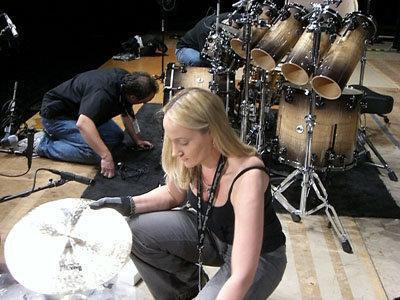
What processes are still used to make DW drums that have remained since the beginning of DW?
Juels: DW is also the only company that features timbre matching, which ensures that all of the shells in a kit fit together as one instrument based on tone, interval, resonance and appearance. It’s a process pioneered by John Good in the early ’80s. And John still personally timbre matches the orders to this day.
Brook: We’re very proud of our process of timbre matching the shells that make up our kits. John Good still takes the time to evaluate and tap on each shell so that our drums will have a purposeful intervallic relationship with each other. He has been doing this for decades because he is driven to ensure that our drums work with each other to the best of his ability.
If you could give one tip to an aspiring drummer, what would it be?
Brook: I would make sure that they were very aware of how frustrating learning to play the drums can be. But, that’s a good thing! Frustration should serve as a motivating factor. If you set goals, they can be achieved through repetition and determination. Keep trying and make it as fun as possible!
Juels: Play with other musicians as much as possible! Don’t shut yourself out of certain music styles or playing levels or be concerned about if the people look like you or not. It shouldn’t matter. Just play with everyone you can and constantly learn. Especially if it’s a style you don’t normally listen to, you’ll get a new perspective. And don’t be scared to try even if you’re not where you think you should be yet. Always remember the saying that playing with people better than you makes you better. Even if you’re Steve Gadd, there will always be someone better than you at something, and that’s a good thing! Plus, the more you play, the more you’ll get seen and recommended to play with other people. Keep up that cycle!
BONUS!
Watch our interview with John Good of DW Drums.