How to Choose an Acoustic Drum Kit
Drumming is an ancient practice that humans have refined over millennia into the high-impact, sonically optimized, and visually stunning exercise we know and love today. But choosing an appropriate acoustic drum kit for your exact application, whether it be studio work, church band, or professional live performance, can lead to a number of questions — especially when you get down to the specifics! This guide will help you understand the fundamental characteristics of drums so that you can make an informed choice. As always, your Sweetwater Sales Engineer is standing by at (800) 222-4700 to answer any drum-related questions you may have!
- Why Go Acoustic?
- What to Look For
- Types of Drum Kits
- Components of a Drum Kit
- Drumheads
- Drum Shell Woods
- Do Cymbals & Stands Come with My New Drum Set?
- Sweetwater Has Your New Drums!
Why Go Acoustic?
Before we get too far into the benefits and character of acoustic drumming, it’s important to understand that traditional acoustic drums are not the only option in today’s changing musical landscape. Electronic drum setshave become increasingly popular over the years, presenting a variety of benefits such as reduced physical bulk, low-volume discretion, minimal maintenance, and more.
While electronic kits serve excellent purposes within home studio spaces, acoustic drums are, on the whole, much better for live performance. Their presence and musical qualities weave into live mixes with natural tone and true percussive energy that audiences can feel. And whether you’re playing shows, drumming at home, or doing a bit of both, the high volume of acoustic drums can be easily tamed to fit your surroundings with mutes and dampening devices. Plus, incorporating elements of electronic kits with your acoustic sound is easier than ever with a dedicated percussion pad mounted off to the side of your setup.
What to Look For
- Establish a budget. The average price for an acoustic drum set varies widely because they differ so significantly in construction method, tonewood composition, and bundled accessories. If money is tight, then remember that most manufacturers offer several different grades of drums, at different price points. The value-priced kits are still excellent-quality instruments; they often incorporate many of the features of the more expensive kits.
- Define your acoustic space. Where will the drums be played? If they’re likely to stay in one location, then you can choose sizes and shell material that “fit” the space. If the drums will be transported a lot, then choose a kit that’s lightweight and easy to move, perhaps one with maple or poplar shells and triple-flanged hoops.
- Choose a musically appropriate combination. Here’s where you decide how many toms and cymbals are necessary to realize your musical goals.
- Choose a finish. Drums today come in a wide array of finishes, from natural wood to plastic wraps. Assess the environment the drums will occupy. For constant gigging, a durable plastic wrap that’s immune to bumps and scrapes may be the best choice. For house of worship and studio centerpieces, stained wood provides an incomparable aesthetic boost.
Types of Drum Kits
The drum set that’s going to suit you best is determined by two main factors: where you’ll be gigging and what type of music you’ll be playing. Smaller venues tend to benefit from smaller drums, which are known to produce a tighter sound and fewer low-frequency tones to resonate throughout a venue. Larger rooms benefit from bigger drums that can project and carry sounds over longer distances. Then, there are the conventions that go along with these: funk and hip-hop kits tend to use smaller drums to achieve their punchier sounds, while classic rock and metal kits employ massive shells to achieve their lower fundamentals and stage-worthy projection.
Interested in learning what type of drum kit is right for you? Consider the options listed below.
Studio Kits
Studio engineers tend to prefer a drier, purer drum sound that can be easily miked without the interference of room tone and additional harmonics — unless, of course, that is the desired effect! Some classic studio kits that that have been used at Sweetwater Studios and throughout the industry include the Yamaha Recording Custom, Pearl Session Studio Select, and DW Performance Series kits.
Jazz/Club Kits
Jazz players favor smaller bass drums (14-inch to 18-inch) that can be “feathered” at low volumes without drowning out a combo. They also tend to reach for smaller, 4-piece kits in a one-up/one-down configuration (kick, mounted tom, floor tom, snare), which can be easily carted around town. Jazz kits are characterized by their tight, wide-open musical tone. Note that jazz kits are often also called “club kits” by players and manufacturers due to their easy-gigging sizes. Examples include Yamaha Stage Custom Bop, Gretsch Drums Catalina Club, TAMA Club-Jam, and Sonor AQ2 Bop kits.
Fusion Kits
Fusion-sized kits are an intermediate size that exists between club kits and rock kits. The fusion kit is marked by a 20-inch to 22-inch bass drum and smaller, evenly intervallic (10-inch/12-inch/14-inch) toms. Don’t let their name fool you: fusion kits serve a wide range of player needs from blues to rock, stage to studio. Examples include the DW Collector’s Series Jazz Exotic, Yamaha Stage Custom Birch, Gretsch Drums Catalina Maple, and PDP Concept Maple kits.
Rock/Stage Kits
Drum kits that are tailored for the stage tend to feature larger shells that are built to project (i.e., greater thickness, denser materials). It’s this same tradition that has given large bass drums and cymbals their dominant place in rock music. The consummate rock kit is John Bonham’s Amber Ludwig Vistalite with its 26-inch-diameter bass drum and one-up/two-down configuration. Also common to the rock/stage kit is the addition of more toms and floor toms for that wraparound look. Other great, stage-ready rock kits include the DW Collector’s Series Maple, the Mapex Armory Studioease Fast Tom, and the SJC Pathfinder.
Hip-hop/House Kits
Fans of the vinyl-sampled grooves and crunchy breakdowns common to house and hip-hop music will no doubt be familiar with the fast, controlled response of these specially sized kits. Today’s hip-hop and house kits are characterized by their small shells and cymbals — notably, a 14-inch to 16-inch kick drum — that work well for backing a small group or an MC. The leader of this pack has to be the Ludwig Questlove Pocket Kit, brought to you by none other than The Roots drummer, Questlove. Other solid options for hip-hop/house kits include the Yamaha Stage Custom Hip, Gretsch Brooklyn Micro, and PDP New Yorker kits.
Metal Kits
Drum kits designed for punk, heavy metal, and modern progressive music are built with two things in mind: projection and articulation. Metal kits often exhibit a crisp, forward tone that allows players to play quickly and technically without notes bleeding into one another, all while supplying the heat needed to rocket through a dense stage mix. Also unique among metal kits are the double bass drums used in gallops and blast beats. This effect can be achieved by having a kit with two physical bass drums, like this DW Collector’s Series, or by using a single bass drum that is operated by a double bass pedal. Kits that are popular in metal today include the Mapex Saturn, Pearl Decade, ddrum Dominion Birch, and the TAMA Starclassics beloved by metal Hall of Famers such as Lars Ulrich and Matt Garstka.
For our favorite picks of the year, check out “Best Drum Sets in 2025”!
Components of a Drum Kit
Although there can be dozens of different drum kit configurations, most begin with these components:
- Kick drum (bass drum) – The lowest-pitched drum in the kit. Generally used to provide the rhythmic foundation of the piece of music.
- Snare drum – The distinctly snappy counterpoint to the kick drum. The snare drum assists in outlining the rhythmic framework, and it also serves to highlight accents in the music.
- Tom(s) – Ranging in pitch from high to low, toms provide tonal color and are often used to play “fills” that bridge two sections of a song. A drum kit may contain one, two, three, or more toms.
- Cymbals – The metallic “soprano” voices of the drum kit. A basic set includes a ride, crash, and hi-hat pair.
- Hardware – The essential gear that makes a drum kit playable. Includes a kick (bass) pedal, snare stand, cymbal stands (including a hi-hat stand), tom holders and legs, and other items as needed.
What Is a Shell Pack?
A shell pack most often includes only the bass drum and the toms. Items such as the snare drum, the stands, and the pedals must be purchased separately. Shell packs are popular because most drummers have very specific preferences for the snare drum, pedals, and other hardware they use.
How Many Toms Are Enough?
You may have seen drummers in concert or on the screen whose kits included a multitude of toms. The reality is that the bass drum and the snare drum are the primary components of a drum kit. Toms are most often used for “fills” — rhythmic phrases that provide a transition from one part of a song to the next. The number of toms used is largely a matter of a drummer’s personal preference, but a basic kit should include at least one small tom (usually mounted on the bass drum) and one larger floor tom.
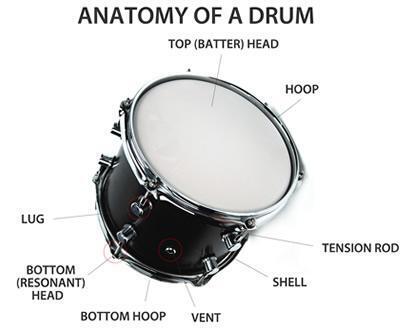
Top (batter) head
The most basic component of a drum, the head is a round membrane — made of plastic or animal hide — that is stretched across a shell, with varying degrees of tension (tightness).
Hoop
A modern drum hoop is most often made of either cast or stamped metal (although many drummers prefer wood hoops), and it contains a flange shaped to hold the head on the shell for tensioning.
Tension rod
Tension rods mount through holes in the hoop and thread into the lug to maintain the desired tension.
Lug
Lugs are normally made of metal and mount on the shell to receive the tension rods. Lug designs can vary from simple to very complex, and they often contain alignment springs and other features.
Shell
Other than the head, the shell has the most significant impact on the drum’s tone. Most shells are made of wood, but fiberglass, acrylic, and more exotic shells can be found.
Vent
A vent is simply a hole that allows air pressure to be released when the drumhead is struck. Not all drums have vents.
Bottom (resonant) head
A drum’s resonant head plays an important role in defining both attack and tone. Most resonant heads are thinner than the top (batter) head.
Bottom hoop
The bottom hoop holds the bottom head on the drum. On snare drums, the bottom hoop includes slots to accommodate the snares (see below).
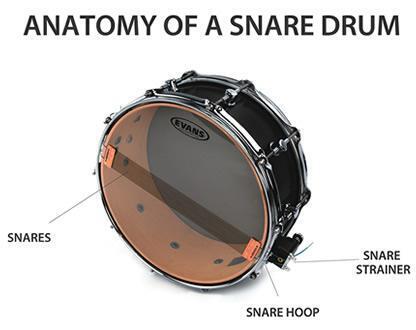
Snares
The snares — a series of coiled wires stretched across the bottom head — give the snare drum its characteristic “snappy” sound.
Snare strainer
This lever-and-thread device allows the drummer to adjust the snare tension and also to disengage the snares entirely from the head for a tom sound.
Snare hoop
This specialized hoop contains slots in its sides to allow the cords or straps holding the snares to pass through.
Sweetwater has over 1,000 snare drums to choose from. To help narrow down your search, consult our thorough “Snare Drum Buying Guide” for an expert road map to the backbeat of your dreams!
Drum Shell Woods
Most drum shells are constructed of several thin plies of wood that are glued together and bent into shape, often with the assistance of steam. Much like the tonewoods used in making guitars, the types of wood that a shell can be made of produce different characteristics of attack and tone. Here are some of the most common shell woods:
- Poplar – A standard among budget kits, poplar offers a great tonal balance for the price and a light weight that’s easy to transport.
- Mahogany – One of the softest woods, mahogany has a softness that gives it a low fundamental tone, for good bottom-end punch.
- Maple – Maple falls in the middle when it comes to both hardness and tone. Its pitch is higher than mahogany’s, yet it is considered “warm” when compared to harder woods. Maple has been among the most popular of shell woods for years.
- Birch – Among the hardest shell woods, birch has a bright sound and a sharp transient attack. The volume possible with birch makes it a pick for drummers in loud live settings.
- Bubinga – Sometimes called “African rosewood,” bubinga is a hard wood that is gaining popularity. It’s sometimes used as the inner ply of a shell (for attack), while other woods are used for the outer plies.
Regardless of the type, drum shell woods can be stained, painted, or wrapped in just about any finish imaginable. The smoothest-sounding, sharpest-looking shells on the market — both acoustically and electronically speaking — can be found in our “Best Professional Drum Sets” article!
Drumheads
From their early incarnation as animal skins stretched across logs, drum heads and their technology have leaped forward, beginning with the invention of the first plastic head over 50 years ago. These synthetic heads can be thick or thin, single- or multi-ply, coated or clear, and outfitted with reinforced centers or edges. While the range of head types can seem abundant, you should remember that moderation is the key: a general-purpose, medium-weight head will usually do the job. For a hard-hitting, loud drummer, double-ply heads are built to withstand the pressure. If tuning out overtones and controlling ring is important, then heads treated with sound-controlling centers or edges will help. Once you’ve got your heads of choice on hand, our guide on how to tune drums will help you find the perfect tension to best suit your sound.
Cymbals
The scope and characteristics of cymbals are extensive. Cymbals provide that metallic “soprano” range of tones to complement the “thuddy” characteristics of drums. Here are three of the most commonly used cymbals:
Ride – A medium-weight cymbal that helps outline the rhythmic framework of a song, along with the kick and the snare. Ride cymbals can generally withstand repeated strikes without building up too much of a roar.
Crash – A thin, often small-diameter cymbal that produces an explosive “crash” when struck on its edge. Crash-cymbal overtones normally die away quickly, which gets them out of the way of the rest of the music.
Hi-hat – Actually two cymbals, with one inverted atop the other on a special stand. Hi-hat cymbals are very versatile, able to be played “closed” with the stand’s foot pedal pressed down, “open” with the pedal up, and everywhere in between. Simply pushing down the pedal without striking the cymbals produces a nice “chick” sound.
Do Cymbals & Stands Come with My New Drum Set?
Unless you buy a kit that specifically notes the inclusion of cymbals and hardware, such as the Pearl Export or the TAMA Imperialstar, modern shell packs will not typically come with these. Sweetwater’s side navigation is your friend here. Just tick the box in the Configuration tab that says “Drum Sets” to filter by kits that include cymbals and, most often, stands. Also, be advised that snare drums (a key component of the modern drum set) may not be included with many of the shell packs on our site.
Sweetwater Has Your New Drums!
If you’re looking for your first set of drums, then you’ve come to the right place. Sweetwater has an enormous selection of drum kits to start your drumming journey on the right foot, and our SweetCare guide “How to Set Up a Drum Kit” will have you up and running in no time. For intermediate, advanced, and professional players, a configuration optimized to your exact needs has been a long time coming — let’s get you set up! Give your Sweetwater Sales Engineer a call at (800) 222-4700 to talk gear and get outfitted with the right combination of shells, cymbals, hardware, and accessories to sound your best in the studio and captivate onstage.