Unless you’ve been listening to your old 8-track tapes while living under a rock, you’ve probably heard murmurs about Dolby Atmos and how it’s been wholeheartedly embraced by both the music industry and major streaming services. In fact, most modern music releases are mixed specifically for Dolby Atmos while stereo is relegated to a mere afterthought. In view of its widespread adoption, you may be wondering if you should equip your home audio system for Dolby Atmos playback. Here at Sweetwater, we’d answer that question with a resounding yes. In our informed opinion, once you’ve experienced the enhanced dimensionality that Dolby Atmos offers, you’ll find that stereo — and even multichannel surround sound — comes up short in many respects.
- Why Should I Care About Immersive Audio & Dolby Atmos?
- How Are Dolby Atmos & Immersive Audio Different from Surround Sound?
- How Will Dolby Atmos & Immersive Audio Benefit Me If I Only Listen to Music?
- Do I Need Special Equipment to Enjoy Dolby Atmos or Immersive Audio?
- It’s Time for You to Enjoy the Benefits of Dolby Atmos Surround & Immersive Audio
Why Should I Care About Immersive Audio & Dolby Atmos?
So, why should you even care about Dolby Atmos? After all, stereo has stood the test of time, and past multichannel formats, such as 5.1 and 7.1 surround, never really took off, especially for music listening.
The main reason you should consider Dolby Atmos is that it operates on a completely different paradigm than all the formats that have come before it. Previous formats are all channel-based formats, which depend on a set number of speakers for accurate playback. Moreover, the playback setup needs to be nearly identical to the setup on which the audio was originally mixed, with similar speaker positioning and frequency response, to achieve anything even remotely close to what the engineer intended.
As a result of this dependence on the quality and configuration of the listener’s playback setup, lowering channel counts — such as listening to a surround-sound mix on a stereo system — causes some of the audio to either become skewed or get lost altogether. Moreover, listening to a stereo mix on a multichannel playback setup has historically relied on subpar algorithms that make less-than-educated guesses to fill in the sonic blanks, leading to a muddy, washed-out sound that’s markedly inferior to the original mix.
How Are Dolby Atmos & Immersive Audio Different from Surround Sound?
Many Dolby Atmos naysayers tend to lump the format in with Dolby Digital, DTS, and other multichannel surround-sound formats. However, this isn’t a valid comparison. As we noted previously, Dolby Atmos is an object-based format, not a channel-based format. Rather than positioning audio elements through panning on a defined speaker configuration, Dolby Atmos enables engineers to place specific audio elements — a.k.a. objects — at specific positions within a three-dimensional soundfield.
Moreover, Dolby Atmos-equipped playback systems offer integrated calibration that automatically customizes its sound for your room and speaker configuration. Therefore, when a listener plays content on a Dolby Atmos-equipped device, the device’s integrated Dolby Atmos decoder will place the objects in exactly the same positions as the engineer intended.
Since Dolby Atmos isn’t dependent on a set number of speakers for accurate playback, the full gamut of playback devices, from Dolby Atmos-equipped soundbars and full-blown multi-speaker A/V setups to game consoles and smartphones, is capable of faithfully re-creating the engineer’s original Dolby Atmos mix. And since Dolby Atmos mixes fold down to binaural over headphones instead of stereo, you can experience astonishingly accurate playback in that scenario — a must-have since so many listeners consume their media with earbuds.
How Will Dolby Atmos & Immersive Audio Benefit Me If I Only Listen to Music?
So far, home-theater enthusiasts have been the biggest Dolby Atmos advocates, and many in that camp have outfitted their home audio systems to accommodate the format. This is especially true for folks who already own 5.1 or 7.1 systems. For these individuals, Dolby Atmos seems to be a logical step forward, as it offers a significant upgrade for consumers who want to achieve a credible cinema experience at home.
Music aficionados have been slower to adopt Dolby Atmos, however. This is likely because of their previous experience with other multichannel formats, which has mainly consisted of a small number of niche releases aimed at select consumers with dedicated 5.1 or 7.1 playback systems. Most music releases, at least in past decades, have been limited to stereo.
As such, most music consumers have historically found little value in upgrading their home setups when the vast majority of their listening is done in stereo. It should also be noted that since most music prior to the current decade was consumed as physical media, obtaining the surround-sound version of an album required purchasing a separate version that was both more expensive and offered fewer options for portable listening.
But Dolby Atmos is different from previous multichannel formats. First of all, it’s widely supported by the recording industry, so much so that rather than being limited to a few specialized releases aimed at a small cross section of consumers, Dolby Atmos-mixed albums make up the majority of new releases. Furthermore, a massive backlog of classic albums, including legendary releases from Marvin Gaye, Elton John, Aretha Franklin, and the Beatles, has also been remixed for the format, and these albums have received enthusiastic acclaim from even the most bullheaded of music aficionados.
To top it off, since most modern music listeners consume media through a streaming service rather than a physical medium, there’s no need to purchase a special version of an album. Rather, the Dolby Atmos version of the release is already at your fingertips.
So, which streaming services support Dolby Atmos? Well, Tidal and Amazon Music have supported the format since 2019. Apple Music has been a huge advocate for Dolby Atmos, and they’ve been implementing their own proprietary iteration of the format since 2021. Spotify also offers limited support for Dolby Atmos on specified releases.
Do I Need Special Equipment to Enjoy Dolby Atmos or Immersive Audio?
You’ll need three components to build a home audio setup equipped for Dolby Atmos: Dolby Atmos-encoded media, a decoding device, and a playback system.
Fortunately for you, Dolby Atmos media is plentiful. The top video streaming services, including Netflix, Disney+, Amazon Prime Video, Apple TV+, Vudu, and Max, all include content encoded in Dolby Atmos. And, as we discussed earlier, Tidal, Amazon Music, and Apple Music include Dolby Atmos-encoded music, and Spotify provides partial support for the format. So, if you already subscribe to any of these services, then you’ll be able to enjoy the content you’re already consuming in Dolby Atmos.
As for a decoding device, many set-top streaming units — notably Apple TV and select models of Amazon Fire TV, Nvidia Shield, and Roku devices — offer native Dolby Atmos support, as do a growing number of modern smart TVs and ultra-HD Blu-ray players.
When it comes down to the actual playback system, you’ll find that you have tons of options. Best of all, since Dolby Atmos isn’t a channel-dependent format, there are plenty of choices that don’t entail filling your listening room with a dizzying number of speakers.
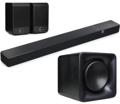
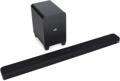
An Atmos-equipped soundbar is the simplest and most cost-effective way to build a Dolby Atmos-capable home audio system. Convenient all-in-one solutions, such as the Yamaha SR-B30A and JBL Bar 300, employ digital technology that simulates the immersive character of Dolby Atmos without the need for extra speakers. While these soundbars won’t unleash the full potential of Dolby Atmos, they still offer a terrific upgrade from your TV’s built-in speakers, and — most importantly — they enable you to enjoy properly decoded Dolby Atmos content. A number of Dolby Atmos-equipped soundbars, such as the Polk Audio Signa S4 and the Denon DHT-S517, include wireless subwoofers, ensuring that movies deliver rafter-shaking explosions and music is punctuated by chest-thumping bass.
It’s important to emphasize that soundbars shouldn’t be viewed across the board as an entry-level option. Quite the opposite; there are plenty of high-end offerings available, such as the soundbars in Sennheiser’s Ambeo series, all of which offer cinema-level sound with an outstanding feature set that rivals larger, multicomponent systems.
The next step up would be to bolster your Dolby Atmos-equipped soundbar with surround speakers. A Klipsch Flexus Core series bundle is an easy, keenly priced way to accomplish this. It includes a soundbar, subwoofer, and rear surround speakers to provide you an amazingly immersive listening experience. Moreover, the Klipsch Flexus Core’s space-saving configuration leverages wireless surround speakers and up-firing drivers to add a multidimensional quality to your movies, video games, and music. The JBL Bar 1300X is another example of a Dolby Atmos-equipped soundbar/sub/rear speaker setup that’s loaded with a bevy of top-tier features.
If you’re craving a full-fledged Dolby Atmos experience, then you’ll want to invest in an Atmos-capable A/V receiver along with a full 7.1.2 speaker system. This is an ideal solution for individuals who already own a 7.1 surround setup, as they’ll only need to add height channels to your speaker configuration. It’s also a great choice for music aficionados who are especially fond of their stereo floor-standing or bookshelf speakers, as they can easily expand their setups to accommodate Dolby Atmos without giving up their favorite set of speakers.
It’s Time for You to Enjoy the Benefits of Dolby Atmos Surround & Immersive Audio
Dolby Atmos and immersive audio do make a difference in your home audio system. And with so much immersive audio and Dolby Atmos media available from the industry’s top video and music streaming services, there’s a trove of immersive content for you to discover. Best of all, unlike the mammoth 5.1 and 7.1 surround systems of yesteryear, you don’t need a large pot of cash and a room full of equipment to experience Dolby Atmos. Whether you want to dip your toes in with an immersive Dolby Atmos-equipped soundbar, upgrade your current setup to Dolby Atmos, or build a top-of-the-line Dolby Atmos system from scratch, give your Sweetwater Sales Engineer a call at (800) 222-4700. We’re confident that once you immerse yourself in your favorite content in Dolby Atmos, you’ll never go back!