Condenser microphones are commonplace today, and there are hundreds of choices available from dozens of manufacturers; but prior to World War II, they were not in widespread use. Carbon, dynamic, and ribbon microphones were the mainstays of both radio stations and recording studios. That changed quickly after the war. Two European companies were largely responsible for this — Neumann in Germany and AKG in Austria. Several of the most popular and widely-used condenser microphones of all time were made by these two companies. While the microphones described in this article are often employed as vocal mics, they are certainly not limited to just that task. For example, the AKG C12 and Telefunken ELA M 251 both are fantastic on drum overheads; and the Neumann U47 and, later, the U67 were the most commonly used microphones on Beatles guitar tracks — both acoustic and electric. Both the Neumann U 87 and various versions of the AKG C414 are widely praised for their versatility on a wide range of sound sources, not just vocals.
Neumann U47

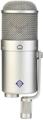
Neumann U 47 FET Collector’s Edition Large-diaphragm Condenser Microphone
This is the granddaddy of modern condenser microphones — the one that made the breakthrough and first achieved widespread popularity in American studios. First released only a few years after the end of the war, the U47 had a transformer-balanced output and used two different capsules. The M7 had a gold-sputtered PVC diaphragm that tends to dry out over time, while the K47 used mylar and was generally more stable. Both capsules sounded and still sound excellent. The U47 offers both cardioid and omnidirectional polar patterns, selectable with a switch on the mic, just below the head basket. Its close sibling, the U48, features cardioid and figure-8 polar patterns but is otherwise identical. Both “long body” and “short body” U47 models exist, but internally they have the same basic electronics and the same sound. The U47 uses a very rare tube called the VF14M. Some of these tubes were also used in radios, but Neumann inspected all the VF14 tubes that Telefunken made and marked the ones that were good enough for use in their microphones with the M — non-M VF14 tubes won’t work in a U47, and the tubes have been out of production for decades. There aren’t any stockpiles of old tubes available. When one does show up for sale, it typically sells for thousands of dollars. The U47 is known for having a big, larger-than-life sound with excellent fullness and a smooth response in the high frequencies. Used by everyone from Sinatra to Ella Fitzgerald, the Beatles, and Michael Jackson, it’s one of the legendary mics in recording history.
AKG C12

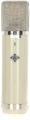
AKG C12 VR Twin Large-diaphragm Tube Condenser Microphone
The C12 was built from 1953 until 1963 by AKG. Like the U47, the C12 (and all the other mics discussed here) is another “side-address” tube mic. It uses a remote pattern-switching box that provides nine different polar patterns, giving it excellent pattern flexibility. The C12 features a highly complex brass-ringed capsule called the CK12. It is a true work of art and a big contributor to the sound of this classic mic, which is known for its bright, open, and silky sound. The tube used in the C12 is a 6072, which is far more readily available than the nearly impossible-to-find VF14M tube used in the U47. AKG later replaced the C12 with a different mic called the C12A, which is also a tube mic, but which has a completely different form factor and looks much more like the later, squared C414 than the original long and thin-bodied C12. While nice mics, they bear little sonic resemblance to the originals. Although, they do use the same CK12 capsule, as do the AKG C414s manufactured prior to the release of the C414 EB P48 in the early 1980s, which, along with all C414 versions that came after that, use the modern nylon-housed version of the CK12 capsule.
Telefunken ELA M 251

Telefunken ELA M 251E Large-diaphragm Tube Condenser Microphone
For years, U47s were distributed by Telefunken (and carried a Telefunken, rather than Neumann, name tag); but when Neumann took over their own worldwide product distribution in 1959, it left Telefunken without a large-diaphragm condenser microphone in their product line. Telefunken turned to AKG and asked them to make a mic that they could market. Instead of allowing them to market a Telefunken-branded version of the C12, AKG developed a new microphone that bore some similarities to both the C12 as well as the Neumann U47. The result is the legendary Telefunken ELA M 251. The polar patterns (omni, cardioid, and figure-8) are selected with a switch on the body of the mic, as with the U47, but the capsule and tube are the same as the ones used in the AKG C12. The diameter of the mic body is somewhere in between the U47 and the C12. Sonically, the ELA M 251 is similar to the C12 but with a bit less of the extended highs and a slightly fuller sound in the lows and midrange. It is widely considered to be one of the finest-sounding microphones ever produced, and vintage models typically sell for tens of thousands of dollars.
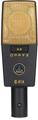
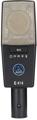
AKG C414

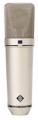
AKG C414 XLII Large-diaphragm Condenser Microphone
The AKG C414 is a solid-state, phantom-powered microphone. The first version of the C414 was released in 1971 as a four-pattern version (adding a hypercardioid pattern to the omni, cardioid, and figure-8) of the similar, yet short-lived, three-pattern C412, which can be thought of as a solid-state version of the C12A that pre-dated it. It is built into a similarly shaped housing that looks somewhat like an electric razor. The polar patterns are selected with a switch built into the mic body. Newer revisions of the C414 remain in production today. Since the early 1980s and the introduction of the C414 EB P48 models, the capsules, while still referred to as CK12s, have been significantly different than the brass-ringed, edge-terminated capsules used on the earlier versions; modern CK12 capsules are still edge-terminated but now sport a nylon outer ring instead of the original handbuilt, brass-ringed capsules. Modern versions of the C414 are still in production and are very useful microphones with great versatility, even though some engineers and collectors prefer the vintage models. Today, you can buy a brand-new C414 in two different forms — as the balanced-sounding C414 XLS or the C414 XLII, which has a more pronounced high-frequency response. Both are highly popular and in widespread use in professional studios all over the world.
Neumann U67

Neumann U67 Collector’s Edition Large-diaphragm Tube Condenser Microphone
The Neumann U67 is another legendary tube microphone, but one that bears significant differences from the Neumann U47. First released in 1960 and intended to replace the U47 after tube shortages prevented its continued production, it also uses a transformer-balanced output and a center-terminated capsule like the U47. But the K67 capsule in the U67 is a different design than the M7 and K47 capsules used in the U47, and the tube used is an EF86, which is much more readily available than the VF14M. The U67 is legendary for its spectacularly smooth and warm-sounding midrange and excellent versatility. It features three polar patterns, switchable on the mic — omni, cardioid and figure-8. Unlike the U47, the parts necessary to build a new Neumann U67 are still available today, and Neumann is once again manufacturing them in limited quantities, so you can purchase a brand-new one today that is identical to the vintage models from the 1960s in all respects.
Neumann U 87

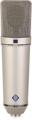
Neumann U 87 Ai Large-diaphragm Condenser Microphone
The Neumann U 87 series are solid-state FET (field effect transistor) microphones. A direct descendant of the U67, it is built into a similarly sized and shaped body and offers the same selection of polar patterns, with cardioid, omnidirectional, and figure-8 options selectable with a switch on the mic. Unlike the U67, it is phantom powered and doesn’t require a separate power supply. The original U 87 and the modern version, the Neumann U 87 Ai, are considered to be highly flexible microphones that are suitable for a wide range of vocal and instrumental miking purposes. It is one of the most popular microphones in studios around the world. Neumann still manufacturers the U 87 Ai, and new ones are readily available.
While some of these microphone models were made in relatively limited quantities of only a few thousand units and most of them are coveted and expensive collector’s items, you can still acquire their sound or close similes of that sound. Some, like the ELA M 251 and U67, are still available new, and most have spawned a variety of clones and tribute mics that offer many of the same sonic characteristics as the vintage classics at far more reasonable price points. For great advice on some of the currently available microphones and their alternatives, contact your Sweetwater Sales Engineer at (800) 222-4700 — they have plenty of experience with a wide variety of mics, and they can help you find just the right microphones for your needs!