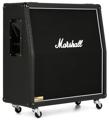
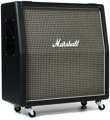
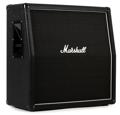
Jim Marshall’s groundbreaking gift to rock guitar: the angled 4 x 12″ cabinet.
To misquote a well-known credit card ad, the plentiful time I got to spend with the late, great Jim Marshall was “priceless.” Not only was he an incredible, impactful innovator (can you imagine the rock music we love without Marshall amps?), but he was also a truly humble chap and an amazing mentor.
One of Jim’s most groundbreaking gifts to rock guitar, however, is often overshadowed by his many now legendary amplifiers. The product in question? The angled 4 x 12″ Marshall cabinet, the industry standard 1960A. Since its creation in Jim’s garage workshop in 1962, the 1960A and its many Marshall 4 x 12″ siblings have graced countless stages all over the world and remain the best-selling 4 x 12″ cabinet family on this planet.
Here’s the fascinating story of the birth of the 1960A:
Despite being conservatively rated at only 30 watts (not 45 watts, as is often incorrectly stated), the first-ever Marshall head, the JTM45, had a nasty habit of destroying 2 x 12″ cabinets because the 15-watt, 12″ Celestion speakers available at the time just couldn’t handle the JTM45’s brutal power when cranked to 11. “Those cabs just didn’t deliver the sound or projection we were looking for anyway,” Jim told me many years later. His solution to this problem was simple but effective. “It occurred to me that four speakers would probably do the trick,” he continued. “They’d be able to handle the amp’s power and also give me the projection I was after. There was nothing brilliant about the design either — I just made it as small as possible for easier transport.”
And so the very first Marshall 4 x 12″ — the 1960B (with a straight front) — was born in Jim’s garage. While it sounded great, Jim had a problem with its aesthetic: “When I put a head on top of that first 4 x 12″, it looked terrible to me,” he recalled with a chuckle. “It didn’t look ‘designed’ at all — it was just a small box sitting on top of a bigger one!” Once again, Jim’s solution was quick and simple. “I had the idea of putting an angle on the upper half of the speaker cabinet to better match the head’s dimensions.” Jim did the deed and got the “neater package” he wanted.
To get the angle he desired, Jim had to angle the top half of the speaker baffle (the piece of wood the speakers are mounted to inside the cab). This meant that the top two speakers were angled upward, making them easier for the player to hear on a small stage. It also gave the cabinet wider sound dispersion — more “throw,” if you will.
“At first I didn’t even realize there was a sonic advantage to having the top speakers angled slightly upward,” Jim admitted with his trademark modesty. “But then I went to a gig and noticed it right away.” A lesser man might well have claimed this “sonic advantage” was a deliberate ploy, but not Jim. No wonder he was affectionately referred to as “the Guv’nor.”