

Maybe it’s time to rethink the traditional guitar amp.
Due to the fast pace of technological change, sometimes it makes sense to rethink what works best for live performance. Hardware modeling units designed for the stage, like the Line 6 Helix, HeadRush Gigboard (fig. 1), BOSS GT-1000, Zoom G5n, DigiTech RP360XP, and others, have matured to the point where they do highly credible emulations of some of the world’s most desirable amps and cabinets.

There’s also the profiling option offered by the Kemper Profiler Head (fig. 2), which produces uncanny reproductions of any amp — including ones you “profile” yourself. Furthermore, some guitarists even bring a laptop onstage and use amp sim software, like IK Multimedia AmpliTube, Waves PRS SuperModels, Positive Grid BIAS Amp 2, and the like.

Sending these sounds through a guitar amp makes no sense, because you already have the amp and cabinet sound before it hits the amp. What you really need is a full-range, flat-response (FRFR) amp to reproduce your modeled or profiled guitar sound accurately.
Full disclosure: I haven’t used a guitar amp onstage since the ’60s. At the time, tubes were getting iffy, and I had started building my own effects to get the sound I wanted. So I switched over to keyboard amps, but they’re not always ideal either, because they often have the same bulky form factor as guitar amps. Fortunately, the final puzzle piece for a guitar-oriented, 21st-century stage setup fell into place with the advent of portable PAs — like the powered speaker systems from Bose, Electro-Voice, JBL, Mackie, Peavey, PreSonus, QSC, Turbosound, Yamaha, and others (fig. 3). These pack a lot of power — hundreds, and sometimes even thousands, of peak watts — into a compact, portable cabinet, and use Class D amplification for cool, reliable operation.
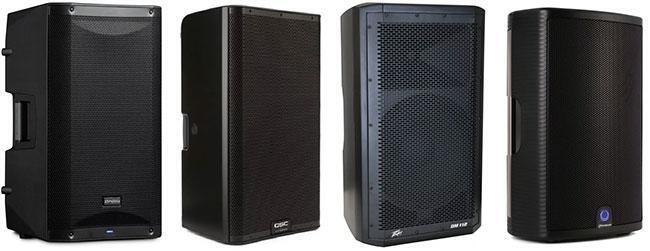
I first used a Bose system at a festival gig in 2007, and I never looked back. (Even better, the linear array made it easy to do feedback — I just held the guitar neck parallel to the column.) In addition to high power and compact size, other FRFR system advantages include:
- Works for bass as well as guitar. If you need that additional low octave, most systems have optional subwoofers.
- Your sound works with anything that has a flat response. Because your sound isn’t dependent on an amp, you can feed directly into the front of house mixer — and then use the FRFR amp as a wedge-type monitor.
- Easy expansion. Most powered speakers can daisy-chain if you need more coverage or extra power.
- Pole mounting. Mounting on a pole (fig. 4) can give better dispersion, as well as a better experience for the audience, compared to a guitar amp sitting on the floor and tilted back.

- Fits more easily in cars. I can fit two of the large original Bose L1 columns and four subs in my 2000 new Beetle. ‘Nuff said.
- Double on electric and acoustic guitar. Powered speakers often have at least two inputs, so you can feed your multi-effects output into one input, and an acoustic guitar — which you probably want to process separately anyway — into the other input.
- Ideal for singer/songwriters. This is another reason why multiple inputs are useful, because there will almost certainly be a mic input. Throw a TC-Helicon voice processor in there, like the VoiceLive Play, and now you’ve covered guitar (or keyboard, for that matter) and vocals.
- Stereo option. Use two powered speakers, and you can do stereo. Granted, preparing stereo sounds that work live is very different compared with using stereo in recordings, but it can have its uses.
- No tubes! Yes, I know tubes have a cool sound, not to mention that warm, reassuring orange glow — but they go soft over time and eventually fail. Some modelers do an incredible job of re-creating that sound (and virtual tubes don’t deteriorate).
- Cost. The all-tube Fender ’65 Deluxe is a sweet 1 x 12, 22-watt amp that costs over $1,000. QSC’s CP12 pushes 1,000 watts peak into a 12″ low-frequency driver and 1.4″ high-frequency driver, for less than half the price and 6 fewer pounds. To be fair, the effects unit to feed the speaker will add to the tab, but you probably use effects with a guitar amp as well.
- Easier to match the sound to the venue. Many portable PAs include DSP for shaping the frequency response to accommodate different venues, and effects units may have a master graphic EQ that provides the same function.
Now don’t get me wrong — I like guitar amps and have several in my studio. But for live performance, the advantages of an FRFR system are compelling. And even if you don’t have a powered speaker, being able to go into the front of house mixer is huge. When I was doing a lot of European EDM gigs in the early 2000s, I only needed to take an AdrenaLinn, volume pedal, MIDI cable, some audio cables, and a tuner. It doesn’t get any easier than that!