

Over the past couple of years, a thrilling assortment of true-analog synthesizers has been introduced — some monophonic, some polyphonic, some with mini keys, and some with full-sized keys. There are also plenty of analog tabletop modules and Eurorack modules to choose from at many price points.
But, if you’ve been a synthesist for more than a decade or two, you’ve surely been wondering, “When is Moog going to release a flagship polyphonic analog synthesizer?” Well, 2018 is the year of the Moog One polyphonic synthesizer, available in 8-voice and 16-voice versions!
What’s in a Name?
Why is it called Moog One (especially when it’s polyphonic)? That’s easy; it’s because this is the one I’ve been waiting on for most of my life. It’s because this is the one you’ll definitely want to own — for yourself, for your studio, for your live rig, and for your classroom.
I’ve had the incredible fortune to be on the Moog One product development team and manual writing team for almost two years, where I’ve witnessed this astounding beast grow more powerful with every firmware update.

Why am I so breathlessly excited about Moog One? First, because of my undying love for the “Moog sound.” I played my first Moog (a Micromoog) onstage in 1977, re-creating the intro to Rush’s 2112 album. The next Moog I got to play was a System 55 at Northern Illinois University in 1980, where I fell in love with its oscillators and especially its Moog Ladder Filters. But it wasn’t until 2008 that I was able to purchase my own Moog Little Phatty (the orange-backed Sweetwater edition), along with all the Moogerfooger effect pedals and then a Moog Voyager RME. That’s when I truly became a hard-core Moog fanatic.
Having been a synth fan for almost the entire history of Moog synthesizers, I can say without question that this is the finest Moog ever made. Every time I wondered, “Will it have this feature?” it turned out to have multiple variations on that feature. The Moog One continues to surprise me every single day with the possibilities it presents.
Too Much?

You may be thinking that the Moog One will be too complicated for you to master. But here’s the best part: on the surface level, the Moog One is as easy to operate as the famously simple Minimoog and Memorymoog. One look at its spacious front panel will show you everything you’re used to — three analog oscillators with variable waveshapes, variable noise, a mixer, two filters (State Variable and Ladder Filters), three looping envelopes, four LFOs, and a panning VCA. Now, multiply all of that by three since you can have three independent “Synths” running at the same time. Then add a musically powerful arpeggiator and a 64-step sequencer to each of those three Synths (yes, different for each Synth), and then give each of the three Synths its own independent DSP effect. And finally, take the mix of all three Synths and run them into another pair of effects designed by Moog and Eventide.
Under Control
Okay, so the Moog One sounds great. But what about control? How about the finest synth keys (with velocity and aftertouch) that I’ve ever put my fingers on? Plus the pitch and mod wheels are conveniently next to a luxurious-feeling X/Y pad that also responds to pressure. Want more control? How about sustain and two expression pedal inputs that can all be configured to control any combination of parameters per Synth? And it has four CV (control voltage) input jacks, again configurable per Synth, and two audio input jacks (one 1/4″ line level and one Neutrik XLR with mic preamp).
Programming
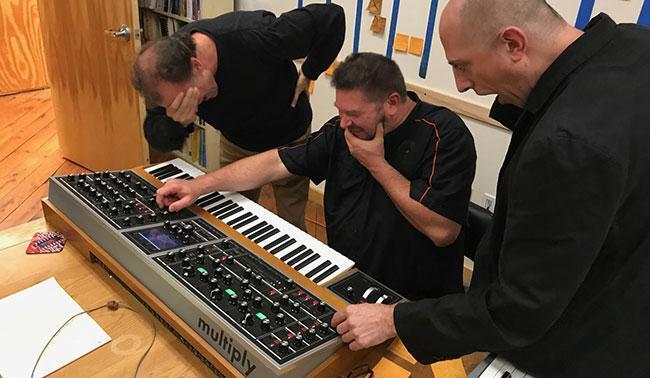
Okay, so it’s controllable. What about programming possibilities? Each of the three Moog One Synths features a Modulation Matrix that allows you to connect pretty much any control source (internal or external) to any controller destination, with yet another controller in between to control that. So how many modulations can you make per Synth? We honestly don’t know, as the Moog One is equipped with a ridiculous amount of parameter memory. We have yet to run out, no matter how hard we try.
So how many presets, performances, sequences, and effects can it hold? Again, we really don’t know (many thousands, maybe millions). And there are no preset numbers; everything is identified by its name, group, category, style, etc. This means that you can gather every synth, sequence, and effect ever made and keep them all inside your Moog One. No need to ever worry about running out of preset slots. But don’t worry — you can easily gather any of your favorite 64 presets into Performances (that can be accessed from front-panel buttons and via MIDI program changes). How many groups of 64 Performances can you have? We don’t know yet, but we suspect you’ll never run out of them!
Feel the Excitement!
Are you starting to see why I’m so excited about the Moog One? To learn more, please contact your Sweetwater Sales Engineer at (800) 222-4700 about this capstone instrument. Sweetwater is committed to being the worldwide experts on the Moog One.