
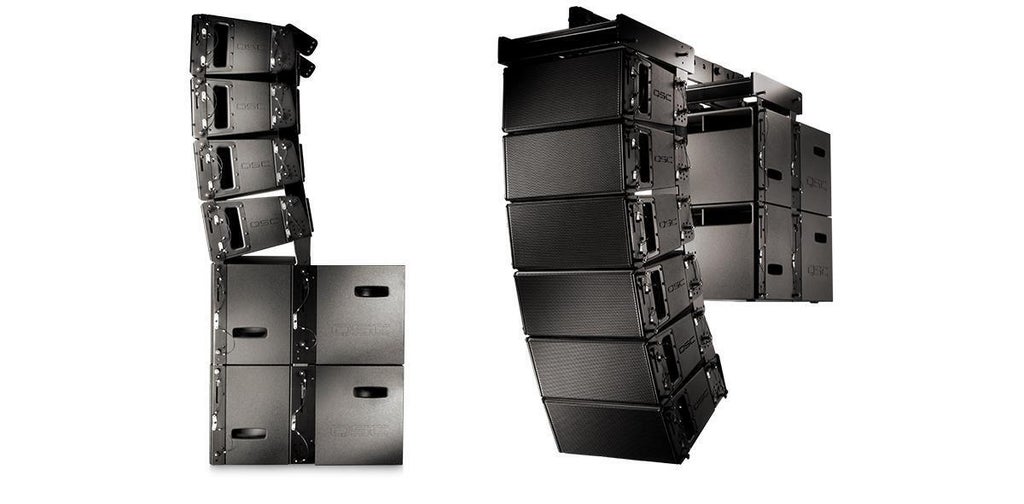
Early line arrays, such as the 1967 Shure Vocal Master system that featured the VA300-S Speaker Column, a “highly directional, wide range, line-radiator” (according to Shure’s manual) didn’t initially catch on, but they’ve steadily gained popularity over the past few decades in large sound-reinforcement applications where achieving balanced coverage is a considerable challenge. What is a line array? It is a series of loudspeakers that covers the same frequency range and is stacked above one another.
The key to a line array is that the speakers face slightly different vertical angles, allowing them to consistently cover a greater depth of field than a single PA speaker can. The effect is that people experience similar sound whether they’re in the back rows, the middle, or the front of the venue, providing a better experience for everyone in the venue. If you’re working in larger spaces and need reasonably high SPLs (Sound Pressure Levels) and clarity, then this is one option you should definitely consider.
How Do Line Arrays Work?
How line arrays work can be a fairly deep discussion. Instead of going down the entire theoretical rabbit hole here, we’ll explain how line arrays work in plain English, starting by understanding how a typical speaker disperses sound over distances.
The Inverse Square Law
The inverse square law tells us that SPL drops by 6dB each time the distance doubles from a point source of sound in a free field of intensity (meaning no boundaries). This is the behavior we’re normally used to with speakers, though there are many nuances to it.
Point Source

The inverse square law assumes the speaker is radiating omnidirectionally. Except at very low frequencies, this is rarely the case. However as distance increases, even a typically directional loudspeaker (e.g., 90° horizontal dispersion by 90° vertical dispersion) acts like a true point source (i.e. omnidirectional) with respect to how the inverse square law applies.
Line Source

A line array functions as what’s known as a line source, and therefore will not fall off in level by 6dB each time the distance doubles. Theoretically, it would only drop by 3dB per doubling, but in practice the results aren’t quite that good for a myriad of reasons that are mostly beyond the scope of this writing. However, the overall effect of speakers with line-source dispersion is that you can put more sound in the back of a hall or outdoor space, without requiring the high output level at the front of house speaker position that you’d need with single PA speakers with wider dispersion patterns that are closer to true point-source speakers.
Achieving Line-source Dispersion
Phase Cancellation
Phase cancellation is usually one of the things you try to avoid in a sound system, yet it plays a central role to the way line-array speakers work together to provide a system of speakers with narrow vertical dispersion characteristics. Even with advanced speaker cabinet designs to shape the vertical dispersion, there’s still plenty of natural overlap between speakers in a line array. However, each speaker is at a slightly different distance from the audience, which introduces a small degree of phase cancellation. By introducing a small amount of additional delay, you can fine-tune these phase differences to reduce each speaker’s vertical dispersion.
A Few Important Caveats
While applied phase cancellation can shape the vertical dispersion of the speakers in a line array, their horizontal dispersion is not affected. So in effect, an individual speaker in a line array may wind up with a 90° horizontal dispersion by only a 20° vertical (for example). Also, even though phase cancellation can achieve a line-source distribution and dramatically improve long-distance coverage, as distance increases, even line arrays begin to take on point-source characteristics and succumb to the -6dB per doubled distance of the inverse square law.
There are limitations and caveats to a line array’s ability to approximate a line-source function. First, the overall top to bottom length of the array determines the lowest frequency that will behave accordingly. This is simply because as the wavelengths get longer, the relevant time arrival distances at the listening position must be greater to achieve the effect. That necessitates a longer array. At the other end of the spectrum, the wavelengths become so short that the drivers are too big to be placed close enough together, so the relative phase differences become too great to achieve line-source function. In those cases, waveguides (horns) are used to achieve enough directionality to approximate something between a point-source and line-source function.
Fringe Benefits
Line arrays are inherently helpful in acoustically challenging spaces because you can control their vertical dispersion and reduce reflected sound. Keeping sound off of ceilings and floors is a great start, and then choosing speakers with horizontal dispersions that will help you keep excess sound off of the sidewalls gives more benefit.

Line-array Shape
Because vertical dispersion per speaker is so tight, you can effectively think in terms of dividing the listening space into sections from front to back, with each front section covered by only one or two speakers, while more speakers may cover the rear sections. This idea gives rise to the popular J-shaped line array so commonly seen in concert halls and outdoor venues.
Shading
The exact shape will vary depending on the layout and dimensions of the area needing coverage. You can see how this configuration will inherently put more sound toward the rear of the hall relative to the front rows, which helps with the overall coverage consistency. You can manipulate this further by regulating the power (wattage) delivered to each speaker cabinet — a technique commonly referred to as shading.
Line-array Challenges and Limitations
Though line arrays can be helpful in solving the problems of certain spaces, they do have complex limitations. In addition to the challenge of creating an array length long enough to control lower midrange frequency ranges, line arrays can sometimes suffer from weird anomalies such as certain frequencies lobing into areas directly above and below the array. In a poor acoustic space, this can be extremely problematic, and if your vocal mic is directly beneath a line array, you may experience feedback issues.
Line-array Setup
At the very least, a proper array requires a rigorous mechanical and electronic setup procedure. Because of the complex interactions involved, everything matters — the exact angle of each cabinet, the exact crossover points, the individual driver delays, and sometimes even the filter settings have to all be exact to achieve the best performance.
Sound Quality
Even at their very best, line arrays are unlikely to deliver the purity of sound that high-quality single driver or single two- or three-way cabinets offer, which is one reason why they’re much less likely to be found in smaller spaces where a small number of speakers are more appropriate. Cost and space are considerations too, of course.
Small Line Arrays
While line-array technology most often appears in large sound-reinforcement applications, there are a number of companies, such as Bose, Fishman, Turbosound, and others, that offer small, personal PA systems that use miniature arrays of small speakers (typically 2″–4″) to create the same line-source-dispersion effect. When used correctly, these systems can provide excellent coverage in small venues.
What’s the Next Step?
If you’re not sure whether line array or conventional point-source speakers are for you, or you need a hand to configure a PA system for your space, your Sweetwater Sales Engineer will be happy to work with you to ensure you get the live sound system that best fits your needs.