

Sweetwater’s Trombone Rental and Buying Guide will help you choose the best instrument for your needs, whether you’re a first-time trombone player or you’ve been playing for years and want to upgrade to a new instrument.
The quality of a trombone’s sound, like that of any instrument, is largely determined by the player’s technique. However, many factors, including the materials and processes employed in the instrument’s construction, work together to determine the tonal quality of a trombone. In this guide, we’ll cover the following topics:
- What are the types of trombones?
- What are the parts of a trombone?
- What materials are trombones made from?
- What are the differences between beginner, intermediate, and professional trombones?
- Trombone Rental: Why and How to Rent a Trombone
What Are the Types of Trombones?
The three primary types of trombones are:
- B♭ tenor straight trombone
- B♭ tenor trombone with F attachment
- B♭ bass trombone
Some of the alternative variations include alto trombone, soprano trombone, and piccolo trombone among other less common types such as the contrabass trombone and cimbasso. The different types of trombones share many common traits and features.
What Are the Parts of a Trombone?
A trombone is composed of three essential elements — the mouthpiece, the slide, and the bell section — and includes numerous small parts that assist in both performance and instrument maintenance. Typically, trombones are disassembled into these sections before storage.
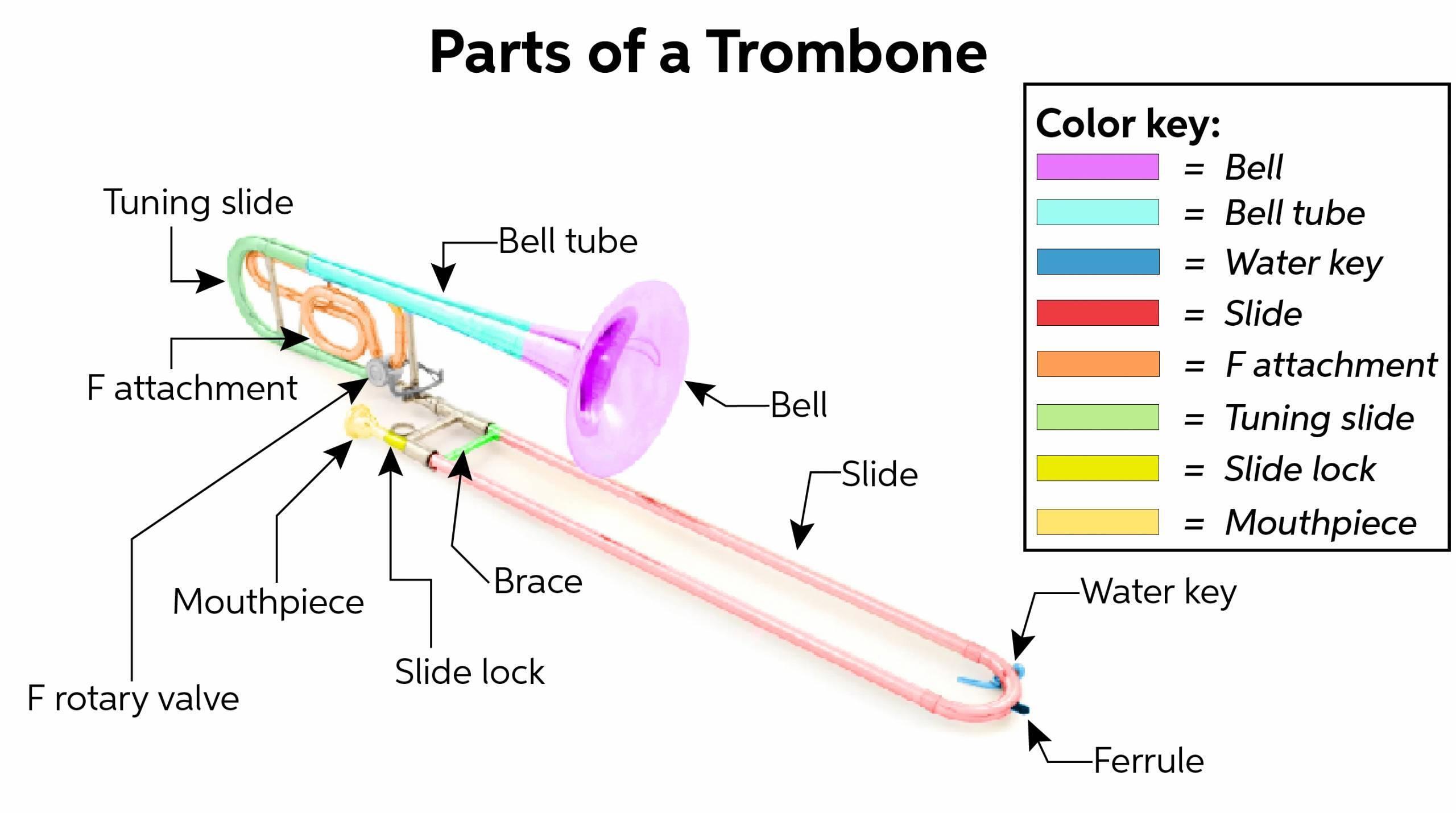
Bb tenor trombone with F attachment
Slide
A trombone slide is made up of two parts, the inner slide tube and the outer slide tube, and it extends over two feet in length. In fact, if you were to straighten a trombone’s tubing, it would measure nearly nine feet! Producing a sound with a trombone involves blowing into the instrument while vibrating your lips. Low notes are produced with slow vibrations, and high notes are produced with fast vibrations. The slide is then used to alter the pitch of the notes. This combination of breath control, vibration, and using the slide makes the trombone a highly expressive instrument. A trombone slide includes a slide lock for securing the slide when you’re not playing your instrument, a slide bumper (which allows you to set the trombone on its slide end without damaging the crook), braces to stabilize the slide, and a water key (more on that later).
F attachment
A standard trombone has a fundamental pitch of B♭. However, many contemporary intermediate and professional trombones are equipped with an F attachment, a clever device that adds approximately three feet of tubing to lower the fundamental pitch of the instrument down a perfect fourth. The F attachment is made active with a thumb-operated trigger — traditionally, a rotary valve. However, trombone designers have undertaken the task of solving some of the shortcomings inherent to the rotary valve’s design, such as impeded airflow. The Thayer axial flow valve is a popular modern alternative that reduces the angles in which the air flows to mitigate air resistance. To extend the range of the instrument even further, some trombones offer an E♭ attachment, which supplies an additional length of tubing to the F attachment.
Closed wrap vs. open wrap
When looking at trombones with F attachments, you’ll encounter the terms “closed” (traditional) or “open” wrap, which refers to the orientation of the additional tubing. Closed wraps contain the tubing within the bell section of the trombone, while open wraps extend the tubing beyond the crook of the bell section.
The advantages of a closed wrap are that they protect the F attachment against scratches and dings, and they don’t add length to an already lengthy instrument. One disadvantage, according to some players, is that closed wraps can restrict airflow since they require more bends to stay within the physical limits of the bell section. Open wraps are designed to address that complaint. They have fewer bends, but they increase the length of the instrument.
Student musicians, especially those who perform in a marching band, may prefer a trombone with a closed wrap for durability reasons. However, if you’re playing primarily in an orchestral setting and you enjoy the feel of a freer-blowing instrument, then an F attachment trombone with an open wrap is an excellent choice.
Bell
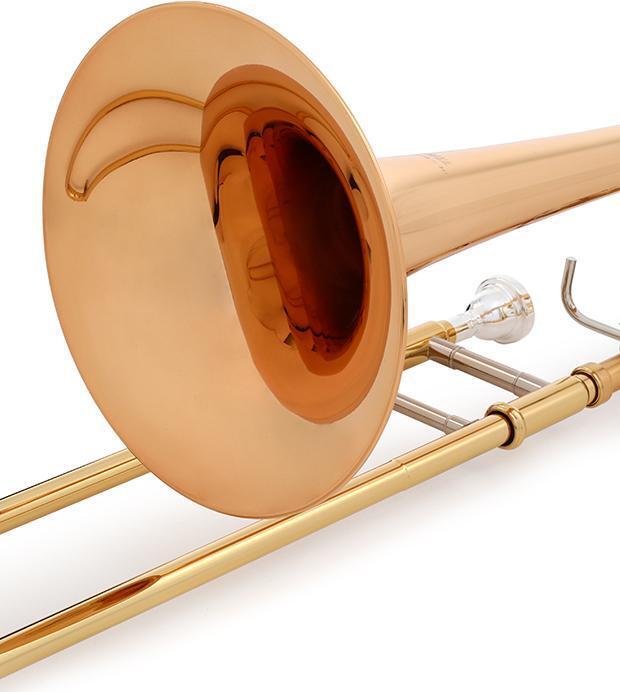
Simply put, the bell is like a trombone’s speaker, and its size and composition have a meaningful effect on the sound of an instrument.
Bell size
The average diameter of a tenor trombone bell is around 8.5 inches (9.5 inches for bass trombones), though custom sizes are offered. Bells also vary in wall thickness and taper. Standard-thickness bells are dark, full, and projective, while thinner bells (referred to by Conn as “thinwall”) are brighter and more piercing but can make it difficult to maintain consistent intonation.
As the bell diameter increases, so does projection, but there is a tradeoff in that smaller bore sizes exhibit a more focused sound and require less effort to produce a clear tone.
Bell taper refers to how quickly the bell widens from the stem of the bell to its rim. A bell that tapers quickly will produce a deeper and warmer sound, whereas a bell with a gradual taper will tend to have a brighter, more biting sound.
1-piece vs. 2-piece bells
Trombone bells come in 1-piece or 2-piece varieties, which denotes how many pieces of metal (typically brass) were used in their manufacturing. Among student models, 2-piece bells are most common because the manufacturing process is simpler, faster, and, therefore, most cost-effective. Higher-end intermediate and professional trombones often feature hand-hammered 1-piece bells. Producing a bell from two pieces of material requires that the pieces be joined together, typically by brazing, which produces a seam. The brazing process ensures that 2-piece bells are as structurally reliable as 1-piece bells. However, some players argue that hand-hammered 1-piece bells produce a clearer tone with greater brilliance than 2-piece bells.
Bell material
Like the rest of the trombone, bells are generally made from brass. High-end trombones will often feature gold-brass or sterling-silver bells. Materials are covered in the section “What Materials Are Trombones Made From.”
Water keys
On the crook of your trombone’s slide tube, you’ll find a water key. Water keys are designed to quickly release condensation from the instrument. Using the water key regularly will mitigate the potential for moisture buildup that can lead to mold and corrosion, thereby lengthening the lifespan of your instrument. The water key is fitted with a small felt disc that makes a tight seal when the water key is closed. The felt disc will wear out over time, and you will need to have it replaced. Sweetwater offers service and maintenance for brass instruments, including felt-disc replacement for trombone water keys. For more information, please contact your Sweetwater Sales Engineer at (800) 222-4700.
Bore size
A trombone’s bore size relates to the inner diameter of the tubing. Trombones have a cylindrical bore shape that remains consistent in dimension from the end of the first side lock to the point at which the bell begins its taper, and trombones are generally offered with small, medium, or large bores. Bore size can have a noticeable impact on the playability of a trombone. As bore size increases, more energy is required to fill a trombone with air, which is why you’ll often find smaller bores on student instruments and larger bores on professional instruments. However, bore size doesn’t just affect playability; it also affects the character of a trombone. Small-bore instruments tend to be brighter, while large-bore instruments are darker and more forceful. Alternatively, there are dual-bore trombones, which some players attest sound larger than a traditional trombone.
| Bore | Characteristics |
| Large Bore | These instruments are loud and have a timbre well suited to harmonizing when playing in an ensemble. They are favored by trombone players in large orchestras and are often used for playing wind music. |
| Medium Bore | These instruments are comparatively new and fall between the large- and small-bore instruments. They are well suited for the first chair in an orchestra or for wind music that requires a fuller sound |
| Small Bore | These instruments produce an overall bright sound and are adept at playing delicate high notes. They are better suited for solo performances and are favored by jazz and pop music players. |
| Dual Bore | Some instruments feature inner slides of two different sizes. The lower slide is slightly larger than the upper slide. This affects the timbre and sound in subtle ways, such as producing a wider and softer sound. |
Courtesy of Yamaha
Mouthpiece receiver
Trombone mouthpieces are made in different sizes to accommodate instruments with different bore diameters. Mouthpiece receivers on standard tenor trombones are sized to receive small-shank mouthpieces, while mouthpiece receivers on bass trombones are sized to receive large-shank mouthpieces. However, some large-bore tenor trombones are designed to exclusively fit large-shank mouthpieces. This can lead to some confusion when purchasing a mouthpiece for your trombone. If you have any questions about mouthpiece compatibility, please consult your Sweetwater Sales Engineer.
What Materials Are Trombones Made From?
As a member of the brass instrument family, the trombone is generally made from one of several varieties of brass: yellow brass, gold brass, or red (rose) brass. On student instruments, yellow brass is most common, and it’s comprised of approximately 70% copper and 30% zinc. Intermediate and professional instruments are often made of gold brass, which has a higher copper content (80% copper, 20% zinc) and is capable of producing wider, fuller tones. Red brass (90% copper, 10% zinc) has a distinctive reddish hue; a warm, mellow sound; and natural anticorrosive properties.
Trombone manufacturers may use a combination of brass types for the different segments of a trombone, which gives you more flexibility to choose a trombone that fits your budget and that has the sonic characteristics you desire.
| Material | Ratio of Copper to Zinc | Tonal Characteristics |
| Yellow Brass | 70:30 | Bright and forceful timbre |
| Gold Brass | 80:20 | Wide and full sound |
| Red (Rose) Brass | 90:10 | Warm and mellow tone |
What Are the Differences Between Beginner, Intermediate, and Professional Trombones?
Buying a trombone for a first-time student musician? Read this.
1. Don’t shop based primarily on price
While it can be tempting to buy the most affordable student trombone you can find, low-quality instruments can have performance issues and a less-than-satisfactory sound. That can make the process of learning to play the instrument frustrating and unrewarding, and it may derail your student’s musical aspirations before they even begin. Fortunately, Sweetwater only carries high-quality student instruments spanning multiple price points to fit your budget.
2. Consider purchasing an instrument your student can grow into
This is a follow-up to the first point. As instruments increase in price, so do their features. If you’re confident that your child will commit themselves to their instrument, then it may be worth exploring a more feature-rich student trombone or an intermediate trombone. The upfront cost will be higher, but you’ll save money in the long term by not having to purchase a step-up instrument as your child progresses.
3. Make durability a key criterion
There’s no way around it: student instruments are going to take a beating. From bus rides and locker storage to getting knocked around in the band room, a student trombone is going to be subjected to numerous opportunities for damage. The best way to know if a trombone is built for durability is to check with your Sweetwater Sales Engineer. They can give you the lowdown on the factors that affect the durability, such as the quality of the finish, how reliable the valve assembly is, and how much maintenance will be required to ensure the instrument plays great, sounds good, and retains a comfortable resale value.
Beginner trombones
Beginner (or student) trombones are designed to meet the needs of new, aspiring musicians, emphasizing playability, durability, and affordability. Typically, beginner trombones are crafted from yellow brass and equipped with a 2-piece bell. Most are straight trombones that do not include an F attachment — though there are some exceptions.
When shopping for a beginner trombone, you may be tempted to select one based solely on cost. However, it’s important to choose a well-made instrument with reliable intonation and a pleasing tone. Some lower-quality trombones don’t prioritize those factors, which can ultimately lead to a frustrating experience when you’re trying to learn your instrument. Sweetwater offers several high-quality student trombones ranging from $600 to $1,600.
Intermediate trombones
Commonly called “step-up” instruments, intermediate trombones provide developing players with a higher level of performance and sound as well as additional appointments that facilitate more advanced playing techniques. The intermediate category is diverse with numerous options for materials and features, including F and E♭ attachments. Bells on intermediate trombones are generally 2-piece, but some will feature a seamless bell, which is a machined version of a hand-hammered 1-piece bell.
The expanded features and configurations of intermediate trombones help match an instrument to your playing style and provide a platform for refining your technical proficiency. Sweetwater carries a selection of intermediate trombones ranging from $1,100 to $2,600.
Shop All Intermediate Trombones
Professional trombones
When you’ve outgrown your intermediate trombone, it’s time to upgrade to a professional model. Professional trombones are the pinnacle of trombone design and manufacture, and they are typically handcrafted or, at the very least, hand finished. Professional trombones are made using high-quality materials, and hand-hammered 1-piece bells are typical. Professional trombones will also have more decoration, including beautiful, hand-engraved motifs.
Professional trombones also have more options than intermediate trombones when it comes to meeting the demands of professional musicians. Sweetwater offers a variety of professional trombones with prices ranging from $2,400 to $5,900.
Shop All Professional Trombones
Trombone Rental: Why and How to Rent a Trombone
If you’re in the market for a trombone, you essentially have two choices: to either rent or buy. If you or your child has already invested considerable time in learning an instrument, then purchasing one would be an excellent option. Owning your own trombone is a gratifying feeling, and you can customize it with high-quality aftermarket components that cater to your specific preferences.
On the other hand, if you or your child are still exploring the possibility of playing the trombone and haven’t fully committed to it yet, then renting an instrument might be a better option. By renting, you can try out a trombone without making a significant financial investment. With the Sweetwater Instrument Rental program, renting a trombone is easy and stress-free. Keep reading to discover more!
Why Rent a Trombone from Sweetwater?
Rest assured that when you rent a trombone from Sweetwater, you’re receiving the finest instrument available. We collaborate closely with music instructors nationwide to provide the precise instruments they require in their classrooms. All the trombones we carry have received the educators’ pre-approval and originate from premium brands such as Bach, XO, Yamaha, C.G. Conn, Jupiter, and others.
Furthermore, with Sweetwater’s 40-point Inspection protocol for instruments, you can be certain that you’ll receive a trombone that’s ready to play immediately. Simply put, your student will receive a top-notch instrument that motivates learning, produces incredible sound, and will last a lifetime. The best part is that there are no concealed fees, and all your rental payments go toward purchasing the trombone. Once it’s paid off, it’s yours to keep.
How to Rent a Trombone from Sweetwater
Sweetwater provides an effortless way to rent a trombone with a budget-friendly monthly rate. Here’s how it works: Start by visiting the Sweetwater Instrument Rental webpage. Click on the “Rent Now” button and complete the form. Pick your state, school district, and your child’s school, along with the preferred instrument – in this case, “Trombone.” Next, select from a pre-determined list curated by your child’s music teacher!
Following that, the trombone will be delivered to your doorstep in just a few days. It’s an incredibly straightforward process that you can complete from the comfort of your home, with no need to wait in lengthy queues or visit another store!
Trombone Rental Repairs
You might be thinking, “What if my trombone malfunctions and requires repairs?” Not to worry! Sweetwater provides an Instrument Protection Plan for a nominal monthly fee, enabling you to switch out the trombone whenever it requires repair. If anything goes wrong, simply inform us, and we’ll ship you a replacement horn that same day.
All you need to do is return the damaged trombone using the free shipping label we provide. Then, you may continue your rental period with the newly arrived instrument. It’s a speedy and convenient process that saves you or your student from enduring weeks of downtime, allowing you to spend more time playing and practicing!
Trombone Rental Returns & Exchanges
What happens if your child decides that the trombone is not their cup of tea? In that case, there’s no need to worry! With a Sweetwater rental, you have no long-term obligations. You may return the instrument to us at any moment – no questions asked – and your monthly payments will cease.
On the other hand, suppose your student is excelling with their trombone and is ready to advance to the next level. In that case, we make upgrading a breeze! You can apply all your rental payments toward another instrument here at Sweetwater, making it simple to switch out that student trombone for a more advanced model. The equity remains with you, not the instrument!
And if your student wishes to experiment with a different instrument, such as a trombone or saxophone, it’s just as easy. Sweetwater will assist you in exchanging your existing rental for a completely different instrument while retaining the equity you’ve earned!
Conclusion
No matter where you are on your musical journey, we’re here to help. Sweetwater has the most highly trained salespeople in the business. Call your Sweetwater Sales Engineer at (800) 222-4700; they’ll be happy to help find the best trombone for you.


