When it comes to practice volume, acoustic drummers have gotten the short end of the stick (pun intended). After all, most of us can just turn down a knob when we want to avoid disturbing our neighbors. Drummers don’t have that luxury. Even if you set up your kit in the basement, odds are that your family or roommates are going to start complaining. And drumming in an apartment can be a one-way ticket to Evictionville. So, what’s the solution? You can’t create a truly soundproof room without serious remodeling, construction, new walls or floors, and likely a building permit. Don’t worry, friends, all hope is not lost. Sweetwater has a few easy-to-implement ideas that are sure to make your life (and the lives of those around you) more peaceful.
1 — Reinforce Your Door
Doors are notorious for sound leakage. So, what can you do about it? Start by installing weather stripping around them. This will prevent sound from leaking around the sides. And, if your door doesn’t have one, add a sealing threshold at the bottom of the door to close that gap. Interior doors are often cut “short” (leaving a gap above the floor) for ventilation so that air will still flow under the door when the door is closed. Beyond that, if you have a hollow-core door, your best bet is to replace it with a composite or solid-core door. Alternatively, you can reinforce it with something heavy by adding mass with a product like Dynamat, mass-loaded vinyl, or a Sound Seal wall blanket. (Be aware that adding weight to a door may require different hinges or even a reinforced doorframe depending on how the door is hung.)
2 — Fortify Your Windows

After your door is reinforced, you’ll want to reduce the amount of noise that’s leaking through your windows. Start by installing weather stripping around them, much like you did with your door. Then, use StopGap to seal any gaps between your walls and the borders of your windows. Finally, install thermal-insulated blackout curtains. Tailor-made for noise dampening, you’ll be shocked at how much sound these curtains can block.
3 — Seal Your Room
The next thing you should do is seal your room. If air can pass through a hole or opening, so can sound (and that includes heating and air conditioning ductwork). Start by installing foam gaskets on your electrical outlets and wall plates. These are available at most hardware stores. Then, walk the perimeter of your room. If you see light peeking through or feel air flowing from a wall, look for the small holes that are causing the leak and plug them with foam seal tape, caulk, or our sealant of choice, Auralex StopGap. StopGap is great stuff — it’s paintable, non-staining, and compatible with most large-sized caulking guns available at your local hardware store.
4 — Decouple Your Kit

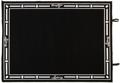
If your drum practice room is in an upstairs bedroom or if you live in an upper-floor apartment, then you’ll need to decouple your drum set from the floor. That’s because your drums are anchored to the ground, and, every time you hit one, the impact is transmitted through the floor as vibration. The result? To your downstairs neighbors, it sounds like a family of cloggers is practicing upstairs. So, what can you do about it? For starters, we recommend a high-quality drum rug. This will absorb a bit of the sound. On top of that, the spurs on your stands will have something to dig into, which will keep them from sliding around and protect your floor from damage. Want a drum rug with maximum isolation? Take a look at Auralex’s HoverMat. It was designed especially for drum-isolation purposes. For even better sound attenuation (especially if your room has hardwood floors), get a set of interlocking gym mats from your friendly neighborhood sporting-goods store and place your drum rug on top of those. For the ultimate in home-brewed drum decoupling, check out YouTuber Stephen Clark’s makeshift tennis ball riser.
5 — Quiet Down Your Kit

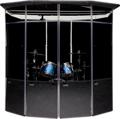
If you’re serious about wanting to play your acoustic drums without disturbing your neighbors, then you’re going to have to quiet down your kit. Simply sealing your room isn’t going to cut it. When our Sales Engineers are asked how to lower the volume of an acoustic drum kit, one product is always mentioned: Evans SoundOff mutes. These ingenious devices drastically lower your volume, enabling you to practice at reasonable volume levels while maintaining the core tone and feel of your drums. Not quiet enough? Then add a portable drum-isolation booth like the ClearSonic MiniMegaPac. This pro-level iso booth provides 60–70% sound reduction via 360 degrees of acoustic panels. The kit also includes a fan to keep you cool and a special lid to reduce noise escapement.
6 — Tame Your Room

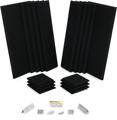
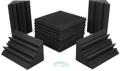
Our last suggestion is that you install acoustic treatment in your room. Not only will it improve the sound of your practice space, but it will also lessen the impact of sound waves as they impact the walls. Not sure where to start? The Auralex Roominator Starter Kit or the Primacoustic London 12 package make excellent jumping-off points.
Final Thoughts
Dampening the sound of your practice space can be a time-consuming endeavor, but it’s well worth the effort. Your family and/or neighbors will appreciate it. Another Sweetwater tip: practice strategically at sensible times of the day. Nobody will appreciate your rapid-fire blast beats at 3AM, no matter how tight and brutal they are. If you have any questions about drums, drum accessories, or acoustic treatment, then be sure to call your Sweetwater Sales Engineer at (800) 222-4700. They eat, live, and breathe this stuff and will be happy to help.