

Eleven. Exactly. One louder.
— Nigel Tufnel, Spinal Tap
For many guitarists, it’s a given that loud is good, and louder is better. In the quest for loud, a lot of guitarists move their pickups as close as possible to the strings. And this does, in fact, generate more output. But pickup height affects not just the guitar’s output level, but it also affects sustain and how the guitar’s output level relates to a pluck or strum’s initial transient.
To find out how pickup height affects a guitar’s output, I tested the rhythm and treble humbucker pickups in a Gibson Les Paul Standard guitar, with two different pickup-to-string distances, using 0.010-gauge strings. With the close position, the strings were 2mm away from the top of the pickup pole pieces. For the far position, they were 4mm away. I then recorded similar strums into a Steinberg WaveLab digital audio editor. Although it’s impossible to strum exactly the same way every time, there was a definite pattern.
Figure 1 summarizes the neck pickup results (the bridge pickup results were similar). The image on the left shows the raw signal output from three strums with the rhythm pickup close to the strings, then three strums with the pickup in the far position. The signal level in the far position is about 8dB less. The image on the right amplifies the peaks of the far strums to the same peak level as the close strums. The far strums are fatter because there’s a higher average level; with the close waveforms, the average level drops off rapidly after the transient.
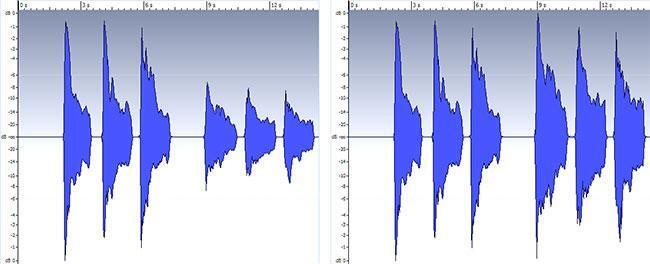
Figure 1: Although there’s less output when strings are farther away from the pickup, the average level is higher once you amplify the peaks to the same level as those recorded when the strings are closer to the pickup.
Now let’s look at sustain. Figure 2 shows two chords ringing out (close on the left, far on the right) with the waveforms normalized to the same peak value and amplified by the same amount to better show the last part of the decay. There’s clearly more sustain with the pickup farther away from the strings. This is because the magnets in the pole pieces are creating drag on the strings.
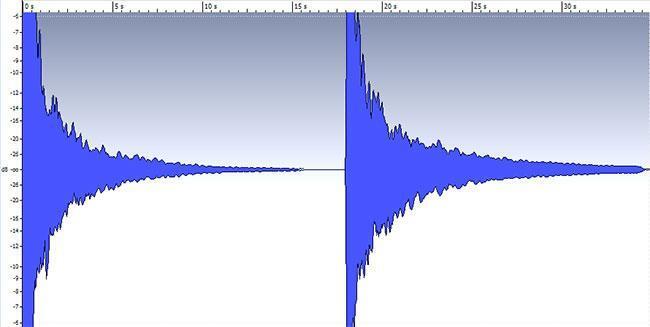
Figure 2: The tail of the second (far) waveform stays louder for longer.
However, you don’t get something for nothing. Because the overall level is lower when the strings are farther away from the pickups, you’ll need to turn up your amp’s drive control, an audio interface’s input control, or an amp sim’s input control to compensate and to benefit from the increased sustain. Remember that pickup height adjustments are angled, so you’ll want to make sure that the levels coming out of the high and low strings are as evenly matched as possible.
Other Implications of Pickup Height
Guitars are percussive instruments, so the initial transient can reach significant levels — note that this is mostly a non-tonal transient, because it consists of string and pick noise. These transients tend to be less of a problem with tube inputs, because the tubes absorb the higher levels. However, it’s another matter with digital processors. With compressors, high-level transients tend to “grab” the gain control mechanism to turn the signal down. This can create a pop when the compression kicks in. Furthermore, amp sims generally don’t like transients because they don’t distort very elegantly. High-level transients also require turning down direct inputs in audio interfaces to avoid clipping, which lowers the signal-to-noise ratio and resolution.
Lowering the level of transients can help minimize these problems. With the pickups farther away from the strings, the initial transient’s level is lower than average. Again, you’ll need to increase the input level to compensate for the lower pickup output, but these days there’s plenty of gain at our disposal — this would hardly be considered a problem.
So if you want to go up to eleven and output is what matters, be my guest! But there’s much to be said for dialing back a bit when tone, sustain, and signal processor performance are more important than raw level.