

Ever since “Love Me Do” first hit the airwaves, drummers have tried to copy Ringo Starr’s iconic sound. Unfortunately, there is no textbook because Ringo’s drumming was anything but textbook. He would adapt and morph the rhythm, following wherever the music led him, so nailing down Ringo’s drumming can be a bit like nailing Jello to the wall. But let’s give it a shot – a Jello shot, as it were.
We’re going to divide Ringo’s drumming into three components: Style, Gear, and Sound. Will we all be able to play like Ringo when this is over? Who knows? If nothing else, we’ll all walk away with a better understanding of the drummer John Lennon called “the heart of The Beatles.” Let’s get busy.
Ringo’s Style
“He’s not a technical drummer. Men like Buddy Rich and Gene Krupa would run rings around him, but he is a good solid rock drummer with a steady beat, and he knows how to get the right sound out of his drums.”
That’s how Sir George Martin, the man who produced The Beatles into existence, summed up the magic of Ringo’s drumming genius. No, it wasn’t technically perfect, but it had an intuitive soul that all truly great musicians have. So how did he do it?
Ringo would say that a lot of it has to do with simply being left handed in a right handed world:
Ringo was also known for “painting” his hi-hat with an unorthodox swing. He swung his stick at a more horizontal angle, glancing back and forth off of the hi-hat. He would also aim to hit the middle of the stick, not the tip. The beauty of this technique is that he could add more sound without expending more energy, simply by adjusting the angle of his swing and how close to the tip he would hit. This technique is easy to spot in early hits like “I Saw Her Standing There.”
https://www.youtube.com/watch?v=kXieo_hfqbU
Then there are the signature Ringo fills. He had a go-to formula that he would turn to again and again, molding it to fit the song he was playing:
(2x) sixteenth notes on the one beat > a sixteenth rest > four or five sixteenth notes
From “Hey Jude,” right on through to the White Album and Abbey Road, Ringo found innovative ways to add this fill at the most opportune times. Take a listen to the fills in “Helter Skelter” and you’ll see what we mean.
https://www.youtube.com/watch?v=ntUIjp6yxj8
While he may have had his go-to tricks, Ringo was never afraid to think outside the box. In fact, sometimes he would flatten the box completely so that he could fold it into something entirely different. He was a bold experimenter, constantly looking for new ways to squeeze new sounds from his stripped down drum set.
For example, listen to “Ticket to Ride.” Up to that point, conventional rock ‘n’ roll wisdom dictated that the snare drum play primarily on the second and fourth beat. But Ringo wasn’t in the mood for convention. Instead, he hit his snare on the second beat, and then waited for the third offbeat to hit it again. He temporarily skipped the fourth beat, adding a flam on the toms to the fourth offbeat. Ringo then went back and overdubbed a tambourine for the fourth beat. The result was a rhythm that cheerfully lopes through the song.
For the bridge of the song, Ringo switched things up, playing the conventional rock beat on the kick and snare, while adding eighth notes on the hi-hat and sixteenth notes on the tambourine.
We all know how the final product turned out, but it’s worth hearing again.
As time went on, Ringo became bolder, pushing the boundaries of his drumming even further. He fragmented the rhythm into a series of eighth and sixteenth notes, and mixed the drum combinations to create rhythm treatments no one had imagined before. Listen to this isolated drum track from “Come Together.”
https://www.youtube.com/watch?v=XQdI1oo9Swc
Ringo’s Gear
While Ringo was showy enough to be one of the first drummers to perform on risers instead of hiding behind the frontmen, his drum sets remained remarkably humble. Putting together a setup to re-create his won’t break the bank.
 [credit] Scott Robert Ritchie | Gary Astridge: RingosBeatleKits.com
When Ringo first starting with The Beatles in 1962, he sat behind a Premier Mahogany Duroplastic drum set. The set was downright spartan by today’s standards, and was made up of an 8″x12″ tom, a 16″x16″ floor tom, a 14″x20″ bass, and a 4″x14″ snare.
Once The Beatles’ popularity began to grow, Ringo decided it was time to move to a new set. On a sunny May 12, 1963, Ringo and the band strolled into Drum City in London. We’ll let him take it from here.
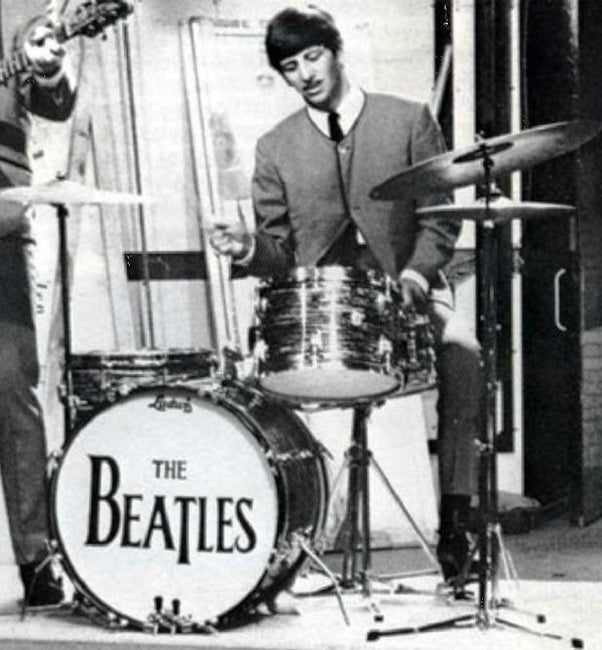
This Ludwig Oyster Black Pearl set included an 8″ x 12″ tom, a 14″ x 14″ floor tom, a 14″ x 20″ bass, a 5.5″ x 14″ snare and chrome over brass rims.
[credit] Scott Robert Ritchie | Gary Astridge: RingosBeatleKits.com
Ringo would use this new drum set for the first time when The Beatles appeared as the headliners on Thank You Lucky Stars. He used his faithful Premier set throughout rehearsal, saving the new Ludwig’s for the show performance. Here’s a fun fact: in 2015, this drum set sold for a whopping $2.1 million – so much for not breaking the bank.
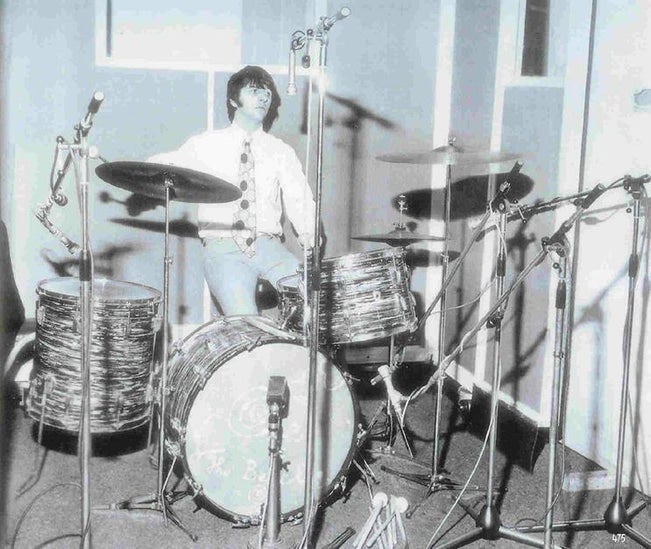
Ringo would remain committed to the Ludwig brand, buying another Oyster Black Pearl set before The Beatles’ legendary appearance on the Ed Sullivan Show. This set was again made up of an 8″ x 12″ tom, a 14″ x 14″ floor tom, a 14″ x 20″ bass, a 5.5″ x 14″ snare and chrome over brass rims.
[credit] Scott Robert Ritchie | Gary Astridge: RingosBeatleKits.com
In 1964, Ringo bought a Ludwig Oyster Black “Super Classic” set. This was the set he would use for the bulk of his Beatles career. It included a 9″ x 13″ tom, a 16″ x 16″ floor tom, a 14″ x 22″ bass and a 5.5″ x 14″ snare. He bought an identical set for The Beatles’ 1965 U.S. tour, but may have left it in the U.S. – when the band returned to the U.K., Ringo returned to playing his other Ludwig Super Classic.
[credit] Scott Robert Ritchie | Gary Astridge: RingosBeatleKits.com
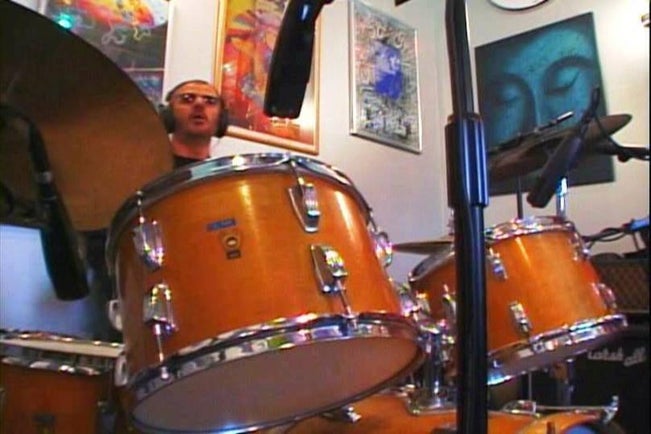
For Let it Be and Abbey Road, Ringo used another Ludwig set, this time a Maple “Hollywood” finish. This set had a 9″ x 13″ tom, an 8″ x 12″ tom, a 16″ x 16″ floor tom, a 14″ x22″ bass, and a 5.5″ x 14″ snare.
It’s a little weird that we have never mentioned cymbals to this point. That’s because for the most part, Ringo used the same cymbals throughout his career. When it came to choosing cymbals, Ringo seemed to want them as thin as possible for increased resonance. This may account for the challenge of recreating his iconic sound today, as most contemporary cymbals are more robust than back in Ringo’s day.
Ringo’s Sound
Ringo’s drum sound was a collaboration between Ringo and master producer George Martin. It began with Ringo’s unorthodox approach to drum tuning. Up to that time, many of the early rock ‘n’ roll drummers were still aiming for the same tones produced by jazz, swing and bebop players.
Ringo wanted deeper, more resonant tones. He started by tightening his top heads and loosening the bottom heads. He also tinkered with the bass, removing the front head and adding blankets or pillows to muffle the sound. Ringo would also play with thin tea towels draped over the toms and a pack of cigarettes or roll of masking tape resting on the snare. As a final touch, Ringo removed the resonant heads from his toms, creating a louder, flatter effect. You can see all of this in action during The Beatles’ famous rooftop concert.
For his part, many of George Martin’s recording techniques are considered standard today. For example, George would mic Ringo’s bass drum very closely, with the mics practically touching the head. Typically, the bass mic would be an AKG D-12. This mic could handle high sound pressure levels and thanks to a special “bass chamber,” it would bring out lower frequencies in the 60 – 120 Hz range.
George would also have Paul and John sing into omnidirectional Neumann U-47 mics. These mics picked up the ambiance from Ringo’s drums, adding another layer of sound to the rhythm. Ringo is proof positive the the right gear, in the right hands, inspired by the right mind can make music that lasts for generations – and isn’t that what music’s all about?
Sweetwater’s Summer Drum Sale – Happening NOW!
Rock ‘n’ roll to reggae, western to world music – no matter how you keep the beat, we’ve got thousands of percussion’s best brands in stock and on sale. Best of all, you can get up to 48-month financing on your purchase, so you can play now and pay later. Shop the deals!
