

As a guitarist, it’s possible to find yourself in the middle of a song where your guitar isn’t quite giving you what you need. It can be the sound or feel of a particular instrument that doesn’t exactly fit what you’re playing. That’s tough if it compromises your performance. Do you try to find one guitar that covers every sound that you need live or do you carry multiple guitars? There are plenty of reasons for either option.
Since all guitars sound and feel different, each may invoke a different musical inspiration – and you want to be inspired so you can give your best performance Try playing high-gain, muted, low, heavy rhythms on a Strat with vintage pickups and a trem or ripping chicken-pickin’ licks on a Les Paul. The notes on the neck are the same but the tone, feel, and vibe are tougher to conjure up; the right gear for the job is always helpful.
However, a single guitar is easier to travel with, takes up less space onstage, there’s no time between songs needed for guitar changes, fewer tuning issues, less and easier maintenance, and the list goes on. It’s also easier to dial in the rest of your rig for one guitar and have a great, consistent sound. That’s better for the sound guys and the rest of the band because no one is struggling to turn you up or down in their mix as your sound changes. The downside is that you’re confined to the sound and feel of one guitar.
I’ve personally been on both sides of this issue. Touring with a truck for your gear and having a guitar tech facilitates multiple guitars onstage. It’s great to have an open-G-tuned, guitar with lipstick pickups for a song that needs swampy slide. It’s equally great to trade it for a standard-tuned Les Paul when the next song is a power-ballad. Of course, that same scenario without a guitar tech would cause me to choose a guitar with coil-tapping humbuckers and force me to brush-up on my standard-tuned slide licks.
Your decision depends on finding the balance between what you need to adequately cover the gig and what you can deal with on a practical level. For example, if your band is on a van tour playing coffee houses, every square inch is precious. You may not be able to bring an extra pair of shoes, much less an extra guitar. On the other hand, if the guitar is prominently featured throughout the show and your band covers a wide stylistic range, one guitar may not be able cover it.
Knowing the band/artist and the style/pace of the show is the starting point for deciding how many guitars are needed. I have a friend who plays guitar with a singer-songwriter/guitarist. The songs are built around two acoustics, in various tunings. Between the two of them, the job requires about a dozen guitars onstage. Changing and tuning guitars can slow down the pace of the show, but in this case, that’s what’s needed.
Using a single guitar to cover a wide variety of sounds certainly has its challenges. I recently flew to New York City, and played on a stage barely big enough for a drum set, covering the theatrical, prog-rock-epic, The Shaming of the True, by Kevin Gilbert. Shaming has intimate acoustic moments, greasy R&B, heavy rock rhythms, and a variety of clean and distorted solo sounds. My single guitar of choice was a PRS Hollowbody II with coil-tapping humbuckers and an LR Baggs piezo pickup system with a separate output. I routed the main out to an amp and pedals and the Baggs pickup to a DI for the acoustic sounds. Even though all of the sounds weren’t perfect, I was able to switch instantly between them and more importantly, properly do the job.
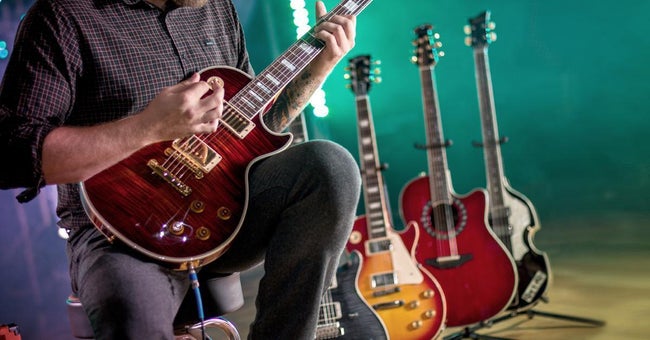
Most of the time, you’ll find yourself somewhere in the middle of these two extreme examples. It’s possible to cover a lot of sonic territory with two or three well-chosen guitars. Look for guitars that have obvious differences: humbuckers versus single-coils, hardtail versus trem, solidbody versus hollow, bright-sounding versus dark, etc. The combo of a Strat and a Les Paul is tried and true. A 335 and a Tele is another classic. An SG and a Country Gentleman, perhaps?
Assess the situation from every angle, decide what’s most important to getting the job done, and do what’s most comfortable for you. After all, you’re the one that has to make it work onstage. If you give your best, it will resonate through the band and ultimately to the audience. That’s what makes a great show.