The TC Electronic Plethora platform is the perfect first multi-effects gateway for people who think they prefer analog or are intimidated by traditional multi-effects units. I am both of these — or, at least, I was up until Plethora.
Right out the gate, it’s important to know that I’ve had a low-boil bias against digital effects for years, and I’m not alone. Many millennials (me included) had our formative years laced with a feverish and nostalgic appetite for all things analog and the sentiment it carries. We’re talking Jack White, vinyl’s resurgence with Record Store Day, and the explosion of folk-pop groups like Mumford & Sons that tore up the charts with neither amplified guitars nor beats but with folk instruments (and some stellar recording gear, of course).
Today, impacts from those mid-aughts analog urges stretch beyond the music industry into city blocks and shops overflowing with organic foods, artisan coffee, farmers markets, crafts side hustles, and the like. Growing up amidst such change ingrained the bias against digital into my brain and shaped gear preferences for years to come.
My signal chain has nearly doubled in length since joining Sweetwater’s team — no doubt a perk of the job. But with a great rig comes a great temptation to tweak tone. Daily signal-chain rearrangements eventually began cutting into my practice time. Soon enough, I was hungry for a faster way to re-order the effects and began eying multi-effects with a more open mind.
Perverse fortune struck when a recent winter flood soaked several items in my collection and sent them swimming to Davy Jones’s pedalboard for a permanent nautical nap. Rather than replace the items one-to-one, I took the digital plunge and opted for a TC Electronic Plethora X3. Months later, I am happy to report total satisfaction with this purchase. I’m now equipped with a robust blank canvas for experimentation, efficient preset tools, speedy signal-chain swaps, and a spread of high-quality effects modeled on hardware units — all for the price of a few analog pedals.
Why Pick Plethora?
There are plenty of multi-effects options; however, vastly different prices, features, and workflows muddy the waters for intimidated, uninitiated players. Plethora, available as a 3- or 5-slot effects unit (the TC Electronic Plethora X3 TonePrint Multi-FX pedalboard and the TC Electronic Plethora X5 TonePrint Multi-FX pedalboard, respectively), strikes the perfect middle ground for features and price. Both Plethora models offer 15 effects plus a digital tuner, and future updates could add more.
Plethora’s interface is beyond user-friendly, making exploring the vast effects library seamless and smooth, even for digital dummies like me. Rotary push knobs fuel fast menu navigation for selecting effects without cumbersome multi-button gymnastics. The screen size is generous and spans nearly the entire pedal’s length for assured visibility and quick at-a-glance monitoring of active effects. Moreover, core modes stay neatly organized; a sturdy play/edit toggle switch provides ironclad separation between live settings and detailed editor menus, which keeps unintended tweaks at bay and encourages intentional workflow.
What Plethora Is
Plethora’s library of 15 effects may seem modest at first glance, but the actual effects count is somewhere in the hundreds. Even before user programming, there are . . . a plethora of options. Every included “effect” functions as a master grouping full of variations to explore.
On the surface, every effect models the names and features of popular TC Electronics TonePrint pedals (with the exception of Plethora’s Tape Deck Looper, which has no hardware corollary). There’s a complete list in the box below. Still, in short, Plethora makes the broader TC Electronics’ pedalverse its muse with hardware roots that help organize possibilities with familiar names and battle-tested TonePrint voicings at the fore.
Modulation:
- Corona Chorus
- Pipeline Tap Tremolo
- Vortex Flanger
- Shaker Vibrato
- Viscous Vibe
Delay/Reverb:
- Hall of Fame 2 Reverb
- Flashback 2 Delay
- Alter Ego Vintage Echo
Pitch/Octave:
- Sub ‘N’ Up Octaver
- Brainwaves Pitch Shifter
- Mimiq Doubler
- Quintessence Harmony
Utility:
- Hypergravity Compressor
- Tape Deck Looper
- Sentry Noise Gate
- UniTone Chromatic Tuner
Beyond Plethora’s familiar spine are dozens of pre-programmed voice options (the proprietary term “TonePrint” will appear interchangeably with “voice” here). Many voices emulate rare, famous, and/or vintage effects. Much of the hardware referenced here would otherwise cost a small fortune (if they were available at all). Historic inclusions are vast, particularly regarding delays, phasers, and compressors. When time or money is scarce, this library offers a powerful catalog of historical units that players may never experience otherwise.
Other voices, included or available as free downloads, were created by guitar celebrities ranging from influencers like Pete Thorn and Andy Martin to big-name artists like Omar Rodríguez-López (The Mars Volta, At the Drive-In), Reeves Gabrels (The Cure, David Bowie), and many more. Celeb TonePrints typically describe sounds using evocative titles, while historical emulation TonePrint titles allude to the hardware that’s being modeled.
In edit mode, three center rotary knobs let users adjust parameters, and the resulting feel is virtually identical to adjusting a traditional pedal. Tweaks in play mode are an option, too. A “Hot Knobz” feature lets users assign parameters to center knobs for live adjustments if desired. Many delay and modulation effects offer tap tempo as well.
What Plethora Isn’t (& How to Cope)
Dirt is not included, folks. Drive, distortion, fuzz, and all other dirt effects are entirely up to you. This brings us to a key difference between the X3 and X5 versions: the X5’s send/return effects loop lets users insert pedals anywhere in Plethora’s signal chain. This feature, made for versatile deployment of dirt, is notably absent from the X3. Plethora systems share the same effects library regardless of which version you choose, and both versions store up to 127 boards. Connectivity options, however, vary slightly. Use the chart below for a quick but comprehensive comparison. When in doubt, the X5’s expression pedal support, effects loop, and extra slots are more than worth the price difference.
| Includes: | Plethora X5: | Plethora X3: |
| Cab Sim | Yes | Yes |
| Stereo In/Out | Yes | Yes |
| Effects Loop | Yes | No |
| MIDI In/Thru | Yes | Yes |
| Expression Pedal Support | Yes | No |
| True Bypass/Buffered Switching | Yes | Yes |
| Supports TonePrint Editor | Yes | Yes |
| Dimensions (Rounded to the Nearest Inch) | 2 Inches x 11 Inches x 5 Inches | 2 Inches x 7 Inches x 5 Inches |
As an X3 user, I cope by placing Plethora last in my chain. That’s where I would typically place my most frequented effects, such as delay, reverb, and phaser, regardless, so it doesn’t feel like a compromise. In between dirt pedals and Plethora, I reserve space for unique sounds that Plethora may struggle to replicate (right now, that’s EarthQuaker Devices’ Afterneath and Nightwire). With buffered bypass selected, this end-chain placement restores signal integrity across a long cable run just before the signal hits the amp. If I used needier effects like octave or harmony at gigs or for studio work, then the X5 would make more sense, as pitch-shifting effects yield wildly different results depending on their placement.
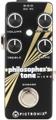
Plethora’s Hypergravity Compressor offers one handy solution for adding volume and/or limited gain. The compressor can cut, balance, or boost output as needed and is a great way to add makeup gain after long cable runs. I use the included optical compressor TonePrint (along with the Pigtronix Philosopher’s Tone compressor/sustain pedal at the start of my chain) for end-of-chain level adjustments and smooth, studio-quality compression. Some users have even programmed the Hypergravity to go beyond compressor functions. This popular TonePrint edit transforms your compressor into a powerful boost with colorful EQ!
To Delay or Not to Delay?
Taking the Plethora plunge has made my rig more versatile and ready to tackle long-term goals. Either model is a great supplement or replacement for analog pedals while you grow your sound and save time, cash, and hassle.
I’ve seen my sonic capabilities grow in unexpected ways. In particular, Plethora’s delays (and the ability to stack them) have helped me explore ambient soundscape textures more efficiently with save capabilities for complex settings. Beyond delay, I have fewer reasons — legitimate or otherwise — to blow off practice or songwriting due to gear woes. I also have better tools for fun projects, like TonePrint boards dedicated to specific artists. For instance, my Lana Del Rey board stores reverb and tremolo sounds I might never utilize elsewhere and lets me play along without modifying manicured settings elsewhere on my board. Think of it as a place to store little shrines of tone however and whenever you’d like.
Hungry for More?
Our knowledgeable Sweetwater Sales Engineers are here to guide pedal purchasing decisions with sage advice and helping hands; give them a shout at (800) 222-4700 and get started today!