

While dropping the tuning of an electric guitar down into the nether regions has never been more popular — especially since the advent of 7-string, baritone, multi-scale, and even 8-string axes — it’s hardly a new idea in the world of metal. In fact, Tony Iommi, the genre’s undisputed “Riff Lord,” started tuning down to C# nearly 50 years ago on most of Black Sabbath’s 1971 classic album, Master of Reality.
One question still frequently pondered, though, is this: “What are the best string gauges to use when tuning to, say, D, C#, B, or even lower?” And the answer isn’t a simple one, I’m afraid. Why? Because there are a number of factors that have to be taken into account — the most important one being this: at the end of the day, it’s 110% personal!!
Factors to Consider
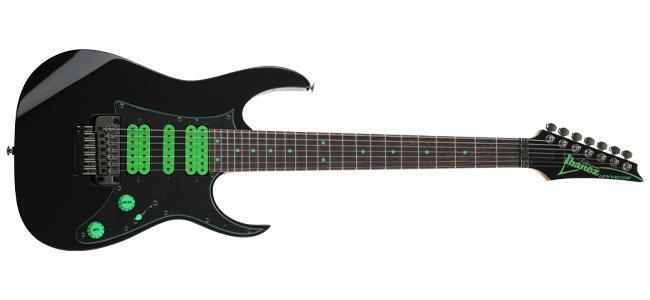
- How low you’re actually going. Believe me, the whole-step drop from C# to B is a pretty darned big one.
- The scale length of the guitar you want to “go low” with. This is the distance between the bridge and the nut and is sometimes referred to as the “vibrating length of the strings.” Here are a few common guitar scale lengths:

- Gibson scale (e.g., Les Paul) = 24.75″
- PRS scale = 25″
- Fender scale (e.g., Strat) = 25.5″
- Baritone scale = 27″ to 30.5″
- Multi-scale (where each string has its own scale length) = for example, 25″ (high string) to 28″ (low string)
- 7-string guitars = 25.5″ to 27″ or more
- 8-string guitars = 27″ to 29.5″
- This trio is often overlooked/forgotten, and they’re all doozies:
- The size of the “string receiving holes” in your guitar’s machine heads! While buying an .080-gauge string seems, on paper, like the perfect way to drop that low E string on your Les Paul down to A, the chances of pushing that nickel-wound monster through your machine-head hole is probably less than zero!
- The same exact logic applies to the precut string slots in your guitar’s nut.
- Ditto, the bridge saddle — will the slot in it satisfactorily house a monster string?
Note: You might understandably be thinking, “hold-on, an .080 string is a bass string; that’s a bit extreme, isn’t it?!” My response is simply: well, that’s what Lee Malia of Bring Me the Horizon uses. Yes sir, Lee tunes a Les Paul down to C standard or Drop A, and his lowest string is an Ernie Ball .080. “I play a lot of single-string riffs, so the heavier strings keep it sounding solid,” the Brit told Guitar World.

- As already mentioned, the “personal” ones — namely, the sound and feel you’re looking for. Both are impacted hugely by your playing style, touch, and taste, as well as your gear. For example — Tony Iommi used the following gauges (from high to low) on his SG guitars tuned down to C#: .009, .010, .012, .020, .032 & .042. To most players, those are inconceivably light for such a low tuning on an SG scale length, yet Mr. Iommi sounds both magnificent and massive. Go figure.
Important Note: When tuning to Eb, Tony’s gauges are as follows — .008, .008, .011, .018, .024 & .032. Why does he go so light? Because he lost the tips of the middle and ring fingers of his fretting hand when he was a young man. As a result, this legendary lefty pioneered both the use of light strings and detuning in metal — where there’s a will, there’s a way. Especially when said will is one of iron.
Another metal legend who often tuned low to great effect was the late, great Dimebag Darrell of Pantera fame. When he tuned down to C#, his gauges were 9, 11, 16, 28, 38, 50 — not nearly as heavy as you may think, especially when you consider the fact that he tuned all his guitars “approximately a quarter-step down” anyway — so his C# tuning was actually approaching C!
But then of course, you’ve got the other end of the scale — like Lee Malia who uses an .080 low string! To each his or her own, it’s all a matter of personal preference.
What Effect Does Scale Length Have?

- String tension. In a nutshell, the rule of thumb is this: the longer the scale length is, the tighter a particular gauge of string has to be stretched in order to be tuned to a specific note. For example, let’s say you were using a regular 10-gauge set (high to low: .010, .013, .017, .026, .036, .046) for standard (E, A, D, G, B, E) tuning. The strings would feel loosest on a Gibson scale — the shortest scale in the above list — a little tighter on a slightly longer-scale PRS; noticeably tighter on a Fender; and pretty-scary, “on the brink of snapping!” tight on a baritone-scale axe!So not surprisingly, scale length is a pretty pivotal factor when choosing string gauge. That’s why a lot of players will use a 10-gauge set of strings on their Les Paul and a slightly lighter 9-gauge set on their Strat tuned exactly the same — so the strings on both guitars will feel pretty similar in terms of tension/tautness. Make sense?Therefore, unless you want to resort to literally using bass guitar strings on a short-scale guitar to tune low, logic would dictate that in terms of string tautness and vibration physics, longer scale lengths are more “low tuning friendly.”
- Fret spacing. The longer the scale length, the more spaced out the frets are. Thus, if you’re used to shredding on a Les Paul–scale axe, moving to a baritone guitar with a much longer scale length may well mess with both your muscle memory and chops for a time.
A Tense, Personal Decision
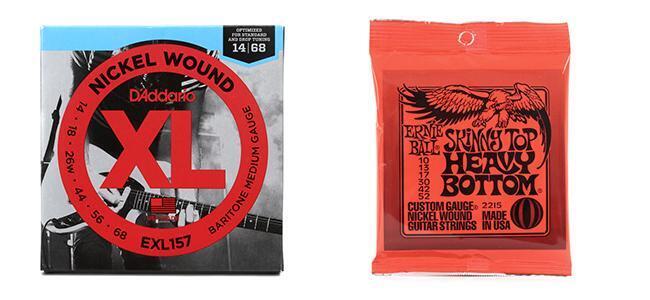
As already asserted, to a large degree this will ultimately be a choice of a personal nature as each player is very, very different. One of the biggest factors will be your taste in string tension — namely how loose (slinky) or tight you like them — and that’s something only you can decide.
Without getting overly scientific, there are six principal factors that determine the string tension on your axe:
- String gauges: the thicker (heavier) the gauge, the more tension it’ll take to tune to the required note — duh!
- Tuning: if you leave the string gauges “as is,” the lower you tune a string, the looser/flappier it’ll get.
- Scale length: the longer the scale length of your guitar, the more tension it takes to tune to the required note. Consequently, a 10-gauge set tuned to concert on a Strat will feel tighter than the same exact strings and tuning on a Les Paul.
- String material: as you may expect, different raw materials can have an effect on tension.
- String construction of the wound strings:
- If the ratio between the core and the wrap wire is different, two strings with the same diameter, tuned to the same pitch, on the same guitar could have a different tension. To be specific — the one with the thickest core will be tighter.
- In general, a wound string with a hex core (hexagonal) will feel slightly stiffer (tighter) than the same string with a round core. And last, but certainly not least:
- Ensure your guitar is properly set up!!! Avoid an overly high action and/or a badly adjusted truss rod, which determines neck relief — or lack thereof!
There are, of course, a few other factors that can play a part in how taut a string feels (e.g., the string break-angle at the nut and bridge), but the above six are the “biggies.”
Bigger Is Better — or Is It?!?!
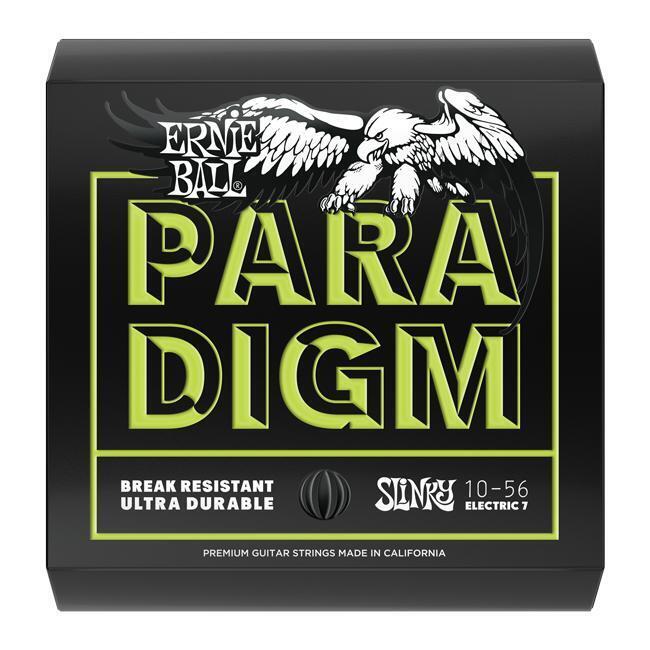
In the same exact way that “logic” dictates that longer scale lengths are better suited for low tunings, one would automatically assume that the same is true of heavier-gauge strings — especially on a “regular-scale-length” (24.75″–25.5″) axe. After all, beefing up string gauges as your tuning drops lower will help maintain tautness, thus countering the “rubber banding” effect of detuning the same-gauge string on the same guitar — especially on the wound strings.
To this end, our good pals at D’Addario created a cool String Tension PDF you can download with some easy-to-follow instructions (they must be — I was able to follow them!). Taking a gander at this free offering will help take some of the guesswork out of your search for the string gauges that will suit you best when you enter the world of detuning your axe.
That said, due to the extremely personal nature of this, logic might not always apply! For example, in my past, there was a time when the “physics genius” that lurks within me was convinced that heavier strings and a high action would “sound heavier” — after all, it was logical, right?! Especially when I read that one of my biggest heroes, the late, great, Gary Moore, was using 10–52 at the time with an action so high you could drive a truck under it! But when I learned that the likes of Billy Gibbons, Brian May, Tony Iommi, Glenn Tipton (Judas Priest), and K.K. Downing (Judas Priest) used really, really light gauges and anything but high actions, my perception changed. Especially when I learned that Eddie Van Halen was using 9–42 tuned down a half-step.
So when it comes to detuning, I leave it up to my fingers and ears to decide what string gauges feel and sound the best. For example, for a recent recording session, I tuned a Gibson-scale (24.75″) axe down to B, but even with a .062 low string, it felt a tad loose and also a little difficult to keep in tune, especially as I pick pretty aggressively. But then I used the same low .062 on a 25.5″-scale Charvel dropped down to B, and it was perfect — it felt and sounded just right. But that’s ultimately just my taste and my style — or lack thereof!
Conclusion
While logic might dictate that when it comes to detuning, longer scale lengths and the thickest strings known to man are “the way to go,” the habits of groundbreaking players such as Tony Iommi strongly imply this might not always be the case. We at Sweetwater pride ourselves in offering the best instruments and accessories for all genres, tastes, and styles. So we not only stock a wide selection of baritone, multi-scale, 7-string, and 8-string axes, but we also have an impressive choice of string sets specifically made for said designs. As an old adage wisely states: “one man’s meat is another man’s poison.” So what sounds and feels right to you is always the right way to go — regardless of what certain “experts” may say. Always let your style and taste ultimately dictate your detuned path.
A Word to the Wise
When dropping the tuning on any guitar “lower than whale droppings,” please don’t forget the following.
- Once your new tuning has “sat” for a while, make sure that your axe’s truss rod doesn’t need adjusting. And if you’re not experienced in this, please have a qualified tech do it. Ditto the next two:
- Check your intonation.
- Check your action — the more “rubbery” your strings get, the more “flappy” they become, so raising your action a bit may be a necessary evil!