

Guitars are made up of tonewoods, strings, hardware (metal and plastic), and electronics — all working together to create a music machine. Every guitar is a little different, but there are three fundamental parts — the headstock, the neck, and the body. In this article, we’ll examine and explain all three parts and their components.
Note: This article is included in our Electric Guitar Buying Guide, a comprehensive, step-by-step guide to purchasing your first electric guitar.
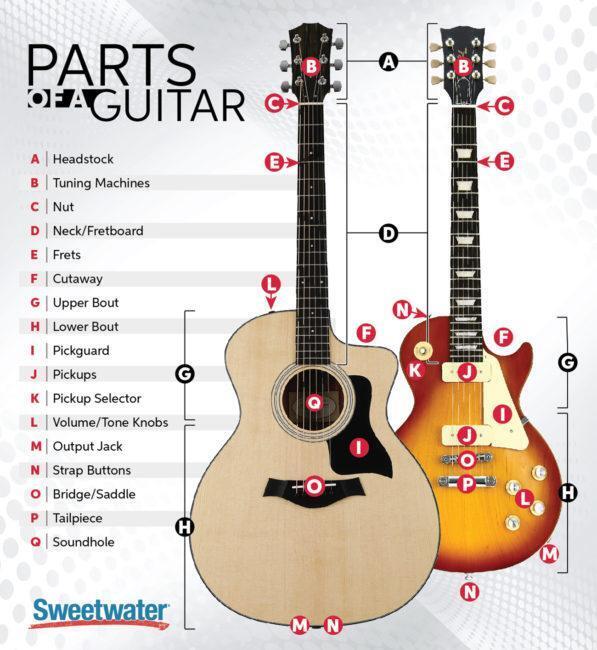
Parts of Electric and Acoustic Guitars
Guitar Headstock
Headstock (A)
The headstock sits at the top of the neck (opposite the body) where the tuning machines and nut are installed.
Tuning Machines/Tuning Posts (B)
On a standard guitar, there are tuning machines which include the tuning posts to hold each string in place and tuning pegs that turn to adjust the tuning.
Nut (C)
The nut is a notched piece of plastic or bone installed where the headstock meets the fretboard of the guitar. The nut has notches where the strings are seated. These notches keep the strings aligned on the fretboard and play a role in the string height. It makes a critical contribution to the tone since it is the end point (on the neck side) of the strings.
Guitar Neck
The neck of a guitar is the long, thin piece of wood between the headstock and the body where you’ll find the fretboard, frets, and truss rod. Necks are typically attached to the body with bolts, glue, or sometimes both.
Fretboard (D)
The fretboard is attached to the top of the neck and is usually made from tonewoods like rosewood, maple, or ebony to prevent dents or warping. The fretboard is a separate piece of wood from the neck and may be the same or a different type of wood, such as a maple fretboard on a maple neck, or a rosewood fretboard on a mahogany neck.
Frets (E)
Frets are the metal strips running across the fretboard. When a string is pressed down behind a fret, it changes the length of that string and produces a different note. Most fretboards also have fret markers (either dots or blocks or birds) that designate the location of frets 3, 5, 7, and 12 (and sometimes more) for easy reference.
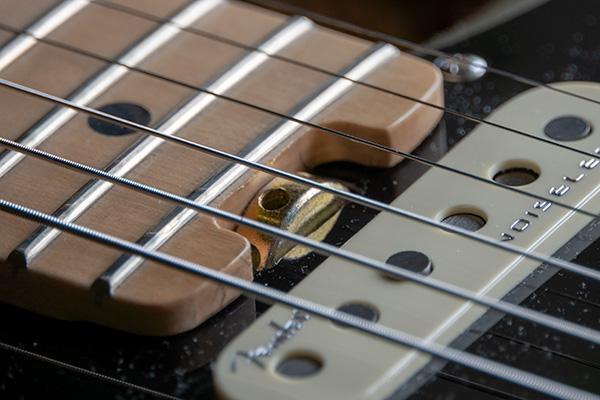 Truss Rod
A truss rod is a long, adjustable piece of metal that is mounted inside the neck and runs the length of the neck, helping to keep it from bending under the tension of the strings. A properly adjusted truss rod is essential to any good setup and helps to eliminate things like fret buzz, intonation issues, and other playability problems.
Guitar Body
The body of your guitar plays a large part in the tonal characteristics of your instrument. Let’s take a look at the parts of the guitar body and then highlight some of the similarities and differences between an acoustic and electric guitar body.
Cutaway (F)
The cutaway allows a player to more easily reach the highest fret positions on the neck.
Upper Bout (G)
The upper bout is the part of the guitar body that is nearest the neck.
Lower Bout (H)
The lower bout is the largest part of the guitar that is nearest to the string termination at the bridge.
Pickguard (I)
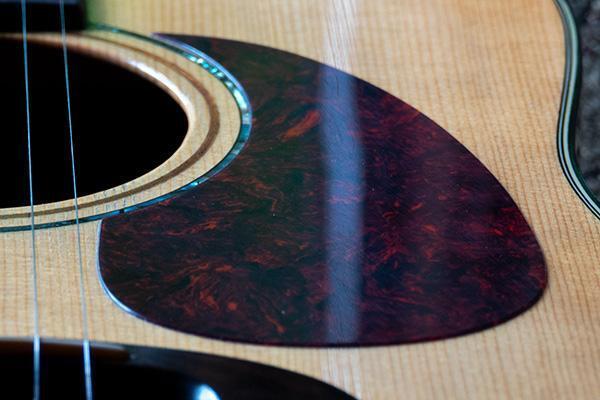
You can think of the pickguard as a shield for your guitar. It is intended to prevent scratches, dings, and wear from the hard pick of even the most aggressive strummer. Pickguards come in a variety of different colors and are an easy upgrade on most electric guitars. If you’re interested in an upgrade, Sweetwater’s Guitar Repair Shop is happy to help.
Pickups (J)
On acoustic guitars, the pickup can be in several places. On this guitar in the diagram, the pickup is located under the bridge. Typically, electric guitars come with one, two, or three pickups, and the placement of the pickup plays a large part in your guitar sound. Pickups placed closer to the bridge will sound bright and chimy; whereas, pickups placed closer to the neck will sound warmer and bassier.
Pickup Selector Switch (K)
If your guitar has multiple pickups, a pickup selector switch allows you to engage single or multiple pickup combinations and gives you the ability to access a wide range of tones.
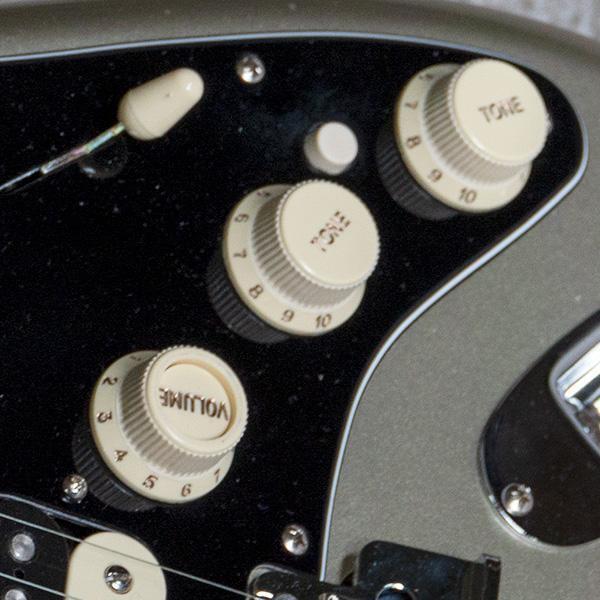 Volume and Tone Knobs/Potentiometers (L)
The potentiometers, often referred to as pots, control the volume and tone of your guitar. The tone knob(s) allow you to adjust the amount of high frequency, or brightness, of your guitar, while the volume knob(s) adjust the overall output of your guitar.
Output Jack (M)
To get signal out of a guitar, connect one end of a 1/4″ guitar cable (TS) to the output jack and the other end to your amplifier, DI box, pedal or pedalboard, mixer, or recording interface.
Strap Buttons (N)
Strap buttons allow you to attach a strap to your guitar and are typically located on the lower bout and upper bout of a guitar. It’s a great idea to upgrade to strap locks if you have a guitar that isn’t balanced or if you plan on doing any crazy stage antics during your solo.
Next, let’s focus on the differences between acoustic and electric guitars.
Electric Bridge (O)
The electric guitar bridge is the other termination point for the string. It is hugely important, because its placement defines the feel, tone, and intonation of the guitar. The string runs either through a tailpiece (P) to the saddle, or through the body. Along with the saddle, the bridge also helps to dial in action and intonation. Electric guitar bridges can have additional features, like a whammy bar that allows you to raise or lower the pitch.
Acoustic Bridge (O)

An acoustic guitar bridge holds the saddle and secures the strings in place using bridge pins. The saddle is usually made of bone, plastic, or some kind of graphite material. The string runs over the saddle and is held in place by a bridge pin. When a string is plucked or strummed, the vibration is transferred through the saddle, to the bridge, and to the top (soundboard) of the guitar.
Electric Tailpiece (P)
Some electric guitars, and even certain archtops and acoustics, feature a separate tailpiece to anchor strings to the body and direct them into the bridge and saddles.
Soundhole (Q)
The hole in the top of an acoustic guitar is called the soundhole. The hollow body of an acoustic guitar allows the bass frequencies produced from the strings to resonate and be amplified and then project through the soundhole, while the top acts to enhance the mid and high frequencies. Some soundholes may be off center or shaped differently (like an ƒ-hole).
Strings

A guitar string typically consists of a thin core with wire wrapped around it (in the case of bass strings) or just the core by itself (for higher strings). The thicker the string or core, the lower the pitch. You can find strings that are roundwound and flatwound and made from a variety of metals, including steel, nickel, and/or bronze — each with its own sound and characteristics.
Acoustic Guitar String Buying Guide
Electric Guitar String Buying Guide
Hopefully you found this guide to be informative and you feel more in tune with your guitar. If you’re interested in learning more, check out the links below.