Since its release at winter NAMM 2026, the Neural DSP Quad Cortex Mini has seen overwhelming popularity here at Sweetwater. An ultra-compact iteration of the revolutionary Neural DSP Quad Cortex floorboard amp modeler with scaled-down controls and streamlined I/O, the Quad Cortex Mini endeavors to provide an identical experience to the full-sized Quad Cortex with zero compromises. So, does it deliver on its promise? Well, after spending two weeks with the Mini, I’ve been able to thoroughly put it through its paces. Moreover, I was also able to get my hands on an original Quad Cortex for comparison. Now, with both units fresh in my mind, I’m ready to dig into whether the Mini truly earns its place beside its full-sized counterpart.
- The Sound
- Neural Capture
- The User Experience
- Verdict Time: Choosing Your Ultimate Cortex Companion
- Which Quad Cortex is Right for You?
The Sound
To audition the sound of the Quad Cortex Mini, I ran signal out of the unit’s stereo XLR Out jacks straight into an Apogee Duet audio interface. I listened through Focal Alpha 50 Evo studio monitors. My guitar of choice for this venture was a Jackson Dinky with Wilde by Bill Lawrence L500R and L500XL humbuckers in the neck and bridge, respectively.
The Mini comes loaded with over 90 amps, more than 100 effects, and more than 1,000 cabinet IRs, as does the full-sized Quad Cortex. I cycled through the unit’s factory presets, which ranged from clean, Fender-style models to crunchy, Marshall-style models to high-gain, EVH-style models. Every model sounded — and felt — remarkably amp-like. The models responded as expected when switching between pickups and when rolling back the guitar’s Volume knob. Additionally, I goosed the high-gain models with the Mini’s Green 808 and Rodent Drive emulations — two of my most oft-used dirt boxes in the real world — and they sounded and behaved exactly how I expected them to.
Finally, I auditioned several Modulation, Delay, and Reverb effects. As a self-confessed digital effects junkie, I was duly impressed. The Micro Processor effect compared quite favorably to one of my all-time favorite bits of ear candy, the MicroPitch algorithm on the Eventide H9. Likewise, the onboard Digital Delay, Dual Delay, Circle Delay, Studio Plate 70, and Blossom effects offer stunning textures inspired by Lexicon, TC Electronic, Strymon, and other iconic hardware units, to which I’m very well acquainted.
After spending ample time with the Mini, it was time to check out its larger sibling. I auditioned the full-sized Quad Cortex using the exact same method as the Mini, running signal out of the unit’s XLR Out jacks into my audio interface. I then proceeded to run through the same models as the Mini, and I auditioned the same effects. I’m pleased to say that, once I matched the Quad Cortex’s output level to the Mini’s, I couldn’t tell a difference between the two. Admittedly, I didn’t A/B the two units, nor did I submit to a blind listening test, but to my ears — and fingers — the two units offer an identical playing experience.
Neural Capture
Among the Quad Cortex ecosystem’s most acclaimed features is its ability to create Neural Captures of your amps, dirt boxes, and cabinets using sophisticated neural network algorithms. According to the folks at Neural DSP, it uses something called biomimetic AI technology to replicate the sonic character of your existing gear, after which it digitizes it and stores it in the unit’s state-of-the-art innards.
For this undertaking, I captured a first-generation Blackstar HT40 with the Quad Cortex Mini using a Shure SM57 microphone plugged into the Capture Input jack. The process was simpler than I expected, and the unit even provides you with an easy-to-follow routing diagram to help you along. I made two captures of the amplifier, one using Neural Capture v1 and one using Neural Capture v2. Neural Capture v1 was faster, but to be honest, it didn’t entirely blow me away. Not to say that it wasn’t impressive; it delivered results on par with most high-quality amp sims. That said, it didn’t give me the same satisfaction as playing through my actual amplifier. Neural Capture v2, on the other hand, was downright uncanny — I truly couldn’t tell the difference, via my ears or through tactile sensation, between the original amp and the Neural Capture.
Next, I repeated the procedure using the full-sized Quad Cortex. Again, the process netted identical results to the Mini. My take? I would be entirely comfortable using Neural Capture v2 to replace my physical amplifier using either the Quad Cortex Mini or the original Quad Cortex. As for Neural Capture v1, it would certainly do in a pinch, and it’s a sure bet that nobody listening would know the difference. But after experiencing the authenticity of Neural Capture v2, the first version would almost certainly always seem underwhelming.
The User Experience
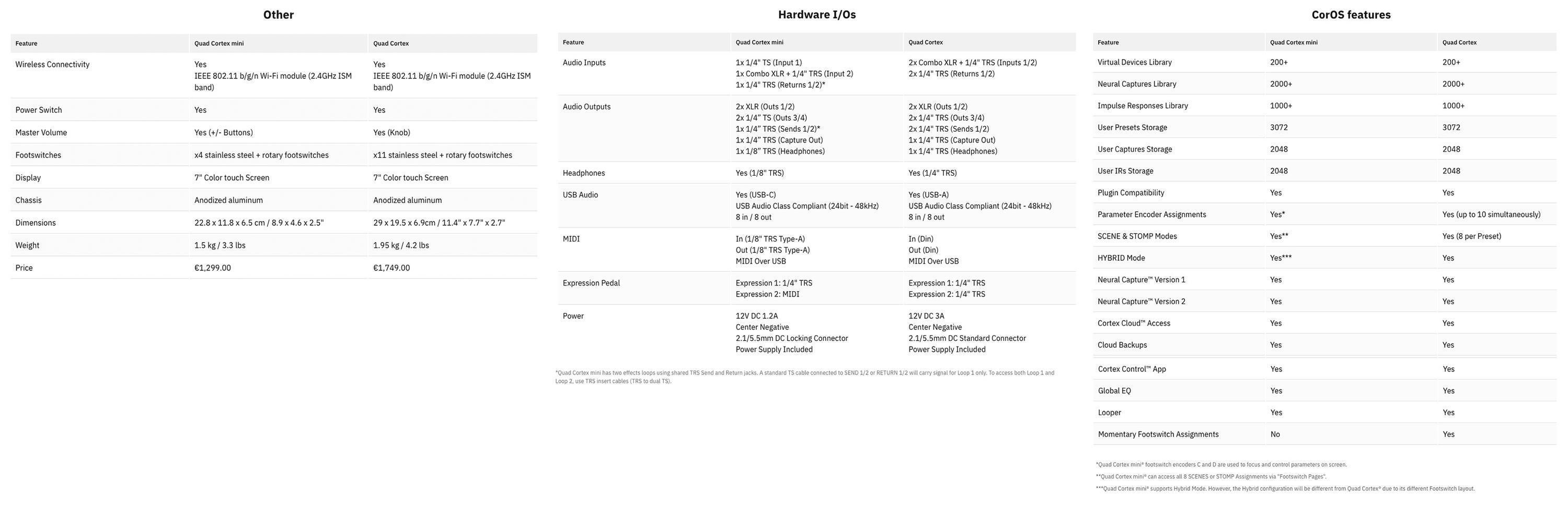
If you’re on the fence deciding between the full-sized Quad Cortex and the Quad Cortex Mini, the user experience is where the two units differ the most, although, not necessarily in a negative way. Both units feature a 7-inch multitouch display with an identical Grid-based graphic interface. But, while the original Quad Cortex features 11 stainless steel footswitches, the Mini scales back to just four. This makes toggling between patches, scenes, and parameters, at least hands-free, more difficult on the Mini. Beyond that, the Mini trades the full-sized Quad Cortex’s easy-to-grab Master Volume knob for separate (and physically awkward) +/- Volume buttons.
Additionally, the Mini’s hardware I/O is streamlined, although not actually reduced — you still get similar connectivity to the larger Quad Cortex, but in a shrunk-down, less-versatile configuration. For example, the original Quad Cortex features two combo XLR/TRS inputs, while the Mini saves space with one combo XLR/TRS input and one TS input. Both units feature two XLR Out jacks; however, the larger Quad Cortex features two additional TRS Out jacks, and the Mini features two additional TS Out jacks. Both units feature two effects loops; however, the full-sized Quad Cortex offers dedicated per-loop Send and Return jacks, while the Mini uses shared Send and Return jacks. Moreover, the original Quad Cortex includes a 1/4-inch Headphone output while the Mini features a 1/8-inch Headphone output.
Both units include a built-in 8-in, 8-out USB audio interface. The Mini benefits from newer technology, however, with USB-C connectivity against the full-sized Quad Cortex’s USB-A connectivity. Additionally, both units accommodate two expression pedals; however, the full-sized Quad Cortex features two dedicated TRS inputs, while the Mini features one dedicated TRS input and a second accessible only via MIDI. And speaking of MIDI, the larger Quad Cortex includes DIN jacks, while the Mini relies on 1/8-inch TRS jacks to save real estate. Beyond that, both units support MIDI over USB.
Last but not least, I need to mention the Mini’s DC locking connector. Embarrassingly, I was unaware of this feature, and I originally thought the unit was damaged because the DC connector kept falling out of the jack. It turns out that this is an actual feature rather than a bug — and a useful feature at that. So, if you decide that the Mini is the right unit for you, be sure to insert the power connector properly, and rest assured, once it’s locked into place, it won’t be going anywhere. The original Quad Cortex doesn’t have this feature; rather, it uses a DC standard connector.
Verdict Time: Choosing Your Ultimate Cortex Companion
My final verdict? Simply put, the Quad Cortex ecosystem stands among the best-sounding — and most inspiring — amp modeling platforms I’ve played through. And since I work at Sweetwater, I’ve played through pretty much all of them! As for which unit you should get, both the original Quad Cortex and Quad Cortex Mini offer identical sound quality and processing muscle, along with a near-identical feature set. The main differences are with regard to the number of footswitches and the complexity of the physical I/O.
Ultimately, if you’re a touring player or live performer who relies on extensive foot control and flexible routing, the full-sized Quad Cortex is the better fit, while the compact Mini shines for studio work and fly rigs, as well as for smaller pedalboard setups. Either way, you can expect the same top-caliber sound and performance that Sweetwater customers can’t stop raving about!
Need help choosing the right Quad Cortex for your musical needs? Reach out to your Sweetwater Sales Engineer at (800) 222-4700 for personalized gear advice!
Which Quad Cortex is Right for You?