Marshall Amplification’s tube amps are, without a doubt, pivotal, tonal cornerstones in the creation and evolution of rock. From blues to classic rock to heavy metal, that legendary script logo has been omnipresent ever since the likes of Eric Clapton, Pete Townshend, Jeff Beck, and Jimmy Page. And, of course, Jimi Hendrix thankfully rewrote the rules in the ’60s and ’70s. That said, even though the Marshall name is synonymous with highly desirable distorted tones, guitarists invariably see the brand as “the stack company” rather than a stompbox maker. This understandable public perception didn’t stop Marshall from boldly stepping into the world of guitar pedals, though.
- Early Days: The Marshall SupaFuzz Pedal & Supa-Wah Pedal
- The World’s First “Amp-in-a-box” Pedal?
- None “Moore” Better
- What’s in a Name?
- Made in England . . . or not?
- The Next Wave of Marshal Pedals
- The John Mayer (After) Effect
- Meanwhile, back at Marshall . . .
- Right Here, Right Now! Reissue Time!
Early Days: The Marshall SupaFuzz Pedal & Supa-Wah Pedal
The first-ever Marshall pedal, a fuzz unit called the SupaFuzz, was released in late 1966/early 1967. Even though the SupaFuzz’s cast-metal casing boasted Marshall’s instantly recognizable script logo, it wasn’t designed or initially manufactured* by the brand. No, sir — it was merely a re-badged version of the Sola Sound** Tone Bender pedal (predominantly the MKII circuit, but apparently, the MKI circuit was used for a short time in the early days of the SupaFuzz as well). The same exact thing was also true of the Marshall Supa-Wah pedal that followed in 1968 — it was merely a Sola Sound wah bearing the Marshall logo.
* Toward the end of 1968, Marshall started manufacturing the SupaFuzz themselves, but the circuit remained the same — namely, the Tone-Bender MKII. And in the early ’70s, the SupaFuzz housing was “upgraded” to include an embossed Marshall logo and lettering, too.
** The Sola Sound company eventually changed its name to the now-famous Colorsound.
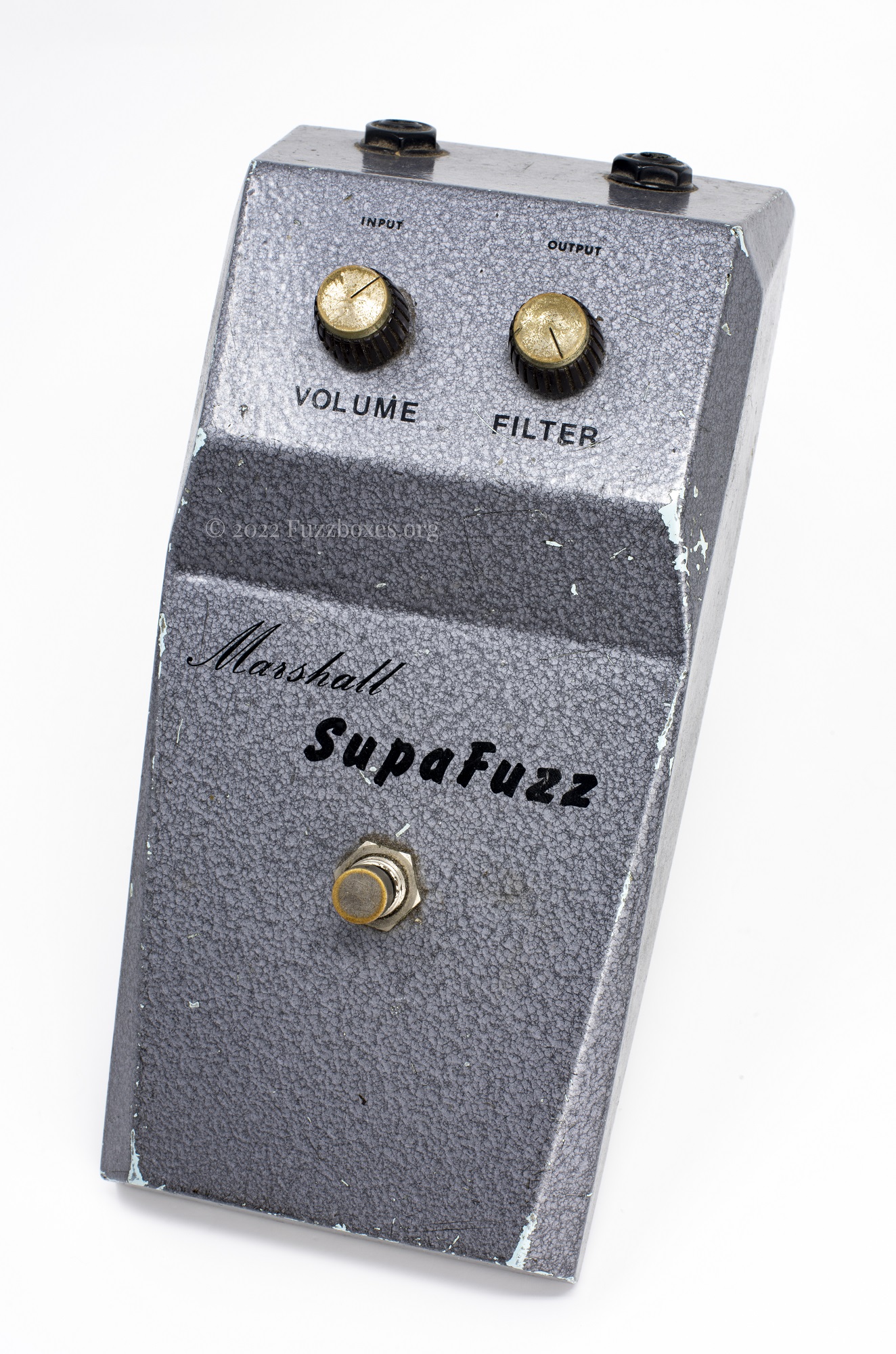

The Marshall SupaFuzz gained some valuable street cred when the always amazing Jeff Beck was seen using one. That stated, while both the SupaFuzz and Supa-Wah are collectable items today, they weren’t exactly huge successes. Any and all production had ceased by 1974.
A couple of decades later, though, Marshall created a pedal “in-house” that had an impressive impact on the guitar stompbox world . . .
The World’s First “Amp-in-a-box” Pedal?
The Guv’nor Pedal
In the world of hard (and, for that matter, softer!) rock, the ’80s will forever be known as the decade that was totally dominated by Marshall stacks. Big bands, such as Judas Priest and Iron Maiden, built impressive walls of them onstage, and, as a result, Marshall amps were seen and heard literally all over the globe. Then, in the later ’80s, Marshall’s head designer, Steve Grindrod, was given the herculean task of creating a stompbox that replicated the glorious and unmistakable sound of a Marshall Plexi or JCM800 amp cranked up to 11! Steve rose to the challenge, and “The Guv’nor” was released in 1988 — a distortion pedal convincingly capable of emulating that instantly recognizable and signature “Marshall sound.”

Fun Fact! The foot shown on the Guv’nor box is none other than Mr. Grindrod’s!
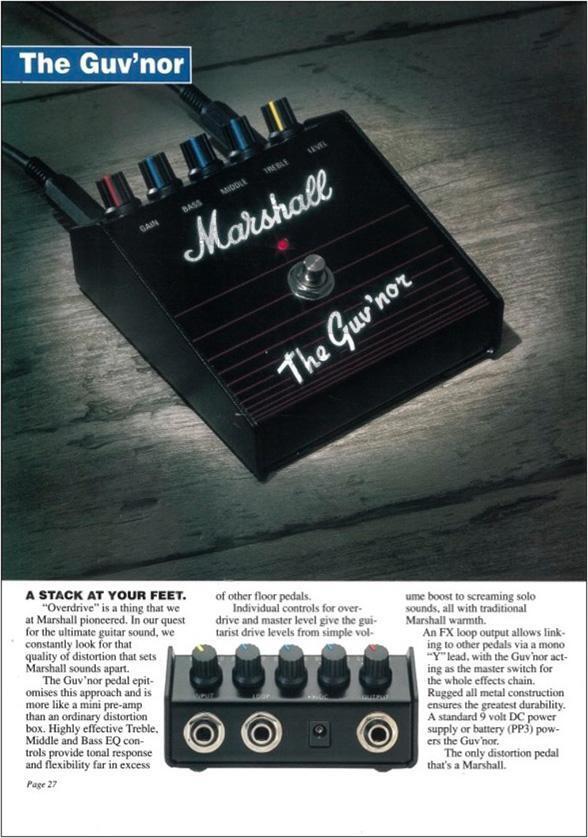
In keeping with its “stack-in-a-box” intentions, the Guv’nor pedal had a single row of control knobs labeled gain, bass, middle, treble, and volume — exactly like a Marshall amp. In addition to having the expected jacks for input and output, this pedal also featured a jack labeled “loop” — once again keeping up with its “amp-it-a-box” identity. To my knowledge, this was the first stompbox to boast such a simple yet clever feature, but I’m certainly no Josh Scott when it comes to being a world-renowned authority on stompbox history!

By using an insert Y cable, one could put, say, an echo pedal into the Guv’nor’s loop and then leave said pedal switched on. Thus, every time you engaged the Guv’nor, you would get delay, too, with just a single tap of your foot. What a wonderful feature that helped minimize your pedal “tap dancing” routine onstage!
While amp-in-a-box pedals are commonplace today, they didn’t really exist back in the late ’80s. To be more precise, there may have been one or two that claimed to deliver the goods, but they didn’t. The Guv’nor pedal, however, did exactly what it said on the tin, making it the world’s first-ever stompbox of its type.
In fact, an early ’90s Marshall catalog boldly states the following on its dedicated Guv’nor page:
“A Stack at Your Feet. ‘Overdrive’ is a thing that we at Marshall pioneered. In our quest for the ultimate guitar sound, we constantly look for that quality of distortion that sets Marshall sounds apart.
“The Guv’nor pedal epitomises this approach and is more like a mini pre-amp than an ordinary distortion box.”
Bold and powerful claims indeed. The page’s closing sentence is just as enticing:
“The only distortion pedal that’s a Marshall.”
The 1989 UK advertisement for the Guv’nor also cut straight to the chase by stating: “You’ve seen the rest. Now put yourself in charge — get yourself a Guv’nor.”

None “Moore” Better
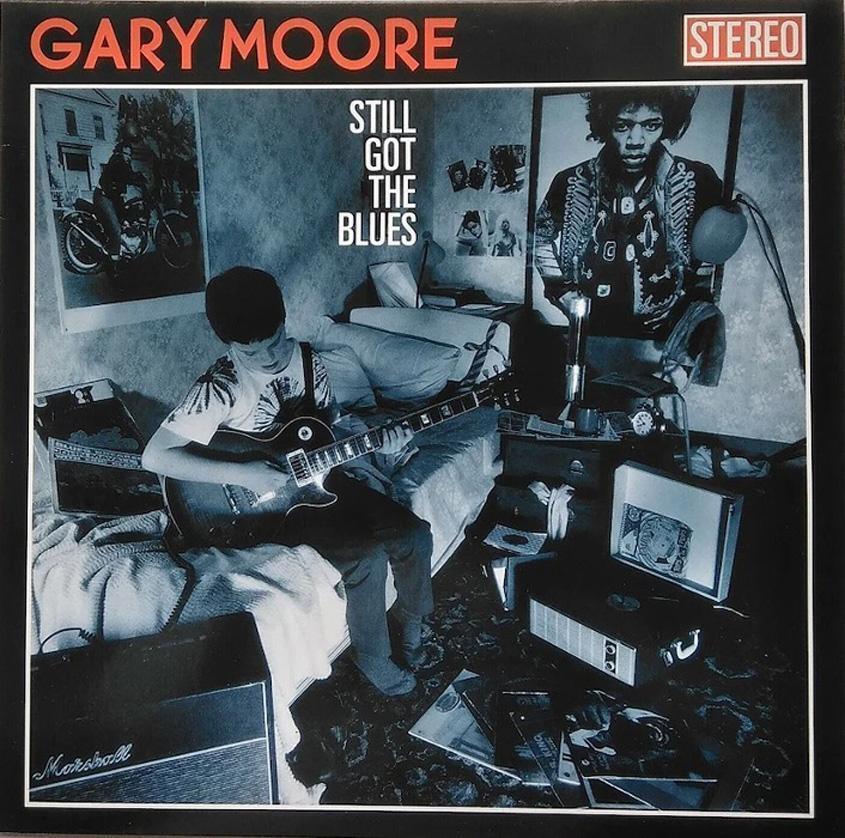
The most famous example of the Guv’nor pedal in action is probably found on the late, great Gary Moore’s Still Got the Blues album, released in early 1990. Moore’s guitar tones on said album are rightfully held in reverence to this very day. Also, according to the man himself, the album’s cornerstones were a 1959 Gibson Les Paul, a Marshall JTM45 head, and a Guv’nor pedal. Plus, if the Guv’nor is good enough for a legend like Gary Moore . . . I rest my case.

What’s in a Name?
If you’re a fan of Marshall amps, then you probably know that “The Guv’nor” was a nickname lovingly bestowed upon the founder and head of Marshall Amplification, Jim Marshall, by his workforce. Why? Because “Guv’nor” simply means “Boss” in England! I used to work for Jim and company, and while that was indeed his nickname, Jim revealed to me that the pedal’s name was based on the reaction of a guitarist who played a final prototype of the pedal. Apparently, the chap was so blown away by what he heard he loudly exclaimed, “Wow! That’s the Guv’nor, innit!” Also apparently, the guitarist’s name wasn’t Nigel Tufnel! Whoever it was, it’s a great story!
Made in England . . . or not?
I met someone recently who asked me if I knew where the original Guv’nor pedals were made. “At the Marshall factory in Bletchley, England, of course,” was my immediate reply. He then pulled out an old version that clearly read, “Made in Korea.” Befuddled, I went home and pulled out one of my two original Guv’nor pedals, and it confirmed the “Made in Korea” truth. That didn’t stop me from double-checking with my other original, though, and that one clearly states, “Made in England.” I’m afraid I don’t know the exact “Made in” history timeline for the Guv’nor, but it was definitely made in both Korea and England . . . and I have indefatigable proof! Hoorah!

The Next Wave of Marshall Pedals
Despite its success, the Guv’nor was retired in the early ’90s when Marshall released three new amp-in-a-box pedals: the BluesBreaker, the DriveMaster, and the ShredMaster. This “new” trio was encased in a less clunky and somewhat more elegant steel housing and became the recipient of Marshall’s high hopes. I say “new” because the DriveMaster was merely the Guv’nor circuit put in a different box, with a different name, and without its useful loop feature. I’ve never been quite sure of the logic behind the name change, but it must’ve made sense to someone.
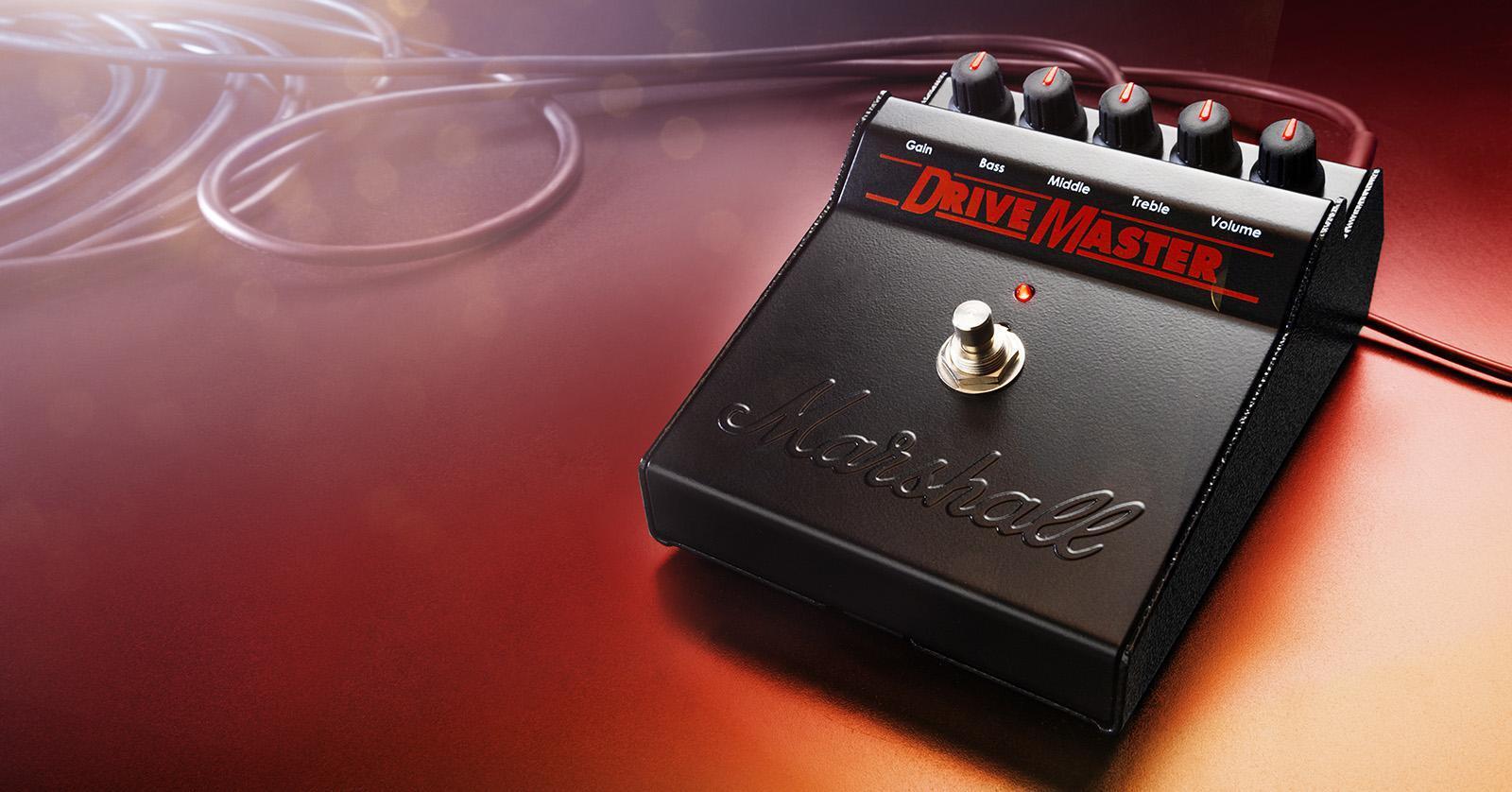
On either side of the Guv’nor — er, I mean, the DriveMaster — were the BluesBreaker and the ShredMaster. In keeping with what their names imply, these other two units were lower gain and higher gain, respectively. As we’ve already covered the DriveMaster in the Guv’nor section (since, again, the former is so similar to the latter), let’s have a quick look at the BluesBreaker and the ShredMaster.
The BluesBreaker Pedal
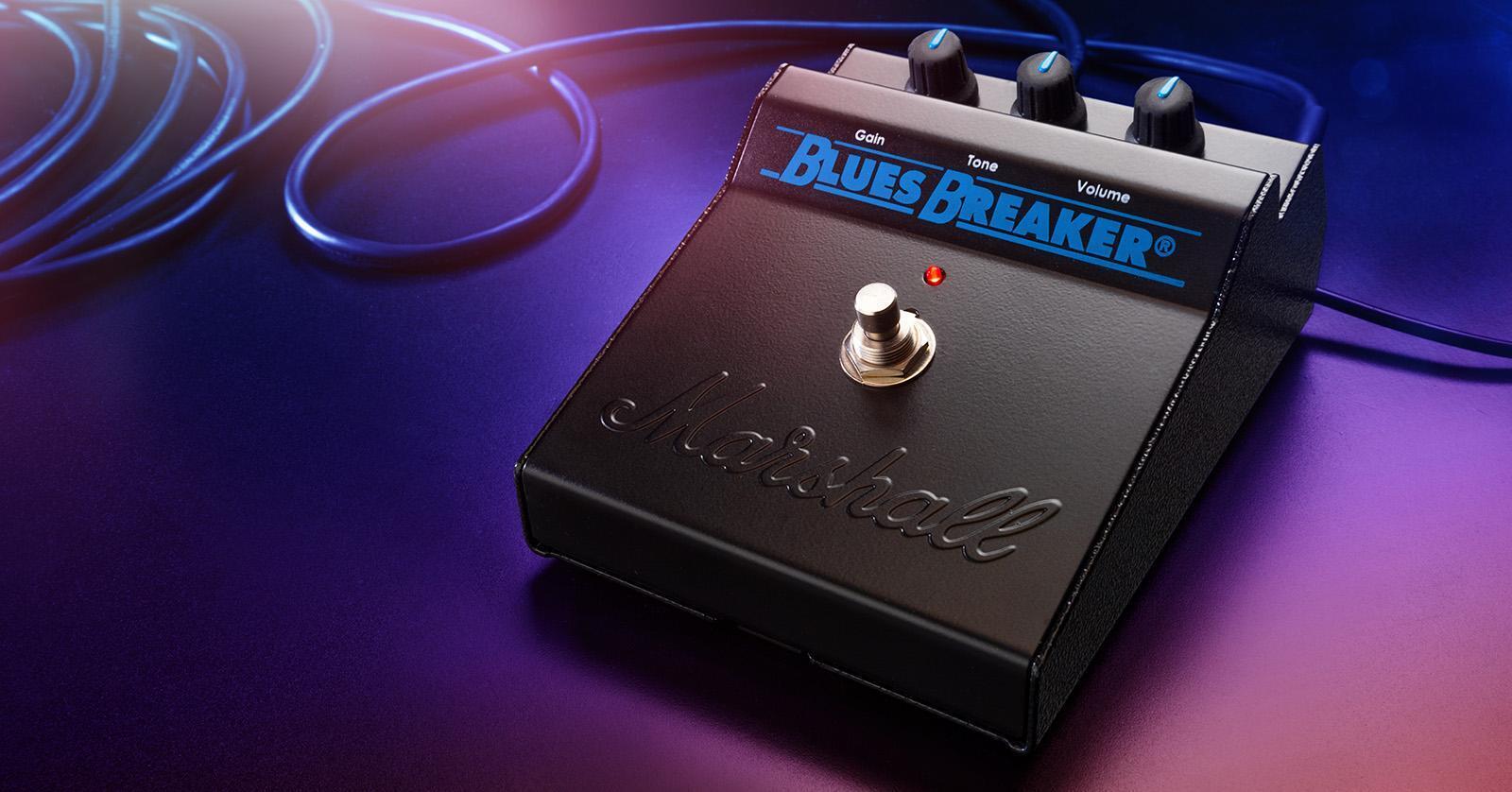
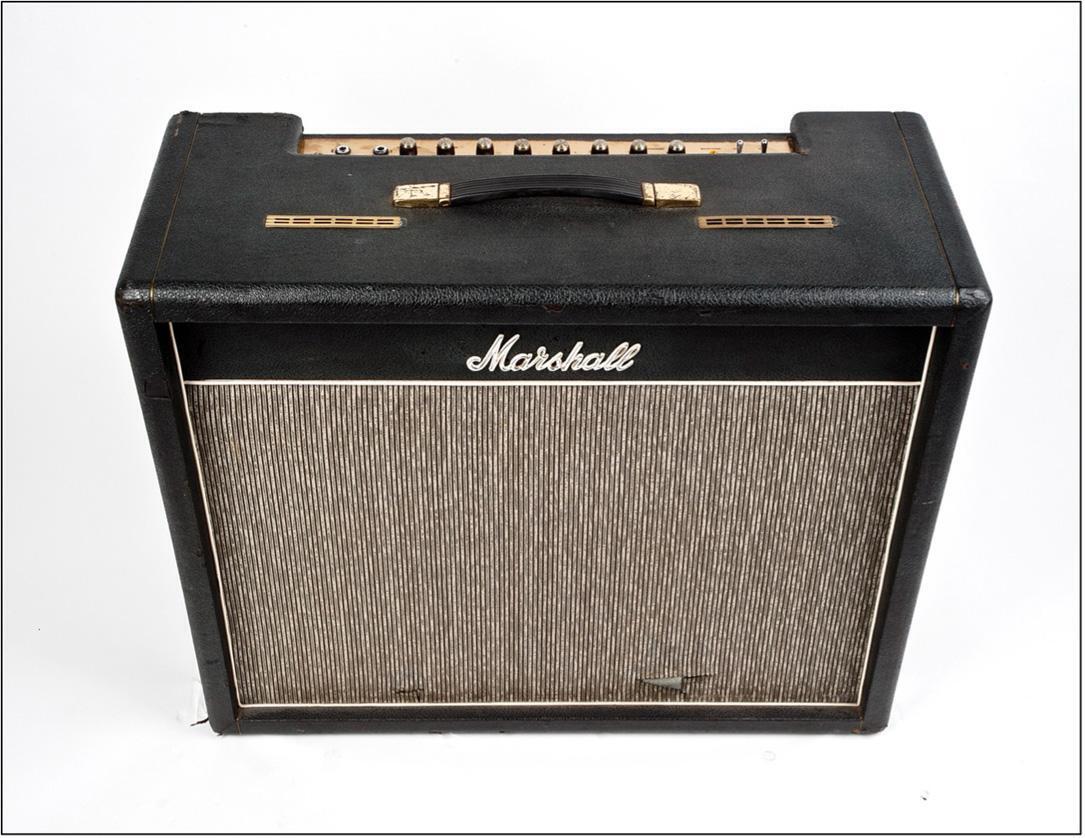
This amp-in-a-box pedal emulates the Marshall 1962 Bluesbreaker 30-watt 2×12-inch tube combo amp that Eric Clapton made famous on the classic Blues Breakers with Eric Clapton album by John Mayall & the Bluesbreakers, released in 1966. In fact, said album spawned the combo’s “Bluesbreaker” nickname. Furthermore, here’s what Marshall boldly claimed in their 1992 30thAnniversary catalog:
“The original Bluesbreaker amplifier began a legend and a long standing guitarist’s love affair with sweet distortion.
“The BluesBreaker pedal captures the magic of those classic vintage amps. It adds sweetness and raunch to your sound, with extra edge that carries solos and squeezes out those extra singing harmonics.
“As smooth as molten glass, as expressive as your fingertips, the BluesBreaker is a tasteful players’ dream.”
The BluesBreaker pedal boasts a mere three controls — gain, tone, and volume — and all three do what you’d expect them to do! The pedal is op-amp-based with diode clipping, and its tone circuit is passive. As you’d expect, the aforementioned clipping is of the soft variety.
The ShredMaster Pedal
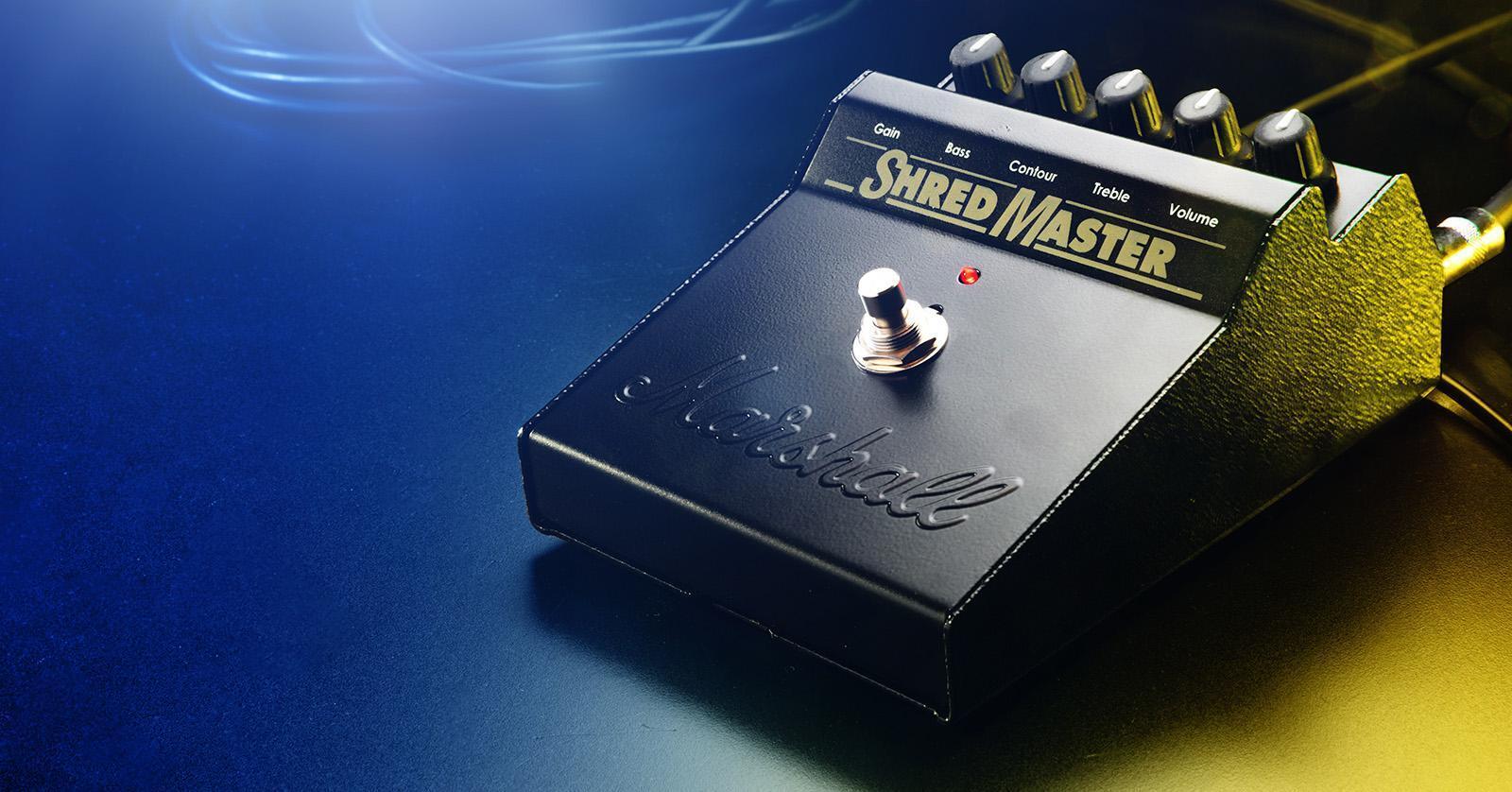
The ShredMaster was the highest gain offering of the trio — think of a front-ended, hot-rodded JCM800 with a souped-up mid control. The ShredMaster’s single row of five control knobs included: gain, bass, contour, treble, and volume. Wondering what the contour control did? It changed the character of the midrange and left a desirable impact on the high and low frequencies, too. If you’re at all familiar with the old Marshall Valvestate hybrid amps that metal mavens like Prong’s Tommy Victor and Death’s Chuck Schuldiner (ab)used so well, then this extremely effective control will be a welcomed old friend! Simply put, the contour control took you from classic hard rock to scooped death metal and all points in between. To that end, the further you cranked this control clockwise, the more scooped your tone became.
Although the ShredMaster was unashamedly aimed at the heavier side of rock, it found its way onto the pedalboard of Radiohead’s Jonny Greenwood right around the time the band recorded their highly influential 1997 album, OK Computer, thus proving that it wasn’t just for metalheads like me!
How Did These Three Pedals Fare?
Despite the Guv’nor’s previous success, and even with the great sounds from the famous pedal trio, the DriveMaster, BluesBreaker, and ShredMaster didn’t fare well in the American marketplace. By 1998, they disappeared from the Marshall line. It certainly wasn’t because of their sound, so maybe it was their size that jinxed them? Who knows. After all, they certainly weren’t compact by any stretch of the imagination! The DriveMaster and ShredMaster both offered up sufficient gain for the hot-rodded amp era that was the ’90s. The two pedals also had more EQ capabilities than most other distortion pedals available during that time. The fact that the BluesBreaker was a low-gain pedal definitely didn’t do it any favors at the time, regardless of how good it sounded and felt. And a few years after it departed from the Marshall production line, the BluesBreaker blossomed into a highly desirable — and highly expensive — device.
The John Mayer (After) Effect
If the BluesBreaker was anything but a hot item in the ’90s, then why is it in such high demand today? Well, that’s all down to a chap named John Mayer, my friend. Mayer incorporated a BluesBreaker into his pedalboard in the early 2000s and raved about it online. He also spoke glowingly about his discontinued pedal in an interview with a leading guitar magazine, and the rest, as the saying goes, is history.
As a direct result of Mayer’s enthusiastic and deserved praise, the guitar world woke up to the fact that the BluesBreaker was a great-sounding, highly desirable pedal. In fact, while writing this article, I saw an allegedly unused original Marshall BluesBreaker pedal on sale for a staggering asking price of $2,277.97. Wow!

Meanwhile, back at Marshall . . .
Before Mayer made the original BluesBreaker pedal a much sought-after item, Marshall launched another line of pedals in 1998 — six in total. This sextuplet of compact devices consisted of three distortions: the Bluesbreaker II, the Guv’nor Plus, and the Jackhammer. The other three were compressors amusingly named: Edward the Compressor, the Supervibe Chorus, and the self-explanatory Vibratrem unit. Another trio of pedals was added to this line a few years later, too: the Echohead Delay, the Reflector Reverb, and the Regenerator Modulation.


Another ad highlighting the three pedals that later joined the line.
While these well-built, good-sounding, offshore-made products deservedly garnered positive reviews, they never really took off in America. Now, all nine reside in the Spinal Tap-like “Where Are They Now?” file. It should also be noted that while both the Bluesbreaker II and the Guv’nor Plus were indeed nice-sounding pedals, neither successfully captured the tonal magic their now-famous ancestors delivered in spades.
Right Here, Right Now! Reissue Time!
Fast-forward to February of 2023, and we see Marshall offering “Made in England” reissues of the original Guv’nor pedal, as well as the DriveMaster, ShredMaster, and the now highly desirable BluesBreaker. The design MO for this quartet of reissue pedals was both simple and obvious: to replicate the sound and look of the originals exactly. To this end, both the circuits and the housings remain the same. In fact, to ensure these reissues are as authentic and accurate as possible, the circuit-board layouts were redrawn to match the original ones!
The only things Marshall was unable to source were the original control knobs because they’re no longer made. The substitutes are pretty close, though! You can rest assured that this small cosmetic change has had no sonic impact whatsoever.

As our good friend and stompbox maven Josh Scott of JHS Pedals pointed out on his popular YouTube channel, the topology of the circuits in both the Guv’nor and the BluesBreaker has proven highly influential in the boutique pedal market, which sprang to life in the late ’90s. As a result, many great stompboxes have effectively evolved from these two great guitar pedals — guitar pedals created by an English amplifier company famous around the globe for making stacks that “go to 11”!